If you are serious about landing a government job in India, you already know how competitive it is. Whether you are preparing for UPSC, SSC, Railway, Banking, or State PSC exams, having a structured daily routine is not optional — it is essential.
Even hardworking students can fall behind without a proper plan. Time slips away, syllabus coverage becomes uneven, and motivation fades. A well-designed daily routine fixes all of that.
This guide is for every type of aspirant — beginners, college students, and working professionals — who wants a realistic, proven daily schedule for government exam preparation.
Why a Daily Routine Matters for Government Exam Preparation
India produces millions of government exam aspirants every year, but only a fraction make it through. For competitive exams like SSC CGL or UPSC CSE, thousands of candidates compete for just a few hundred seats.
What separates toppers from the rest? It is rarely raw intelligence or expensive coaching. It is consistency — and consistency only comes from having a routine you actually follow.
Here is what a solid daily schedule does for you:
- Ensures every subject gets proper time and attention
- Helps you complete the syllabus without last-minute panic
- Gradually builds concentration and mental stamina
- Creates discipline, even on days when motivation is low
- Reduces exam anxiety by making preparation feel structured and in control
Before you pick your books or enrol in coaching, build your routine first. Everything else follows from there.
Understanding Your Exam and Setting Realistic Goals
Every government exam has a different syllabus and demand level. Before designing your daily routine, know what you are preparing for.
| Exam | Key Subjects |
| UPSC CSE | General Studies, CSAT, Optional Subject — requires deep reading and analytical thinking |
| SSC CGL / CHSL / MTS | Mathematics, English, Reasoning, General Awareness |
| RRB NTPC / Group D | Mathematics, Reasoning, General Science, Railway GK |
| IBPS PO / Clerk / SBI | Quantitative Aptitude, Reasoning, English, Banking Awareness |
| State PSC Exams | State-specific History, Geography, Polity, Economy (varies by state) |
Once you know your exam, break the syllabus into weekly and daily targets. For example, if your exam is six months away, calculate how many chapters you need to cover per week — then plan backwards.
One important reality check: Many aspirants set unrealistic goals like “I will study 16 hours a day.” They burn out within a week. A consistent 8 to 10 hours of focused study daily will always outperform sporadic marathon sessions.
The Ideal Daily Routine for Government Exam Aspirants
Below is a sample schedule designed for full-time aspirants. If you are working or attending college, adjust the timings to fit your situation — the structure remains the same.
| Time | Activity |
| 5:00 AM | Wake up, drink water, light exercise or walk — no phone |
| 5:30 AM – 6:00 AM | Quick revision — notes, formulas, vocabulary, or yesterday’s current affairs |
| 6:00 AM – 8:30 AM | Main study session — your hardest or most important subject |
| 8:30 AM – 9:30 AM | Breakfast and rest — avoid social media |
| 9:30 AM – 12:30 PM | Second study session — another core subject, full concentration |
| 12:30 PM – 1:30 PM | Lunch and a short nap or relaxation |
| 1:30 PM – 4:00 PM | Practice time — mock tests, previous year papers, question sets |
| 4:00 PM – 5:00 PM | Exercise, walk, or light outdoor activity — essential for stress relief |
| 5:00 PM – 7:30 PM | Current affairs and reading — newspaper, GK notes, short note-making |
| 7:30 PM – 8:30 PM | Dinner and family time — rest your mind |
| 8:30 PM – 10:30 PM | Weak area revision — difficult topics, error correction, short notes |
| 10:30 PM – 11:00 PM | Final revision and next-day planning |
| 11:00 PM | Sleep — 6 to 7 hours of proper rest is non-negotiable |
Weekly Planning Tips for Government Exam Aspirants
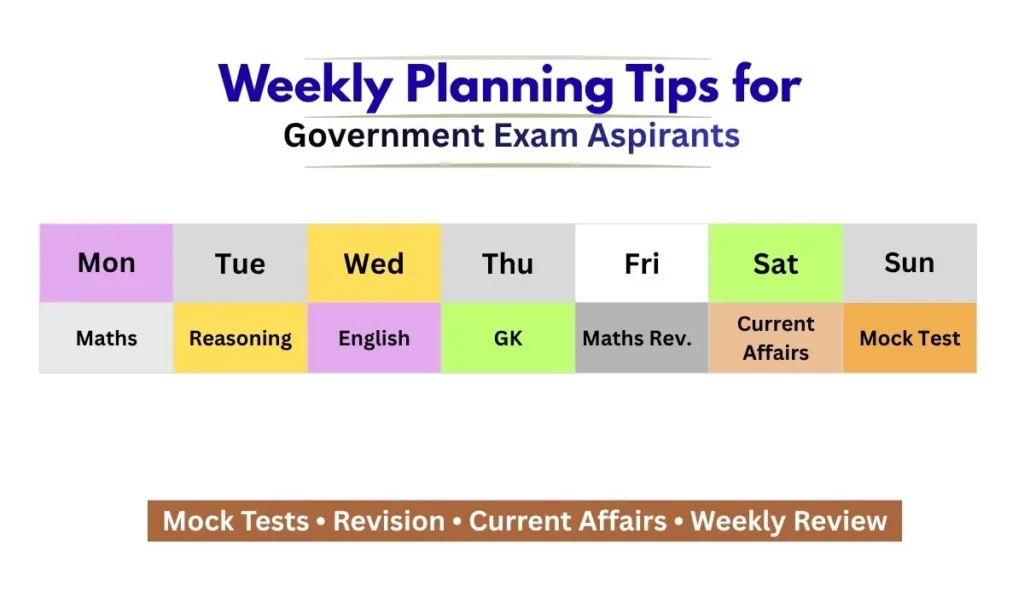
A daily routine works best when it is backed by a weekly plan. Here is how to structure your week:
- Dedicate one day (preferably Sunday) to a full mock test. Review every wrong answer carefully — this is where actual learning happens.
- Review your week every Sunday evening. Ask yourself: Did I cover what I planned? Which topics need more time next week?
- Assign subject-specific revision to specific days. Rotate through all subjects so nothing gets neglected.
- Set a weekly current affairs target. Cover Monday to Saturday news throughout the week, then do a full revision on Sunday.
Common Mistakes Aspirants Make in Their Daily Routine
Many students start with full enthusiasm but slowly drift off track. Here are the most common pitfalls — and how to avoid them:
- Studying without a goal: Sitting with books and no clear target wastes hours. Always begin each session knowing exactly what you will cover.
- Using too many sources: Jumping between 10 books and 5 YouTube channels for the same subject creates confusion. Stick to 2–3 reliable sources per subject.
- Skipping mock tests: Theory alone will not get you through. Mock tests simulate real exam conditions and expose weak areas early. Start taking them from the beginning.
- Not taking breaks: Studying for hours without a break reduces efficiency. Your brain needs time to rest and consolidate information.
- Comparing yourself to others: Every aspirant’s journey is different. Focus on your own progress — not someone else’s study hours or strategy.
- Skipping revision: Reading a topic once is never enough. Regular revision is what makes knowledge stick for the long term.
Tips to Stay Motivated During Long Preparation
Government exam preparation in India can span one to three years. Staying motivated throughout that journey is one of the real challenges. Here is what actually helps:
- Revisit your “why.” Write down your reasons for wanting a government job — stability, family support, public service — and keep that list visible at your study table.
- Celebrate small wins. Finishing a chapter or scoring well on a mock test deserves acknowledgement. Reward yourself — it keeps the momentum going.
- Join a study group or online community. Connecting with others who are on the same path makes tough phases easier to handle.
- Protect your health. Stress and exhaustion are real obstacles. If you feel genuinely overwhelmed, take a day off. You will return sharper and more focused.
- Visualise your success. Spend a few minutes each day imagining the moment you clear the exam. It sounds simple, but it genuinely reinforces your confidence and direction.
Role of Technology in Government Exam Preparation
Today’s aspirants have access to high-quality free resources that earlier generations did not. Platforms like Testbook, Unacademy, and government apps like iGOT Diksha offer study material, live classes, and mock tests at no cost.
That said, technology can easily become your biggest distraction. Social media and entertainment apps quietly consume 3–4 hours a day without you noticing.
Here is how to use technology smartly:
- Use app timers or website blockers like Freedom or StayFocusd during study hours
- Download subject PDFs and watch educational YouTube videos with a clear purpose
- Take online mock tests on platforms like Testbook or PYQs apps
- Keep entertainment apps off your phone screen — out of sight, out of mind
Special Advice for Working Professionals Preparing for Government Exams
Balancing a job with government exam preparation is genuinely difficult — but thousands of people do it successfully every year. Here is a practical approach:
- Wake up early. Study from 5:30 AM to 8:00 AM before heading to work. Morning hours are distraction-free and highly productive.
- Use your commute. Listen to current affairs podcasts or recorded lectures during travel time — this adds 1–2 productive hours to your day.
- Make the most of your lunch break. 20–30 minutes of quick revision or current affairs reading during lunch adds up significantly over time.
- Study for 2–3 focused hours in the evening. Quality matters more than duration. A focused two-hour session beats a distracted four-hour one.
- Use weekends intensively. Aim for 6–8 hours of study on Saturday and Sunday. Your weekends are your biggest asset.
| Join Yuva Safar WhatsApp Group for Latest Job Updates | Click Here |
| Join Our Telegram Channel for Daily Government & Private Job Alerts | Click Here |
Conclusion
Clearing a government exam in India is absolutely achievable — but it demands a plan, consistency, and patience. Toppers from small towns and villages crack UPSC, SSC, and Banking exams every year. They are not always the smartest people in the room. They are the most disciplined.
Build a routine that fits your life, follow it daily, and trust the process. The government job you are working towards is not out of reach. Take it one day at a time — and keep showing up.
Frequently Asked Questions (FAQs)
Q1. How many hours should I study daily for a government exam?
8 to 10 focused hours per day is ideal for full-time aspirants. Working professionals can realistically aim for 4 to 5 hours.
Q2. Is it necessary to wake up at 5 AM for government exam preparation?
Not compulsory, but early mornings offer fewer distractions and better concentration. Adjust your schedule based on what genuinely works for you.
Q3. Which newspaper is best for government exam current affairs?
The Hindu and Indian Express are most widely recommended. For Hindi medium students, Dainik Jagran or Dainik Bhaskar are strong options.
Q4. How often should I take mock tests?
At least 2 to 3 times per week. Increase the frequency as your exam date approaches.
Q5. Can I clear a government exam without coaching?
Yes. Many toppers are entirely self-taught. Good books, free online resources, and consistent practice are sufficient.
Q6. How do I deal with exam stress and anxiety?
Exercise daily, sleep well, take regular breaks, and talk to people you trust. Avoid comparing your preparation with others.
Q7. Is it okay to take a day off from studying?
Absolutely. One day off per week — or whenever you feel genuinely burned out — actually improves long-term productivity.
Q8. What is the best time to study — morning or night?
Most people retain information better in the morning. However, study at the time when your focus is naturally at its highest. Consistency matters more than timing.
Q9. How do I cover the entire syllabus on time?
Break the syllabus into weekly targets from day one. Review your progress every Sunday and adjust the plan as needed.
Q10. Should I prepare for multiple exams at the same time?
It is possible when syllabi overlap — for example, SSC and Railway, or IBPS and SBI. However, avoid spreading yourself too thin. Quality, focused preparation always beats scattered effort.