If you’re preparing for a government exam in India—whether it’s SSC, UPSC, Railway, Banking, or a State PSC—learning the right Government Exam OMR Sheet Filling Tips is just as important as studying the syllabus. A small mistake on your OMR sheet can cost you marks, even after months of hard work.
You might know every answer correctly, but a smudged bubble, an incorrect roll number, or the wrong test booklet code can lead to unnecessary problems. These simple errors are more common than many candidates realize.
That’s why this guide covers everything you need to know about filling an OMR sheet the right way. From marking answers correctly to avoiding common mistakes, you’ll learn the best practices to ensure your hard work counts on exam day.
What Is an OMR Sheet?
OMR stands for Optical Mark Recognition. It’s a special answer sheet that a scanning machine reads to grade multiple-choice exams. The machine detects shaded bubbles using light sensors and records your answers automatically, without any manual checking.
In India, OMR sheets are used across almost every major recruitment exam, including those conducted by SSC, IBPS, RRB, UPSC (for the objective-type papers), and most State Public Service Commissions.
Because a machine — not a human — reads your answers, there’s no room for guesswork on its part. If a bubble is shaded too lightly, marked outside the circle, or left with a stray mark nearby, the scanner may misread it or skip it entirely. That’s marks lost for reasons that have nothing to do with your actual knowledge.
Why OMR Sheet Filling Deserves Your Attention
Most aspirants pour their energy into studying — covering NCERT books, solving practice sets, and staying on top of current affairs — but give little thought to the physical act of filling the answer sheet. That’s a mistake worth correcting early.
Here’s the reality: the scanner only sees marks, not intentions. It can’t tell the difference between a bubble you meant to leave blank and one you shaded by accident. It can’t “figure out” that you meant option B when you accidentally darkened both B and C. Once a mark is made, especially in pen, there’s usually no taking it back.
In an exam where thousands of candidates compete for a few hundred vacancies, even one OMR error can shift your rank by several hundred places. There’s no second attempt once the sheet is submitted, which is exactly why accuracy here matters as much as accuracy in your answers.
Before You Start: A Quick Pre-Check
Before shading a single bubble, take two minutes to run through this checklist:
| Check | What to Do |
| Sheet condition | Look for smudges, tears, or pre-existing marks. If found, raise your hand immediately and request a replacement sheet. |
| Instructions printed on the sheet | Read them carefully — some exams require a pen, others a pencil, and some specify blue-black ink only. |
| Personal details fields | Confirm spaces are provided for your roll number, name, date of birth, booklet number, and exam centre code. |
| Physical handling | Never fold, crease, or bend the sheet. Keep it flat on the desk at all times. |
Step-by-Step Guide to Filling an OMR Sheet
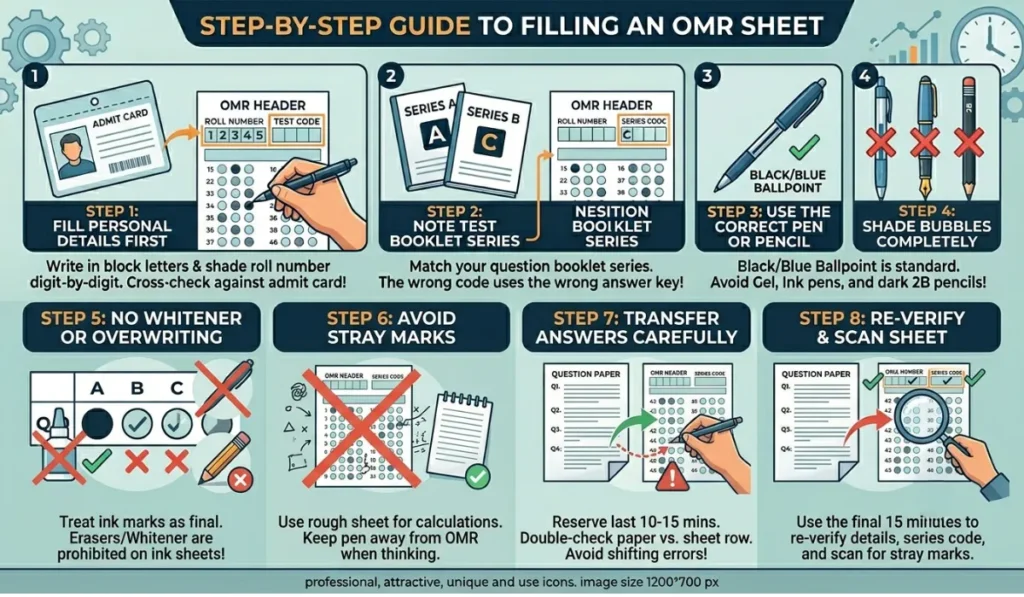
Step 1: Fill in Your Personal Details First
Start with your name, roll number, exam date, test series code, centre code, and date of birth. Write these in block letters, using only the pen or pencil specified in the instructions.
Many OMR sheets also require you to shade your roll number digit-by-digit in corresponding bubbles below the written number. Take your time with this section — rushing here is a common source of errors.
Cross-check every entry against your admit card. If your roll number on the OMR sheet doesn’t match the one on your admit card, your result may not be processed at all, regardless of how well you scored.
Step 2: Note the Test Booklet Series Carefully
Government exam papers are usually printed in multiple series — A, B, C, D, and so on — to prevent cheating. You must shade the correct series code on your OMR sheet to match your question booklet.
This step is critical: each series has its own separate answer key. If you mark the wrong series code, your correct answers will be checked against the wrong key, and your score could drop drastically even though you answered well.
Locate and fill the booklet series and number before attempting any questions.
Step 3: Use the Correct Pen or Pencil
This is one of the most common mistakes among Indian aspirants.
- Use a black or blue ballpoint pen unless instructed otherwise.
- Avoid gel pens — they tend to smudge or bleed through the paper.
- Sketch pens and fountain pens are not permitted.
- Some older or state-level exams allow an HB pencil only. Never use 2B or 4B pencils, as the darker graphite can smudge and confuse the scanner.
When in doubt, check your admit card or the instructions printed on the question booklet.
Step 4: Shade Bubbles Completely and Firmly
Partial shading is one of the biggest reasons scanners misread or skip answers. The entire circle should be filled in solidly — not just a dot, a tick, or a half-shaded mark.
Press firmly enough that the mark is dark and even, but not so hard that you tear or indent the paper. Try to maintain consistent pressure throughout the exam so all your marks look uniform.
Step 5: Never Use Correction Fluid or Overwrite a Bubble
Once a bubble is shaded, treat it as final — especially if you’re using a pen, where corrections are not allowed under any circumstances.
- Correction fluid (whitener) and erasers on ink-based sheets are strictly prohibited.
- If you’re using a pencil and the exam permits erasing, do so gently with a clean, soft eraser, and make sure no smudge or residue remains.
Many experienced candidates avoid this problem altogether by marking their answers on the question paper first, then transferring all final answers to the OMR sheet in one focused pass near the end of the exam.
Step 6: Avoid Stray Marks
Keep your pen or pencil away from the OMR sheet while you’re thinking. Resting your pen on the sheet, doodling, or jotting rough calculations anywhere near the bubbles can confuse the scanner and risk being read as an unintended answer.
Always use the separate rough sheet provided for calculations or notes — never the OMR sheet itself.
Step 7: Transfer Answers Carefully (If Marking on the Question Paper First)
If you prefer to mark answers on your question booklet first and transfer them later, follow this approach for accuracy:
- Reserve the last 10–15 minutes of the exam exclusively for transferring answers.
- Double-check each answer as you shade it.
- Confirm that the question number on the paper matches the row number on the OMR sheet.
One frequent error here is shifting by a row — for instance, marking the answer to Question 42 in the row meant for Question 43. This single slip pushes every subsequent answer one row off and can wreck an otherwise strong attempt.
Common OMR Sheet Mistakes to Avoid
| Mistake | Why It’s a Problem |
| Shading outside the circle | The scanner may not register the mark as a valid answer |
| Filling two bubbles for one question | Usually treated as an invalid or wrong answer; may attract negative marking |
| Errors in roll number entry | Can prevent your result from being processed at all |
| Wrong or unmarked test series code | Your answers get checked against the wrong answer key |
| Rushing in the final minutes | Leads to misaligned rows and shading errors |
| Using a gel pen when not permitted | Ink bleed can make marks unreadable to the scanner |
Exam-Specific Tips for Indian Government Exams
Different exams have slightly different OMR requirements. Here’s a quick reference:
| Exam | Key OMR Guidelines |
| SSC (CGL, CHSL, MTS) | Mostly computer-based now, but offline rounds still require a black ballpoint pen and zero stray marks. |
| IBPS / Banking (PO, Clerk, RRB) | Largely online; some preliminary or offline components may still use OMR — carry a spare pen regardless. |
| Railway RRB (NTPC, Group D) | Paper-based OMR is common; pay extra attention to the series code given the very high volume of candidates. |
| UPSC Prelims | Requires a black ballpoint pen; sheets are sensitive, so avoid pressing too hard to prevent indentation. |
| State PSC Exams | Requirements vary by state — for example, some allow pencils while others mandate pens. Always check the specific instructions for your exam. |
What to Do in the Final 15 Minutes
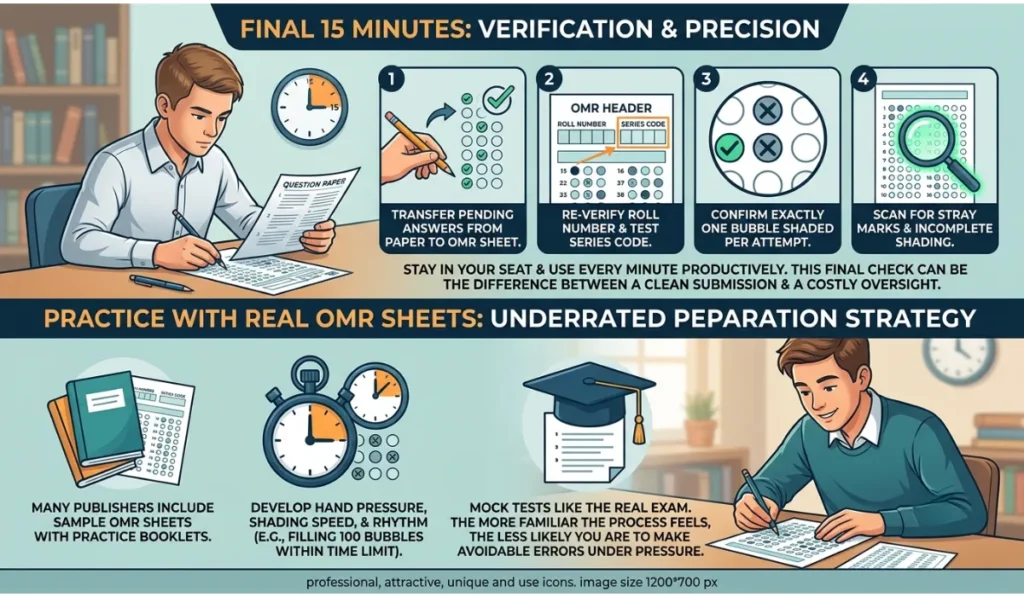
Once you’re in the last stretch of the exam, shift your focus entirely to verification rather than attempting new questions:
- Transfer any pending answers from your question paper to the OMR sheet.
- Re-verify your roll number and test series code.
- Confirm exactly one bubble is shaded per attempted question.
- Scan the sheet for stray marks or incomplete shading.
Stay in your seat until time is called, and use every remaining minute productively — this final check can be the difference between a clean submission and a costly oversight.
Practice With Real OMR Sheets
One of the most underrated preparation strategies is practicing with actual OMR sheets at home, not just solving questions in a notebook. Many publishers include sample OMR sheets with practice booklets, and most coaching institutes conduct OMR-based mock tests.
Filling out 100 bubbles within a time limit helps you develop the right hand pressure, shading speed, and rhythm — skills that are easy to underestimate until exam day arrives. Treat every mock test as seriously as the real exam; the more familiar the process feels, the less likely you are to make avoidable errors under pressure.
Golden Rules: Quick Recap
- Read the instructions printed on the OMR sheet before you begin.
- Use only the pen or pencil specified for that exam.
- Shade bubbles completely, firmly, and within the circle.
- Double-check your roll number and personal details.
- Avoid any stray marks on the sheet.
- Verify the test series code before answering any question.
- Never use correction fluid, whitener, or erasers on ink-based sheets.
- Reserve 10–15 minutes at the end purely for verification.
- Practice with real OMR sheets during your mock tests.
These rules are simple, but they’re easy to forget under exam pressure. Make them second nature well before exam day, so they happen automatically when it counts.
| Join Yuva Safar WhatsApp Group for Latest Job Updates | Click Here |
| Join Our Telegram Channel for Daily Government & Private Job Alerts | Click Here |
Frequently Asked Questions (FAQs)
Q1. Which pen should I use for filling an OMR sheet in government exams? Use a black ballpoint pen unless the instructions specifically state otherwise. Avoid gel pens, sketch pens, or fountain pens, as they can smudge or bleed.
Q2. Can I use a pencil on an OMR sheet? Only if the exam instructions explicitly permit it. Some state-level and older recruitment exams allow an HB pencil — always confirm via your admit card.
Q3. What happens if I shade two bubbles for one question? It’s typically treated as an invalid or incorrect answer and may result in negative marking. Always shade only one bubble per question.
Q4. Can I correct a mistake on an OMR sheet? Not easily. Pen-marked sheets generally don’t allow corrections at all. For pencil-marked sheets, use a soft eraser gently and ensure no residue remains.
Q5. What should I do if my OMR sheet has a printing defect? Inform the invigilator immediately and request a replacement. Never attempt to fill a damaged or defective sheet.
Q6. What is the test series code, and why does it matter? The series code (A, B, C, D, etc.) identifies which version of the question paper you’ve received. Marking the wrong code means your answers get evaluated against the wrong answer key.
Q7. How much time should I set aside for OMR filling? Reserve at least 10–15 minutes at the end of the exam exclusively for transferring and verifying your answers.
Q8. Will the scanner reject a lightly shaded bubble? Yes. Light or partial shading may not be detected. Always fill each bubble completely and firmly.
Q9. Can I fold or bend the OMR sheet during the exam? No. Keep the sheet flat on your desk at all times — folding or creasing can interfere with scanning.
Q10. Should I fill the OMR sheet as I go, or all at once at the end? Both approaches work. Filling as you go saves time but carries a higher risk of rushed shading. Filling at the end allows more careful checking but requires good time management. Choose whichever method you’ve practiced and feel most confident with.
Final Thoughts
On exam day, the OMR sheet matters just as much as your preparation. No matter how thoroughly you’ve studied or how confident you feel walking into the hall, the only thing that ultimately counts is what the scanning machine reads on that sheet.
With lakhs of candidates competing for a limited number of government job vacancies every year, there’s simply no margin for avoidable errors. Treat your OMR sheet with the same care you’ve given your study notes — practice with it, understand its requirements, and walk into your exam confident that your hard work will be accurately reflected in your result.
Best of luck to every aspirant working toward a government job in 2026.