Clearing a government exam in India is often described as the finish line. After months, sometimes years, of early mornings, late nights, mock tests, and constant self-doubt, the moment your name appears on that result page feels like victory itself. But here’s something most coaching institutes and YouTube videos won’t tell you clearly: clearing the exam is not the end of the journey. It’s the beginning of an entirely new one.
Lakhs of aspirants across India prepare for SSC, UPSC, Railway, Banking, and State PSC exams every year, but very few actually understand what happens once they clear the written test or even the final result. The process between “exam cleared” and “joining duty” can stretch anywhere from a few weeks to several months, and it involves multiple stages that catch many successful candidates off guard.
This article breaks down exactly what to expect after you clear a government exam, so you walk into the next phase prepared rather than confused.
The Result Is Just the First Gate, Not the Final Destination
Most government recruitment processes in India follow a multi-stage selection model. Clearing the written exam typically means you’ve crossed only one gate out of several. Depending on the post and recruiting body, the remaining stages could include document verification, medical examination, physical tests, skill tests, and interviews.
Here’s a general overview of how the process unfolds across major recruitment bodies:
| Recruiting Body | Stages After Written Exam |
| SSC (CGL, CHSL, MTS) | Tier 2 exam (if applicable), Document Verification, Medical Test |
| UPSC (Civil Services) | Mains Exam, Personality Test (Interview), Medical Test |
| Railway (RRB NTPC, Group D) | CBT 2, Document Verification, Medical Test |
| Banking (IBPS, SBI) | Mains Exam, Interview, Document Verification |
| State PSC | Mains Exam, Interview, Document Verification |
So, if you’ve just cleared your prelims or Tier 1, don’t pack away your books yet. The real preparation often continues in a different direction altogether.
Step 1: Document Verification — The Stage Nobody Talks About Enough
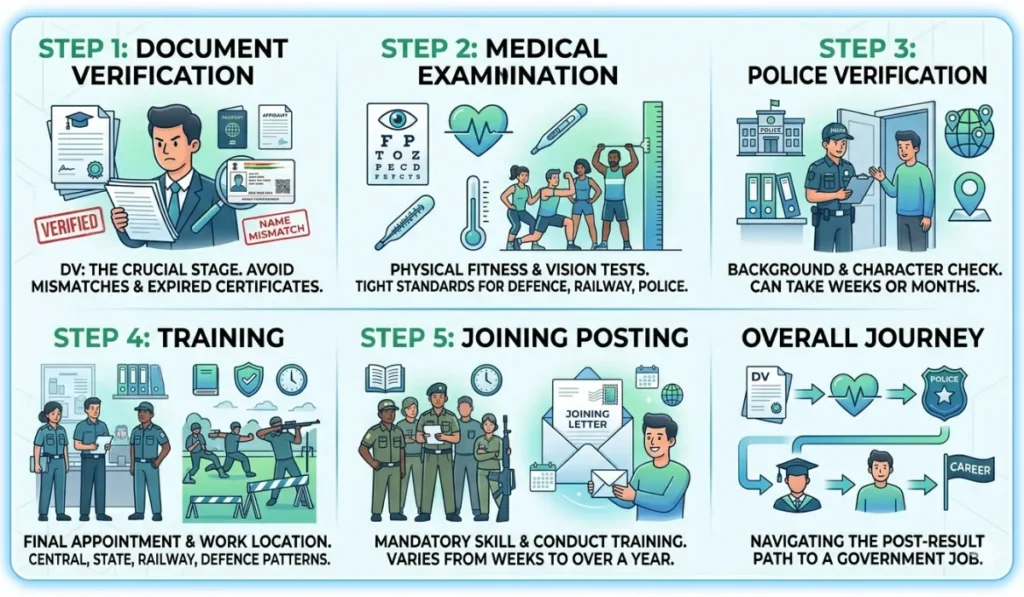
Once your final result is declared, the first major step is document verification (DV). This is exactly what it sounds like: officials will check whether the documents you submitted during the application process actually match your claims.
Many candidates lose their selection at this stage not because they cheated, but because of avoidable mistakes like mismatched names, expired certificates, or missing category proof. This is heartbreaking, and entirely preventable.
Documents You’ll Typically Need
- Class 10th and 12th mark sheets and certificates
- Graduation degree and final mark sheet
- Caste/category certificate (if applicable)
- Income certificate (for EWS candidates)
- Domicile or residence certificate
- PWD certificate (if applicable)
- Character certificate
- Aadhaar card and PAN card
- Passport-size photographs (as specified)
- Experience certificates (for posts requiring work experience)
A practical tip here: start organizing these documents the moment you clear your written exam, not after the final result. Many candidates scramble at the last minute trying to get a caste certificate reissued or a gap certificate notarized, and that stress is avoidable.
Common Reasons Candidates Face Issues During DV
| Issue | Why It Happens | How to Avoid It |
| Name mismatch across documents | Spelling differences between Aadhaar, mark sheets, and application form | Get an affidavit for name correction in advance |
| Category certificate expired | Many certificates have a validity period | Renew before applying, not after selection |
| Photo mismatch | Old photo used in application vs. current appearance | Use a recent photograph consistently |
| Missing gap year certificate | Education gap not explained | Prepare an affidavit explaining the gap |
| Incorrect signature | Signature differs from one document to another | Practice a consistent signature across all forms |
Step 2: Medical Examination — Especially Crucial for Defence, Railway, and Police Posts
If you’re applying for posts like Railway Group D, SSC GD Constable, Indian Army, Navy, or similar physically demanding roles, a medical examination is mandatory. This isn’t just a formality; it genuinely determines your fitness for the job.
The medical test usually checks:
- Height, weight, and chest measurement (for specific posts)
- Vision (with and without glasses, color blindness test)
- Hearing capacity
- Blood pressure and pulse rate
- Overall physical fitness
- Specific medical conditions disqualifying certain posts (flat feet, knock knees, etc., for defence roles)
For posts like SSC CGL or banking jobs, the medical requirements are usually less stringent, often limited to basic fitness and vision standards. However, for Railway, Police, and Defence postings, the standards are significantly tighter.
A genuine piece of advice: if you know you’re applying for a physically demanding post, start working on your fitness months in advance. Don’t leave it for the week before your medical test.
Step 3: Police Verification — A Step That Takes Patience
For most government jobs, especially those involving administrative power, defence, or public safety, police verification is a standard part of the process. This involves local police visiting your registered address to confirm your background, character, and any criminal record (or absence of one).
This step can take anywhere from a few weeks to a few months, depending on your state and the workload of local police stations. There’s not much you can do to speed this up except ensure your documents and address proof are accurate and consistent.
If you’ve recently moved cities or changed your permanent address, inform the relevant department promptly so the verification reaches the correct location.
Step 4: Training Period — Where the Real Transformation Begins
This is where many people are surprised. Getting selected doesn’t mean you start working immediately. Most government posts require a mandatory training period, and this can range from a few weeks to over a year, depending on the post.
| Post Category | Typical Training Duration |
| SSC CGL (Inspector, Officer-level posts) | 1 to 3 months |
| Bank PO | 6 months to 1 year (including on-the-job training) |
| Railway Group C/D | 3 to 6 months |
| Police Constable/SI | 9 months to 1 year |
| IAS/IPS (after UPSC) | Over 1 year at LBSNAA or respective academies |
| Defence Forces | 6 months to 1 year |
During training, you’ll be taught the specific skills, rules, regulations, and conduct expected in your role. For administrative posts, this includes office procedures, file management, and departmental rules. For uniformed services, it includes physical training, weapons handling (where applicable), and discipline protocols.
This period is also when many fresh recruits realize the gap between exam preparation and actual job execution. Passing an exam tests your knowledge and reasoning ability; the job itself tests your patience, adaptability, and people-handling skills.
Step 5: Joining and Posting — Where Will You Actually Work?
Once training concludes, you receive your joining letter, which specifies your posting location. This is a stage that brings both excitement and anxiety for most candidates, especially those who might be posted away from their home state.
A few honest realities about postings:
- Central government posts (like SSC CGL appointments) can place you anywhere in India.
- State PSC and state-level recruitments generally keep you within the state, though district postings vary.
- Railway and banking postings often follow zonal or regional patterns based on your exam zone.
- Defence and police postings can involve frequent transfers throughout your career.
If relocation is a possibility for your post, it helps to mentally and financially prepare in advance, whether that means arranging accommodation, understanding the new city’s cost of living, or simply preparing family members for the transition.
What About Salary and Pay Structure After Joining?
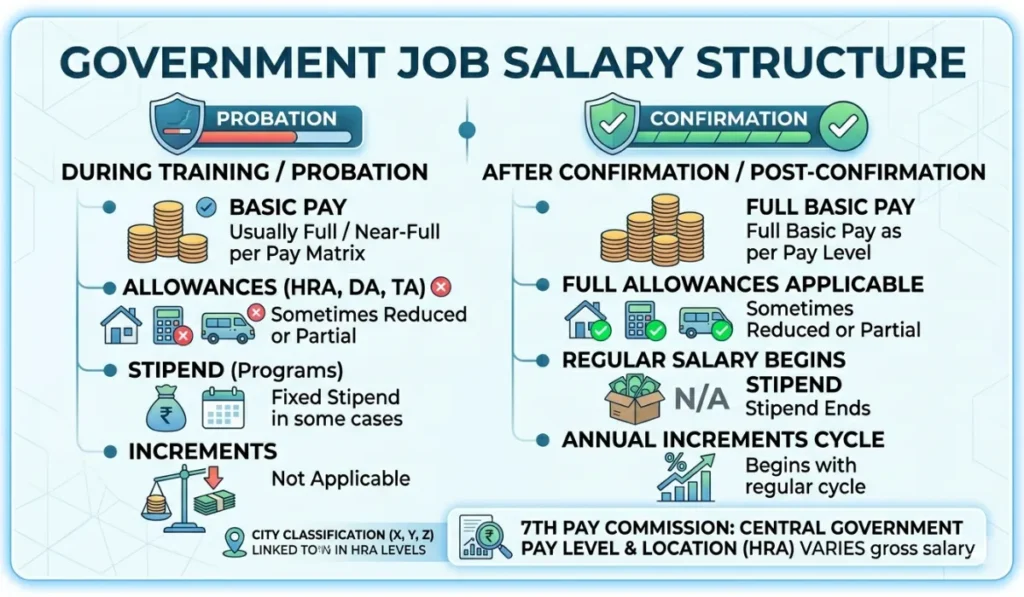
This is one of the most common questions freshers have, and rightfully so. Your in-hand salary during probation or training might differ from your full salary post-confirmation.
| Component | During Training/Probation | After Confirmation |
| Basic Pay | Usually full or near-full as per Pay Matrix | Full Basic Pay as per Pay Level |
| Allowances (HRA, DA, TA) | Sometimes reduced or partial | Full allowances applicable |
| Stipend (for some training programs) | Fixed stipend instead of full salary | N/A (regular salary begins) |
| Increments | Not applicable during probation | Annual increment cycle begins |
It’s worth noting that under the 7th Pay Commission structure, most central government posts have a clearly defined Pay Matrix, and your gross salary depends on your Pay Level and posting location (since HRA varies by city classification).
The Emotional Side Nobody Prepares You For
Here’s something rarely discussed in career guidance content: the psychological adjustment after clearing a government exam can be surprisingly difficult.
For years, your identity might have revolved around being “an aspirant.” Your daily routine, your social circle, even conversations with family centered around exam preparation. Once that chapter ends, many successful candidates experience an unexpected sense of emptiness or directionlessness, at least temporarily.
This is completely normal. You’re transitioning from a singular, intense goal to an entirely new chapter involving training, new colleagues, new responsibilities, and often, a new city. Give yourself permission to adjust gradually rather than expecting everything to feel settled immediately.
Some practical ways to ease this transition:
- Stay connected with fellow aspirants or recently selected candidates who understand the journey.
- Use the waiting period (between result and joining) productively, learning basic computer skills, improving communication, or simply resting.
- Avoid comparing your post or salary with others on social media; every journey and post has its own value.
- Talk to seniors already working in the same department to get realistic expectations about the job.
Probation Period: Why It Matters More Than You Think
Almost every government job comes with a probation period, typically ranging from six months to two years. During this time, your performance, conduct, and discipline are closely observed before your appointment is confirmed.
Key things to remember during probation:
- You may be required to clear departmental exams even after joining (common in banking and administrative services).
- Your confirmation depends on satisfactory performance reports from your reporting officers.
- Certain benefits or allowances might be partially restricted until confirmation.
- Misconduct or unsatisfactory performance during probation can lead to extension or, in rare cases, termination.
Treat your probation period with the same seriousness as your exam preparation. It’s not a formality; it genuinely shapes your career trajectory within the department.
Government Job Benefits You Start Receiving (And When)
Many aspirants focus only on salary while preparing, but government jobs come with a structured benefits system that activates at different stages.
| Benefit | When It Typically Starts |
| Basic Salary | From joining date |
| Dearness Allowance (DA) | From joining, revised periodically |
| House Rent Allowance (HRA) | From joining (if not provided govt. accommodation) |
| Provident Fund (NPS/GPF) | From joining date |
| Medical Benefits | Usually from joining or after confirmation |
| Pension Benefits (NPS) | Accumulates throughout service |
| Leave Travel Concession (LTC) | Usually after a minimum service period |
| Promotions | Based on departmental promotion policy and tenure |
A Realistic Timeline: From Result to Joining
To give you a clearer picture, here’s a general (and approximate) timeline based on common patterns across various exams:
| Stage | Approximate Duration |
| Final Result Declaration | Day 0 |
| Document Verification | 2 to 6 weeks after result |
| Medical Examination (if applicable) | 1 to 3 months after DV |
| Police Verification | 1 to 6 months (can run parallel to other steps) |
| Training Period | 1 month to over a year, depending on post |
| Final Joining/Posting | After training completion |
Please note that these timelines vary significantly based on the recruiting body, post category, and administrative efficiency in your specific case. Some candidates join within two to three months of their result, while others, particularly for central armed forces or administrative services, may wait close to a year.
Tips to Navigate This Phase Smoothly
- Keep all original documents and at least five photocopies ready at all times during this period.
- Track official notifications regularly through the recruiting body’s official website rather than relying solely on social media or coaching institute updates.
- Don’t make major financial commitments (like loans) until your joining is confirmed and salary structure is clear.
- Stay physically fit, especially if your post involves any physical standards or medical tests.
- Maintain a professional demeanor even during informal verification visits, including police verification at your residence.
- Avoid posting your selection news with sensitive personal details on social media, as it could expose you to fraud or unnecessary attention.
| Join Yuva Safar WhatsApp Group for Latest Job Updates | Click Here |
| Join Our Telegram Channel for Daily Government & Private Job Alerts | Click Here |
Conclusion
Clearing a government exam in India is a remarkable achievement, but it’s genuinely just one milestone in a longer journey. Document verification, medical tests, police verification, and training all play essential roles in shaping you into a confirmed government employee. Understanding this process in advance helps you avoid unnecessary panic, prepare your documents on time, and mentally adjust to the transition from “aspirant” to “officer” or “employee.”
If you’ve recently cleared an exam, take a moment to genuinely acknowledge your achievement. Then, use this guide to navigate what comes next with clarity and confidence, because the real journey, in many ways, is just getting started.
Frequently Asked Questions (FAQs)
1. How long does it take to join after clearing a government exam? It varies by post and recruiting body, typically ranging from two to three months for straightforward posts, up to a year or more for administrative or defence services requiring extensive training.
2. What happens if there’s a document mismatch during verification? Most departments allow you to submit an affidavit or supporting proof to resolve minor mismatches, such as name spelling differences. Significant discrepancies may require legal correction before reverification.
3. Can I lose my selection after clearing the exam? Yes, in rare cases, if you fail document verification, medical tests, or police verification, your candidature can be cancelled. This makes it crucial to ensure all your documents are accurate beforehand.
4. Is the medical test difficult to clear? For most non-physical posts, medical standards are basic. For defence, police, and railway technical posts, standards are stricter, so maintaining general fitness and addressing any vision or health concerns in advance helps.
5. Do I get a salary during the training period? Most training periods include either a stipend or near-full salary, depending on the department. Full salary, along with all allowances, typically begins after training completion or confirmation.
6. What if I get posted far from my home state? This is common, especially for central government posts. It helps to research the posting location in advance regarding cost of living, accommodation options, and local language, if relevant.
7. How long is the probation period for government jobs? Probation periods typically range from six months to two years, depending on the post and department, during which your performance and conduct are evaluated before confirmation.
8. Can I apply for other exams during the verification or training period? Generally, yes, until you officially join. However, once you join, most government jobs have rules regarding parallel applications or resignations, so check your specific service rules.
9. What documents are most commonly missed by candidates during DV? Category certificates, gap year certificates, and updated address proof are the most frequently missing or outdated documents during verification.
10. Is it normal to feel anxious or lost after clearing the exam? Absolutely. Many successful candidates experience this transition phase. It’s a natural response to shifting from an intense, singular goal to a new and unfamiliar chapter, and it usually settles once your routine stabilizes after joining.