Preparing for competitive exams in India is genuinely challenging. Whether you are targeting UPSC, SSC, IBPS, NEET, JEE, CAT, or any state-level examination, one factor consistently separates successful candidates from the rest: consistency. Every year, lakhs of students begin their preparation with enthusiasm, yet only a small percentage sustain that effort until exam day. The real difference between those who succeed and those who give up usually comes down to one thing — showing up to study every single day.
This article offers a practical, easy-to-follow roadmap for building a sustainable study routine, one that lasts not just for weeks but for the months and years that serious exam preparation demands.
Why Consistency Matters More Than Intensity
A common mistake among aspirants is binge-studying. They study for ten or twelve hours on a Sunday when motivation is high, then barely touch their books for the rest of the week. This pattern feels productive in the moment, but it rarely translates into long-term retention or strong exam performance.
Studying for four to six hours daily, without fail, produces far better results than occasional twelve-hour marathons followed by days of inactivity. This happens because the brain retains information more effectively through spaced repetition and regular review rather than one-time, high-intensity sessions. When studying becomes a daily habit, it stops feeling like a burden and starts feeling like a natural part of your routine.
Indian competitive exams demand extensive syllabus coverage spread across many months. The UPSC Mains examination, for instance, requires command over history, geography, economics, science and technology, and ethics, among other subjects. The only realistic way to cover this volume of material without burning out is through steady, daily effort rather than sporadic cramming.
Step 1: Set a Realistic and Personalized Study Schedule
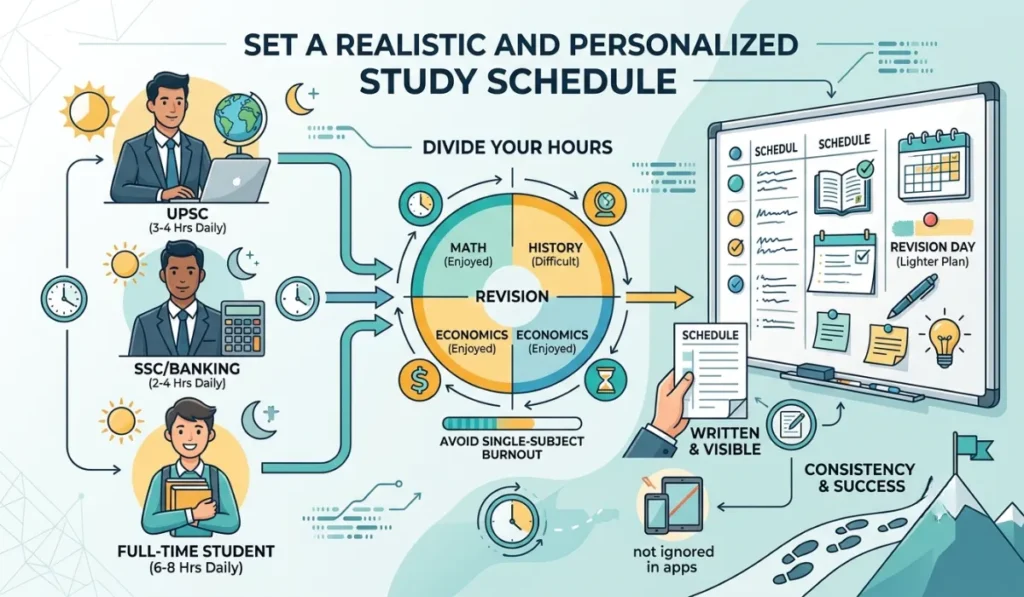
The foundation of consistency is a study plan designed around your actual life, not someone else’s highlight reel. A schedule that works for a topper on YouTube may not suit your circumstances, and that’s perfectly fine.
Start by honestly assessing your daily routine:
- Working professionals preparing for UPSC: 3 to 4 hours daily is a realistic target
- Full-time students with no other commitments: 6 to 8 hours daily may be achievable
- Working aspirants for SSC or banking exams: 2 to 4 focused hours daily can yield strong results over time
Once you know your available hours, divide them across subjects, alternating between topics you enjoy and those you find difficult. Avoid spending an entire day on a single subject, as this leads to burnout and neglect of other areas. Reserve one day each week for lighter revision rather than treating it as a complete day off.
Write your schedule on paper or a whiteboard you can see daily. Plans stored only in apps tend to get ignored over time.
Step 2: Understand the Difference Between Studying and Productive Studying
Sitting at your desk for six hours does not automatically mean you are learning. Many students equate time spent at the study table with actual progress, but this is a misconception.
Genuine studying involves active engagement: writing notes in your own words, solving practice questions, creating diagrams, testing yourself, and discussing concepts with others. Passive reading or re-reading the same material repeatedly may feel productive but results in poor retention.
The Pomodoro Technique is a useful method for staying focused:
| Pomodoro Cycle | Duration |
| Focused study session | 25–30 minutes |
| Short break | 5 minutes |
| After 4 cycles, longer break | 20 minutes |
Additionally, identify your peak focus hours. Some people concentrate best in the early morning, while others perform better at night. Schedule your most difficult subjects during your peak energy period and save lighter tasks for when your concentration naturally dips.
Step 3: Create a Distraction-Free Study Environment
India’s households and neighborhoods are often noisy and lively, with family interactions, street sounds, and constant phone notifications competing for your attention. Where you study has a significant impact on how effectively you study.
Practical steps to build a focused environment:
- Choose one fixed location for studying, whether it is a corner of your room, a library, or a quiet café, so your brain associates that space with focused work
- Keep your phone in another room, or use apps like Forest or StayFocusd, or activate Do Not Disturb mode during study hours
- Inform your family about your study schedule so they know when not to disturb you. It may feel awkward initially, but they will adjust over time
- Remove social media apps from your phone’s home screen, since even seeing the icons can trigger the urge to check them
Step 4: Make Revision a Non-Negotiable Part of Your Routine
A common error among Indian aspirants is treating revision as something to do only right before the exam. In reality, regular revision is what prevents you from forgetting material you have already studied.
According to the Ebbinghaus Forgetting Curve, we forget nearly 70% of newly learned information within 24 hours unless it is reviewed. To counter this, follow a structured revision schedule:
| Revision Stage | Timing After Initial Study |
| First revision | After 1 day |
| Second revision | After 3 days |
| Third revision | After 1 week |
| Final revision | After 1 month |
This spaced repetition approach helps move information from short-term to long-term memory. Maintain a separate notebook for quick revision points, such as key dates, formulas, and concepts you tend to forget, and review it every morning or before bed.
Step 5: Track Your Progress Without Obsessing Over It
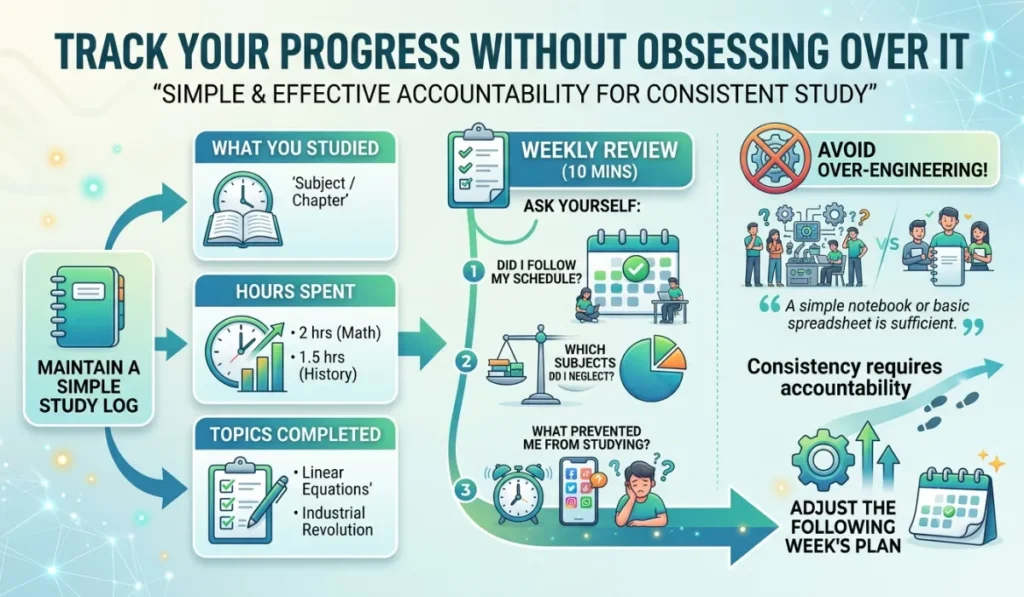
Consistency requires accountability, and the most effective way to stay accountable is by tracking your daily progress. Maintain a simple study log that records:
- What you studied each day
- How many hours you spent on each subject
- Which topics you completed
At the end of each week, spend about 10 minutes reviewing your log and asking yourself:
- Did I follow my planned schedule this week?
- Which subjects did I neglect?
- What factors prevented me from studying as planned?
Use these insights to adjust the following week’s plan. Avoid over-engineering this process. A simple notebook or basic spreadsheet is sufficient. Some students spend more time tracking their study hours than actually studying, which defeats the purpose.
Step 6: Handle Burnout Before It Handles You
Competitive exam preparation in India is mentally and emotionally demanding. Burnout is not a sign of weakness; it is a natural consequence of sustained mental effort without adequate rest.
Watch for these warning signs:
- Persistent lack of motivation
- Difficulty concentrating, even on easy topics
- Increased irritability
- Constant physical fatigue
- A feeling that your efforts are pointless
If you notice these symptoms, do not try to push through by force. Instead, take a deliberate break of two to three days, completely stepping away from books. Use this time for activities that genuinely recharge you, such as walking, spending time with family, watching a movie, cooking, or exercising.
Students who maintain a consistent sleep schedule of 7 to 8 hours, eat balanced meals, and exercise regularly tend to outperform those who sacrifice their health for extra study hours. India’s culture often glorifies sleepless nights and relentless effort, but rest is a strategic tool for better performance, not a sign of laziness.
Step 7: Stay Connected With Your Goal
Several months into preparation, many aspirants lose sight of why they started. The initial excitement fades, and daily studying can start to feel mechanical and pointless. This is precisely when consistency tends to break down.
To stay anchored to your purpose:
- Write down the specific reasons you want to clear this exam, whether it is the career you envision, the financial stability you seek, or the pride you want to bring your family
- Revisit this note whenever motivation dips
- Surround yourself with like-minded aspirants through study groups, coaching communities, or online platforms such as Telegram groups, WhatsApp study circles, Unacademy, Testbook, or BYJU’S
At the same time, avoid excessive comparison with others. India’s competitive exam culture often fuels unnecessary anxiety through constant comparison. Your only meaningful benchmark is your own progress from the previous week or month.
Step 8: Use Mock Tests Strategically
Mock tests are not merely a way to measure how much you know; they are a powerful tool for maintaining weekly consistency. Knowing that a mock test is scheduled every Sunday naturally pushes you to stay on track with your preparation throughout the week.
After each mock test, dedicate at least twice as much time to analysis as you spent taking the test itself. Identify your weak areas, revisit those concepts, and ensure you avoid repeating the same mistakes in subsequent tests.
For exams like UPSC, SSC CGL, IBPS PO, JEE, and NEET, numerous free and affordable mock test platforms are available online. Simulate real exam conditions: take the test at a fixed time, in the same location, without interruptions.
Step 9: Adapt Your Strategy, Not Your Commitment
Review your study plan every few weeks to evaluate its effectiveness. If you have spent months reading theory but continue to perform poorly on practice tests, it may be time to shift focus toward solving more practice questions. If you excel at multiple-choice questions but struggle with descriptive answers for UPSC Mains, dedicate more time to answer-writing practice.
It is completely acceptable to modify your study strategy as you learn what works for you. What should never change is your daily commitment to showing up and putting in the effort.
Common Mistakes Indian Competitive Exam Aspirants Make
| Mistake | Why It Hurts Consistency |
| Frequently switching study materials or books | Prevents deep understanding of any single resource |
| Focusing only on new topics, ignoring revision | Leads to forgetting previously learned material |
| Ignoring current affairs until close to the exam | Creates last-minute overload and stress |
| Passive reading without active recall | Results in poor long-term retention |
| Ignoring mental health and emotional pressure | Increases risk of burnout and reduced performance |
Recognizing these patterns early allows you to course-correct before they significantly affect your preparation.
| Join Yuva Safar WhatsApp Group for Latest Job Updates | Click Here |
| Join Our Telegram Channel for Daily Government & Private Job Alerts | Click Here |
Final Thoughts
Consistency in exam preparation is not an inborn trait. It is built daily through small, deliberate choices: waking up at the same time each day, opening your books even when motivation is low, choosing revision over entertainment, and trusting the process even when results are not immediately visible.
Among the hundreds of thousands of students who attempt competitive exams in India each year, only a select few succeed. What sets them apart is rarely natural talent. It is their ability to keep showing up, day after day, week after week, month after month.
Begin with small, manageable steps. Be honest with yourself about what is realistic. Build a schedule that fits your actual life, rest when your body and mind need it, and show up to study consistently. In the end, consistency, not shortcuts or coaching institutes alone, is what will carry you to your goal.
Frequently Asked Questions (FAQs)
Q1. How many hours should I study daily for competitive exams in India? It depends on the exam and your available time. Full-time UPSC aspirants typically benefit from 6 to 8 hours daily, while SSC or banking exam candidates can achieve strong results with 4 to 5 focused hours daily if done consistently.
Q2. What should I do when I feel like giving up? Take a short break of 1 to 2 days, revisit your original goal, and talk to a friend or mentor. Every aspirant experiences low phases; pushing through them with self-compassion is what builds long-term resilience.
Q3. Is it okay to take Sundays completely off? Yes. A light revision day or a full rest day on Sunday helps prevent burnout. Rest allows your brain to consolidate what it has already learned, making it a productive use of time rather than wasted time.
Q4. How do I stop getting distracted by my phone while studying? Keep your phone in a different room during study sessions, use Do Not Disturb mode, and consider apps like Forest or built-in screen-time timers. Treating phone use as a reward after completing a study block can also help.
Q5. How do I manage studies along with a full-time job? Study during early morning hours before work or in the evening after work. Even 2 to 3 focused hours daily can add up significantly over several months. Use commute time productively by listening to audio lectures or revising notes.
Q6. Should I join coaching or prepare through self-study? Both approaches can work well. Coaching offers structure and expert guidance, while self-study offers flexibility and cost savings. Many successful candidates have cleared UPSC and other major exams through self-study alone. Choose based on your learning style, budget, and access to reliable study material.
Q7. How do I cover such a vast syllabus without feeling overwhelmed? Break the syllabus into small, weekly targets and focus on one topic at a time. Regular revision ensures that earlier topics remain fresh in your memory even as you progress to new material.
Q8. What is the best time of day to study? Early morning generally works best for most people, as the mind is fresh and free of distractions. However, it is important to identify your own peak concentration hours and schedule your most challenging subjects during that window.