India has one of the world’s largest and most competitive government job markets. Every year, millions of students appear for exams conducted by UPSC, SSC, IBPS, RRB, State Public Service Commissions, and dozens of other recruitment bodies. The competition is intense — sometimes thousands of candidates compete for a single vacancy.
So here is the real question: Why do some people crack these exams on the very first attempt, while others struggle for years?
The answer is not just hard work. It is about preparing with the right skills.
Most aspirants focus only on the syllabus and subjects. But toppers — the ones who actually get selected — develop a broader range of skills that help them study smarter, perform under pressure, and stand out at every stage of the selection process.
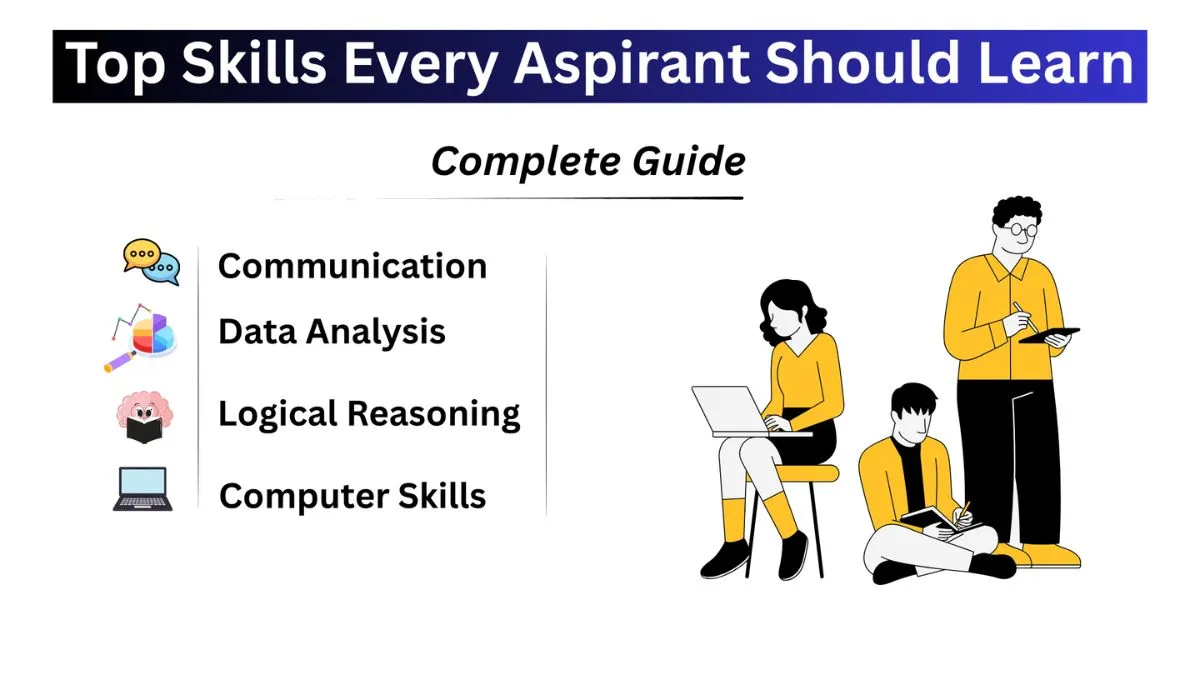
In this article, we cover the most important skills every government job aspirant in India should build — from reading habits and digital literacy to time management and interview confidence. Whether you are preparing for UPSC Civil Services, SSC CGL, SBI PO, or any state-level exam, these skills will give you a real edge.
1. Strong Reading and Comprehension Skills
Almost every major government exam in India — UPSC, SSC, and Banking — tests how quickly and accurately you can read and understand written information. Sections like Reading Comprehension in SBI PO, IBPS Clerk, SSC CGL, and UPSC Prelims require candidates to process long passages and answer questions correctly within a strict time limit.
Why it matters:
- English comprehension is a high-weightage section in most competitive exams
- UPSC General Studies papers demand careful reading of reports, editorials, and policy documents
- Staying updated on current affairs requires reading newspapers daily
How to improve your reading skills:
- Read one English newspaper every day — The Hindu or Indian Express are excellent choices
- Practice summarizing editorials in 5–6 lines to test your understanding
- Solve at least 2–3 reading comprehension exercises daily from previous year papers
- Aim for consistency — candidates who build strong reading habits from Day 1 have a significant advantage
2. Current Affairs Awareness
If there is one skill that cuts across all government exams in India, it is current affairs. Whether you are appearing for UPSC, SSC, IBPS, Railway, or State PCS — current affairs questions appear at every stage, including the written test and the interview.
Key areas to follow:
| Category | Examples |
| National & International News | Major political events, diplomacy, defence |
| Government Schemes & Policies | PM Awas Yojana, Jan Dhan, PLI Scheme |
| Economy & Budget | Union Budget highlights, Economic Survey |
| Science & Technology | Space missions, new technologies, patents |
| Sports & Awards | National/international sports, Padma Awards |
| Important Appointments | New CEOs, Ministers, RBI Governor, etc. |
How to build this skill:
- Read newspapers daily — 30 to 45 minutes is enough
- Watch Rajya Sabha TV or DD News for in-depth analysis
- Make short weekly notes of important events
- Revise monthly current affairs using free PDFs from trusted sources like Vision IAS, Drishti IAS, or Adda247
3. Time Management and Smart Study Planning
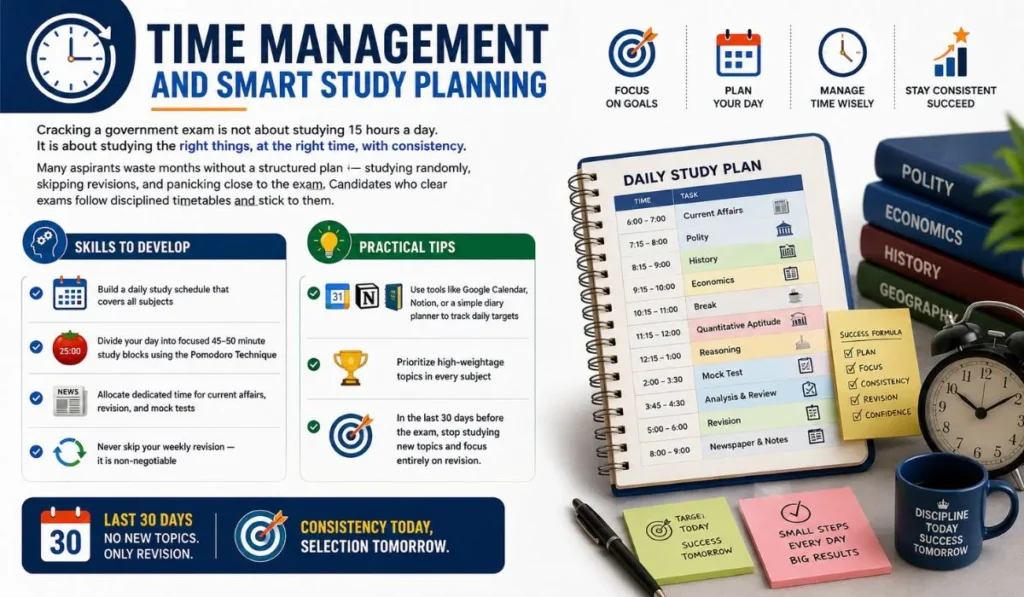
Cracking a government exam is not about studying 15 hours a day. It is about studying the right things, at the right time, with consistency.
Many aspirants waste months without a structured plan — studying randomly, skipping revisions, and panicking close to the exam. Candidates who clear exams follow disciplined timetables and stick to them.
Skills to develop:
- Build a daily study schedule that covers all subjects
- Divide your day into focused 45–50 minute study blocks using the Pomodoro Technique
- Allocate dedicated time for current affairs, revision, and mock tests
- Never skip your weekly revision — it is non-negotiable
Practical tips:
- Use tools like Google Calendar, Notion, or a simple diary planner to track daily targets
- Prioritize high-weightage topics in every subject
- In the last 30 days before the exam, stop studying new topics and focus entirely on revision
4. Mathematics and Quantitative Aptitude
Quantitative Aptitude is a core section in almost every government exam in India. SSC CGL, IBPS PO, SBI Clerk, Railway NTPC, LIC AAO, and UPSC CSAT Paper 2 all include mathematics.
Many aspirants from Arts or Commerce backgrounds fear Maths. But the truth is — government exam Maths covers foundational topics, not advanced calculus.
Key topics covered:
| Topic | Relevance |
| Number System | SSC, Railway, Banking |
| Percentage, Profit & Loss | All exams |
| Simple & Compound Interest | Banking, SSC |
| Time, Speed & Distance | All exams |
| Data Interpretation | Banking, UPSC CSAT |
| Ratio & Proportion | All exams |
| Geometry & Mensuration | SSC, Railway |
How to build this skill:
- Start from the basics — NCERT Class 6 to 10 Maths is your foundation
- Solve 20–30 Maths questions every day without a calculator
- Learn shortcut tricks to improve both speed and accuracy
- Practice Data Interpretation sets regularly if you are targeting banking exams
If you give Maths just 45 minutes daily, you will see noticeable improvement within 2–3 months.
5. Logical Reasoning and Analytical Thinking
Reasoning ability is tested in nearly every government exam in India — SSC, Banking, Railways, and UPSC CSAT all include dedicated reasoning sections. More importantly, strong analytical thinking transforms average UPSC Mains answers into exceptional ones.
Common topics in Reasoning sections:
- Puzzles and Seating Arrangement
- Syllogisms
- Coding-Decoding
- Blood Relations
- Direction Sense
- Statement and Conclusion
- Critical Reasoning (especially for Banking exams)
How to improve:
- Solve reasoning puzzles daily
- Practice previous year papers from SSC, IBPS, and UPSC CSAT
- Play logic games and brain teasers in your free time — they genuinely help build analytical thinking
6. Writing Skills — For Mains and Descriptive Papers
For UPSC IAS/IPS/IFS, State PCS, and banking exams like SBI PO Mains, strong writing is not optional — it is essential.
The UPSC Mains is fundamentally a writing examination. Many well-read candidates fail not because of a lack of knowledge, but because they cannot structure and express their thoughts clearly on paper.
What makes a good answer:
- A clear introduction with a strong opening line
- An organized body with sub-headings or bullet points where appropriate
- A balanced perspective covering multiple sides of an issue
- A forward-looking conclusion
- Neat, legible handwriting
How to develop writing skills:
- Write at least one essay or answer every day
- Join a test series for UPSC or State PCS and get your answers evaluated by experts
- Study high-scoring UPSC answer copies available online — observe their structure closely
- For banking exams, practice letter writing and essay topics from the last 5 years
Writing is a skill that improves only through consistent practice. There are no shortcuts here.
7. Computer and Digital Literacy
Digital literacy has become a basic requirement for government job aspirants in India. Many recruitment exams now include a dedicated Computer Awareness section, and government jobs increasingly expect candidates to be comfortable with computers.
Exams that test computer knowledge:
| Exam | Computer Component |
| SSC CHSL & CGL | Computer Awareness section |
| IBPS Clerk / PO | Computer Knowledge section |
| Railway Group D | Basic computer questions |
| Data Entry Operator posts | Typing + computer proficiency |
What you need to know:
- Basic computer operations — MS Office (Word, Excel, PowerPoint)
- Internet and email usage
- Operating System basics (Windows)
- Common computer abbreviations and terminology
- Basic cybersecurity awareness
How to build digital skills:
- Take a free course on Swayam, India’s government e-learning platform
- Practice MS Word and Excel regularly — they are directly useful in government jobs
- Use YouTube channels for free Computer Awareness preparation
Even if your exam does not test computer knowledge directly, being digitally literate will make your entire preparation process more efficient.
8. Communication and Personality Development
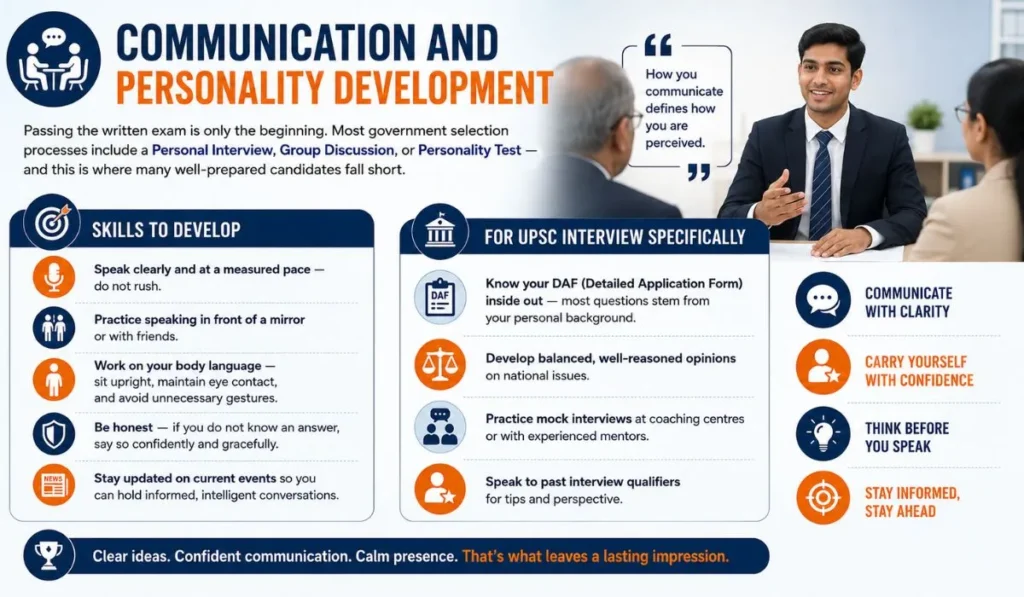
Passing the written exam is only the beginning. Most government selection processes include a Personal Interview, Group Discussion, or Personality Test — and this is where many well-prepared candidates fall short.
Skills to develop:
- Speak clearly and at a measured pace — do not rush
- Practice speaking in front of a mirror or with friends
- Work on your body language — sit upright, maintain eye contact, and avoid unnecessary gestures
- Be honest — if you do not know an answer, say so confidently and gracefully
- Stay updated on current events so you can hold informed, intelligent conversations
For UPSC Interview specifically:
- Know your DAF (Detailed Application Form) inside out — most questions stem from your personal background
- Develop balanced, well-reasoned opinions on national issues
- Practice mock interviews at coaching centres or with experienced mentors
- Speak to past interview qualifiers for tips and perspective
9. Stress Management and Mental Resilience
This is the most underrated skill on this list — and possibly the most important.
Government exam preparation in India is a long journey. UPSC aspirants often study for three to five years. Even SSC and Banking preparation demands months of sustained effort. Over such timelines, stress, self-doubt, burnout, and comparison with peers are very real challenges.
Many capable, intelligent candidates give up — not because they lacked knowledge, but because they could not manage the mental pressure.
Habits to build mental resilience:
- Exercise every day — even a 20–30 minute walk or yoga session makes a meaningful difference
- Meditate regularly — apps like Headspace or free YouTube sessions can help you get started
- Avoid comparing your progress with others on social media
- Take one complete day off every week — rest is part of preparation, not a break from it
- Stay connected with family and friends — their support is a genuine source of strength
A healthy, focused mind studies better, retains information more effectively, and performs significantly better under exam pressure.
10. Revision and Memory Skills
Studying something once is never enough. The Ebbinghaus Forgetting Curve demonstrates that we forget more than 70% of newly learned information within 24 hours if we do not revise it.
Candidates who clear government exams are exceptional revisers — they revisit topics multiple times until the information becomes second nature.
Effective revision techniques:
- Spaced Repetition — Revise after 1 day, then 3 days, then 7 days, then 30 days
- Mind Maps — Create visual summaries of complex topics on a single page
- Flashcards — Ideal for memorizing facts, dates, schemes, and capitals
- Previous Year Papers — The most effective form of active revision
- The Teaching Method — Explain topics aloud to a friend or to yourself; if you can teach it, you truly know it
Make short notes as you study throughout your preparation. These become your most valuable revision material in the final weeks before the exam.
Bonus Skill: Typing Speed (For Specific Posts)
For posts such as Lower Division Clerk (LDC), Stenographer, and Data Entry Operator under SSC, Railways, and State Governments, typing proficiency is a mandatory requirement.
| Language | Required Speed | Font |
| English | 35 words per minute | Standard keyboard |
| Hindi | 30 words per minute | Mangal / Kruti Dev |
Practice daily on platforms like Typing.com and use the official government typing test software to simulate real exam conditions.
| Join Yuva Safar WhatsApp Group for Latest Job Updates | Click Here |
| Join Our Telegram Channel for Daily Government & Private Job Alerts | Click Here |
Final Thoughts
Getting a government job in India is not just about mastering the syllabus. It is about developing the full range of skills needed to study effectively, perform well in exams, and succeed at every stage of the selection process.
Here is a quick summary of the 10 essential skills:
| Serial | Skill | Why It Matters |
| 1 | Reading & Comprehension | Core exam section; builds speed and accuracy |
| 2 | Current Affairs Awareness | Tested at every stage of every exam |
| 3 | Time Management | Ensures consistent, structured preparation |
| 4 | Mathematics & Aptitude | Mandatory in SSC, Banking, Railway, UPSC CSAT |
| 5 | Logical Reasoning | Required across all major exams |
| 6 | Writing Skills | Critical for UPSC Mains and descriptive papers |
| 7 | Computer & Digital Literacy | Tested in SSC CHSL, IBPS, DEO posts |
| 8 | Communication & Personality | Essential for interviews and GDs |
| 9 | Stress Management | Sustains long-term preparation |
| 10 | Revision & Memory Skills | Determines what you retain on exam day |
Start with one skill. Work on it consistently. Build from there. The government job you are aiming for is absolutely achievable — thousands of candidates have proven it, and you can too.
Best of luck with your preparation!
Frequently Asked Questions (FAQs)
Q1. Which is the most important skill for government exam preparation in India? Current affairs awareness is among the most critical skills. Virtually every government exam — UPSC, SSC, Banking, Railway — includes questions on recent national and international events at every stage of the selection process.
Q2. Is mathematics compulsory for all government exams? Not all, but most. SSC, Banking, and Railway exams include Quantitative Aptitude as a core section. UPSC CSAT also tests basic mathematics. Start with NCERT Class 6–10 and build progressively from there.
Q3. Do I need computer skills for a government job? Yes, for many posts. SSC CHSL, IBPS Clerk, and Data Entry Operator roles test basic computer knowledge. Even where it is not formally tested, digital skills make your overall preparation far more efficient.
Q4. How many hours should I study daily for a government exam? Quality matters more than quantity. A focused and structured 6–8 hours of daily study is consistently more effective than 12+ unplanned hours.
Q5. Can I crack a government exam without coaching? Absolutely. Thousands of candidates clear SSC, Banking, and even UPSC every year through self-study alone. Free resources on YouTube, Swayam, and official websites are more than sufficient for comprehensive preparation.
Q6. How do I improve my English for government exams? Read The Hindu or Indian Express daily. Practice reading comprehension and grammar exercises from previous year papers. With 3–6 months of consistent effort, you will see significant improvement.
Q7. What should I do if I feel stressed during preparation? Exercise regularly, take one day off every week, and avoid comparing yourself with others. Talking to family, friends, or a mentor can help you manage the stress and stay motivated.
Q8. Is typing speed required for all government jobs? No — only for specific posts such as LDC, Stenographer, and Data Entry Operator. Always check the official notification of your target exam to confirm whether typing is part of the selection process.
Q9. How important is revision in government exam preparation? Extremely important. Without regular revision, most of what you study will be forgotten. Use spaced repetition and concise notes to revise efficiently and retain information long-term.
Q10. Which newspaper is best for UPSC and SSC current affairs? The Hindu and Indian Express are the gold standard for UPSC preparation. For SSC and Banking, Jagran Josh and Adda247 also offer concise and well-organized daily current affairs updates.