Starting your career in India is challenging — especially when you have little to no work experience. The job market is highly competitive, and your resume is often the first impression a recruiter has of you. For freshers entering the workforce, a well-crafted resume can genuinely be the difference between getting that interview call and being overlooked.
This guide is designed for students and recent graduates in India — whether you hold a B.Tech, BBA, BCom, or a diploma or certification — who are entering the job market for the first time. We will walk you through every step of building a resume that stands out.
Why Your Resume Matters More Than You Think
Top Indian employers — including Infosys, TCS, Wipro, HCL, Deloitte, and hundreds of growing startups — receive thousands of applications for a single opening. Research shows that recruiters spend just 6 to 10 seconds scanning a resume before deciding whether to read it in full. That means your resume must communicate your value quickly, clearly, and professionally.
As a fresher, you might feel you have little to offer without formal work experience. That is simply not true. Your academic projects, internships, certifications, and skills are all assets — and when presented correctly, they absolutely impress recruiters.
Step 1: Choose the Right Resume Format
Before writing a single word, select the format that best fits your background. For Indian freshers, three main formats are commonly used:
| Format | Best For | Key Feature |
| Chronological | Freshers with internship or project experience | Lists education and experience in reverse order (most recent first) |
| Functional | Freshers with no internship but strong skills | Focuses on skills and abilities over work history |
| Combination | Freshers with internships or freelance work | Highlights skills first, then lists education and experience |
Recommended: For most Indian freshers, the combination or chronological format works best.
Step 2: Start with a Strong Personal Information Section
The top of your resume should include the following details — clearly formatted and easy to read:
- Full Name (bold, slightly larger font)
- Mobile Number (active 10-digit Indian number)
- Professional Email Address — avoid casual IDs like cooldude99@gmail.com; use firstname.lastname@gmail.com
- City and State (your full address is not required)
- LinkedIn Profile URL (optional but highly recommended)
- GitHub or Portfolio Link (especially important for IT, design, or content roles)
Common Mistake to Avoid: Many Indian freshers include their father’s name, religion, caste, blood group, or marital status. None of these are required and they only waste valuable resume space.
Step 3: Write a Powerful Career Objective
The career objective sits right below your personal details and is one of the most important sections on a fresher’s resume. It tells the recruiter who you are, what you bring to the table, and what role you are targeting — all in just 2 to 4 lines.
Your career objective should mention:
- Your educational background
- Your key skills or strengths
- The type of role you are targeting
- The value you can bring to the employer
Here is the difference a strong objective makes:
| Type | Example |
| Weak | “I am looking for a job in a good company where I can learn and grow.” |
| Strong | “A motivated Computer Science graduate from Delhi University with hands-on experience in Python and web development through two academic projects and a summer internship. Seeking a software developer role where I can apply my technical skills to build efficient and scalable solutions.” |
The strong example is specific, confident, and immediately tells the recruiter why this candidate is worth considering.
Step 4: Highlight Your Education
In India, education is one of the most heavily weighted sections on a fresher’s resume. List your qualifications in reverse chronological order — most recent first.
| Level | Details to Include |
| Graduation | Degree name, college/university, CGPA or percentage, year of passing |
| Class 12th | Board name, percentage, year of passing |
| Class 10th | Board name, percentage, year of passing |
Tips for this section:
- Always mention your CGPA or percentage — do not leave it out, even if it is low
- Clearly state your college or university name
- List relevant online certifications (from Coursera, NPTEL, Google, Microsoft, etc.) here or in a separate certifications section
Step 5: Showcase Your Skills
Skills are where freshers can truly shine, even without formal work experience. Most Indian job descriptions specify the exact technical and soft skills they require — your resume should reflect those skills honestly.
Technical Skills (Hard Skills)
| Field | Examples |
| IT / Software | Java, Python, SQL, HTML, CSS, React, Machine Learning |
| Finance / Accounts | Tally, MS Excel, Financial Modelling, GST |
| Marketing / Digital | SEO, Social Media Marketing, Google Analytics, Canva |
| Data & Analytics | Power BI, Tableau, Python, R |
Soft Skills
- Communication and presentation
- Teamwork and collaboration
- Problem-solving and critical thinking
- Time management
- Adaptability and a willingness to learn
Important: Do not just list soft skills — back them up with context in your project or internship descriptions. Saying “strong communication skills” means far more when it is supported by evidence.
Step 6: Add Internships — Even Short Ones Count
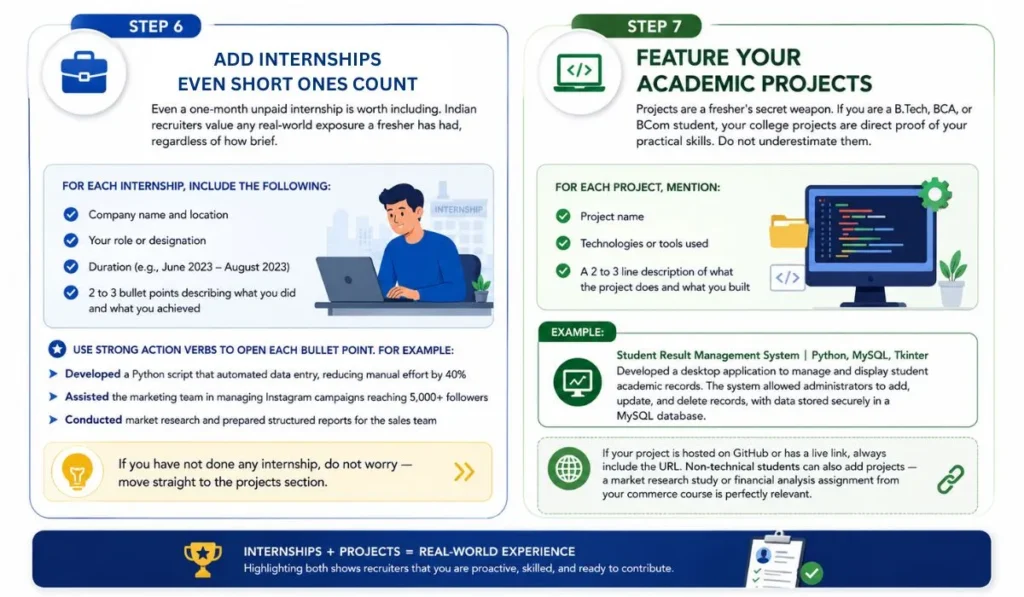
Even a one-month unpaid internship is worth including. Indian recruiters value any real-world exposure a fresher has had, regardless of how brief.
For each internship, include the following:
- Company name and location
- Your role or designation
- Duration (e.g., June 2023 – August 2023)
- 2 to 3 bullet points describing what you did and what you achieved
Use strong action verbs to open each bullet point. For example:
- Developed a Python script that automated data entry, reducing manual effort by 40%
- Assisted the marketing team in managing Instagram campaigns reaching 5,000+ followers
- Conducted market research and prepared structured reports for the sales team
If you have not done any internship, do not worry — move straight to the projects section.
Step 7: Feature Your Academic Projects
Projects are a fresher’s secret weapon. If you are a B.Tech, BCA, or BCom student, your college projects are direct proof of your practical skills. Do not underestimate them.
For each project, mention:
- Project name
- Technologies or tools used
- A 2 to 3 line description of what the project does and what you built
Example:
Student Result Management System | Python, MySQL, Tkinter Developed a desktop application to manage and display student academic records. The system allowed administrators to add, update, and delete records, with data stored securely in a MySQL database.
If your project is hosted on GitHub or has a live link, always include the URL. Non-technical students can also add projects — a market research study or financial analysis assignment from your commerce course is perfectly relevant.
Step 8: Include Certifications and Online Courses
India’s job market increasingly values certifications from recognised platforms. If you have completed courses from any of the following, list them on your resume:
| Platform | Popular Certifications |
| Coursera / edX | Data Science, Business Analytics, Project Management |
| NPTEL | Engineering, Computer Science, Management |
| Digital Marketing, Analytics, IT Support | |
| Microsoft | Azure, Office 365, Data Fundamentals |
| HubSpot | Content Marketing, Inbound, Sales |
| LinkedIn Learning | Leadership, Excel, Communication |
| Udemy | Web Development, UI/UX, Finance |
For each certification, mention the course name, the platform, and the year of completion. Certifications signal to employers that you are proactive about learning — a quality every hiring manager values.
Step 9: Add Extracurricular Activities and Achievements
Many freshers skip this section, assuming it carries little weight. That is a mistake. Extracurricular activities reveal personality, leadership ability, and teamwork — qualities every employer looks for.
Include activities such as:
- Being an active member of a college club or society (NSS, coding club, debate team, college fest committee)
- Winning competitions, hackathons, or quiz events
- Participating in sports at the college or state level
- Volunteering for community service or social initiatives
Keep this section concise — 3 to 5 bullet points are enough. Focus on achievements rather than mere participation.
Step 10: Languages and Hobbies
Languages: Being multilingual is a genuine advantage in India. List the languages you know along with your proficiency level.
| Language | Proficiency |
| Hindi | Fluent |
| English | Fluent |
| Tamil | Intermediate |
Hobbies: Include hobbies only if they add personality or are relevant to the role. Good examples include blogging, photography, coding, public speaking, or reading. Avoid overly generic entries like “listening to music” or “watching movies” — they add no real value.
Common Resume Mistakes Indian Freshers Must Avoid
| Mistake | Why It Hurts You |
| Using flashy, graphics-heavy templates | ATS systems often cannot read heavily designed resumes |
| Spelling and grammar errors | Creates an unprofessional first impression |
| Making the resume too long | Freshers should ideally keep it to 1 page, maximum 2 |
| Using a casual email address | Appears unprofessional to recruiters |
| Lying about skills or experience | Recruiters verify — it can seriously backfire |
| Not customising for each job | Generic resumes rarely stand out |
| Including a photograph | Not required for most modern Indian companies |
| Sending it as a Word file | Always save and send as a PDF to preserve formatting |
Best Free Tools to Build Your Resume
You do not need to pay for a resume builder. Here are reliable free tools available to Indian freshers:
| Tool | Best For |
| Google Docs | Simple, ATS-friendly professional templates |
| Canva | Visually appealing designs for creative roles |
| Novoresume | Clean, modern templates |
| Resume.io | Easy to use with multiple format options |
| Zety | Guided resume building with professional templates |
| Microsoft Word | Widely accepted, many built-in templates |
Pro Tip: For most IT and corporate jobs in India, a simple, clean resume made in Google Docs or Microsoft Word is the safest and most ATS-compatible choice.
What Is an ATS-Friendly Resume and Why Does It Matter?
Most large Indian employers — especially IT companies, BPOs, and MNCs — use Applicant Tracking Systems (ATS) to filter resumes before a human ever sees them. The system scans your resume for keywords that match the job description. If your resume is not ATS-compatible, it may never reach a recruiter’s desk.
To make your resume ATS-friendly:
- Use standard section headings: Education, Skills, Experience, Projects
- Avoid tables, columns, text boxes, and heavy graphics in the body of the resume
- Include keywords from the job description naturally throughout the content
- Stick to clean, readable fonts such as Arial, Calibri, or Times New Roman
- Always save and send as a PDF unless the employer asks otherwise
Final Checklist Before You Send Your Resume
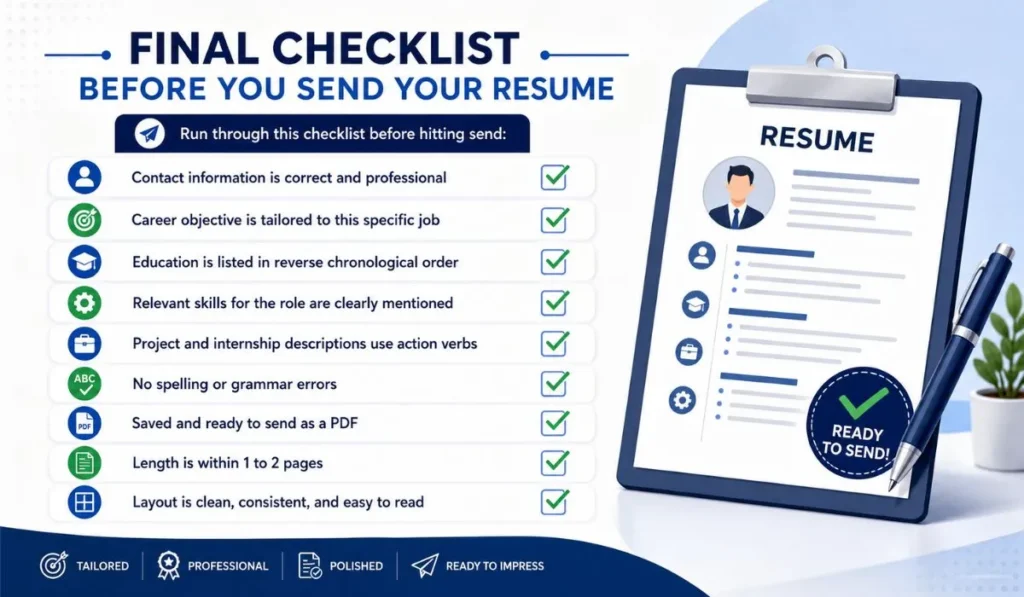
Run through this checklist before hitting send:
- Contact information is correct and professional
- Career objective is tailored to this specific job
- Education is listed in reverse chronological order
- Relevant skills for the role are clearly mentioned
- Project and internship descriptions use action verbs
- No spelling or grammar errors
- Saved and ready to send as a PDF
- Length is within 1 to 2 pages
- Layout is clean, consistent, and easy to read
| Join Yuva Safar WhatsApp Group for Latest Job Updates | Click Here |
| Join Our Telegram Channel for Daily Government & Private Job Alerts | Click Here |
Frequently Asked Questions (FAQ)
Q1. Should a fresher write a 1-page or 2-page resume? Keep it to 1 page. If you have extensive projects and certifications, 2 pages is acceptable — but 1 page is always preferred for freshers.
Q2. Should I add a photo to my resume in India? Generally, no. Unless the job specifically requests one (such as certain government or hospitality roles), skip the photo. Most modern Indian companies now follow international practices where photos are not required.
Q3. What should I write in the career objective if I have no experience? Focus on your education, key skills, and the value you can bring to the organisation. Be specific about the role you are targeting — vague objectives rarely impress recruiters.
Q4. Is it okay to use a colourful resume template? Mildly coloured, clean templates work well for creative roles. For IT and corporate positions, stick to black-and-white or subtle designs to ensure full ATS compatibility.
Q5. How do I make my resume stand out without experience? Highlight your academic projects, internships (even unpaid or short-term), certifications, and relevant skills. A strong, targeted career objective also makes a noticeable difference.
Q6. What font and font size should I use? Use professional fonts such as Arial, Calibri, or Times New Roman. Body text should be sized at 10–12pt, and your name at the top at 14–16pt.
Q7. Should I include my Class 10th marks? Yes. Indian recruiters commonly expect to see both Class 10th and 12th results. Include them unless your graduation marks are strong enough to stand on their own.
Q8. Can I use the same resume for every job application? It is better to customise your resume for each role — particularly the career objective and skills section — so it aligns closely with the specific job description.
Q9. What if my CGPA is low? Should I still mention it? Yes — always be honest. Compensate by emphasising strong projects, certifications, and practical skills. Note that some companies have minimum cutoffs (such as 6.0 CGPA or 60%), so check eligibility before applying.
Q10. How should I send my resume — as a Word file or PDF? Always send it as a PDF unless the employer specifically requests a Word document. PDFs preserve your formatting perfectly across all devices and operating systems.
Conclusion
Building a professional resume as a fresher in India does not require years of experience — it requires the right approach, clear thinking, and attention to detail. Think of your resume as your personal marketing document. Its job is to tell your story in the most compelling and honest way possible.
Focus on what you genuinely have — your education, projects, skills, and certifications — and present them professionally. Customise your resume for each application, keep the design clean and ATS-friendly, and always proofread before sending.
India’s job market is growing rapidly across IT, finance, marketing, healthcare, and manufacturing. Freshers who invest time in building a strong, well-structured resume have a real advantage over those who send generic, poorly formatted documents.
Start building your resume today — and take that first confident step towards your career.