Every year, lakhs of aspirants across India sit down with one shared dream — cracking a government exam. Whether it’s SSC CGL, SSC CHSL, RRB NTPC, RRB Group D, IBPS PO, IBPS Clerk, or SBI PO, the preparation journey is long, and the competition is fierce.
One question almost every aspirant asks — beginner or experienced — is simple: “Which books should I actually study from?”
With hundreds of titles flooding the market, picking the right ones can feel overwhelming. And a wrong choice doesn’t just waste money — it costs you something far more valuable: time. That’s exactly why we put together this guide, covering the most trusted, result-oriented books for SSC, Railway, and Banking exam preparation, along with practical tips on how to use them effectively.
Why Choosing the Right Book Matters
Before jumping into the list, it helps to understand why book selection plays such a big role in your preparation.
Government exams in India follow a fixed syllabus and a defined pattern. If your study material doesn’t align with that pattern, you end up wasting time on irrelevant topics while missing the ones that actually matter. The best books for competitive exams share three qualities: they stick closely to the syllabus, explain concepts in simple language, and offer plenty of practice questions with clear explanations.
The titles recommended in this guide aren’t random picks — they’re the same books that coaching institutes in cities like Delhi, Patna, Lucknow, and Hyderabad have relied on for years, simply because they consistently deliver results.
Best Books for SSC Exams (CGL, CHSL, MTS, CPO)
SSC exams, conducted by the Staff Selection Commission, are among the most popular government exams in India. They primarily test candidates on four subjects:
- Quantitative Aptitude
- English Language
- General Intelligence and Reasoning
- General Awareness
Here’s a subject-wise breakdown of the most recommended books.
Quantitative Aptitude
Quantitative Aptitude for Competitive Examinations by R.S. Aggarwal (S. Chand) remains the go-to book for SSC maths preparation. It has supported generations of aspirants and covers every essential topic — percentages, profit and loss, time and work, speed and distance, simple and compound interest, and more — in simple, easy-to-follow language, backed by a generous number of practice problems.
For SSC CGL Tier 2 aspirants, Advance Maths for SSC by Rakesh Yadav is a strong companion. It dives deep into geometry, trigonometry, algebra, and mensuration, and is widely popular among serious SSC candidates.
If you prefer a single, comprehensive resource, SSC Mathematics by Kiran Publication is worth considering. It organizes previous years’ questions chapter-wise, giving you a clear sense of the actual exam pattern.
English Language
Objective General English by S.P. Bakshi (Arihant Publications) is the most widely used English book among SSC aspirants. It covers reading comprehension, error spotting, sentence improvement, fill-in-the-blanks, cloze tests, one-word substitution, idioms, and phrases — all explained in simple language that’s especially helpful for Hindi-medium students.
English for General Competitions by Neetu Singh (KD Campus) is another excellent choice, known for its logically structured approach to building both basic and advanced grammar skills.
For grammar fundamentals, High School English Grammar and Composition by Wren and Martin remains a timeless reference. It isn’t exam-specific, but it builds a strong grammatical foundation that benefits every English learner.
General Intelligence and Reasoning
A Modern Approach to Verbal and Non-Verbal Reasoning by R.S. Aggarwal is the most recommended reasoning book for competitive exams. It thoroughly covers verbal reasoning, non-verbal reasoning, and logical reasoning.
For SSC-specific practice, SSC Reasoning by Kiran Publication is a solid pick, offering previous years’ questions organized by topic and difficulty level — making it easier to understand exactly what the exam expects.
General Awareness and GK
Lucent’s General Knowledge is practically a household name among Indian exam aspirants. It covers history, geography, polity, science, economics, and current affairs in an easy-to-digest format.
General Awareness for SSC Exams by Arihant is another helpful resource, designed specifically with the exam pattern in mind.
To stay updated with current affairs, consider supplementing your books with monthly magazines like Pratiyogita Darpan or free apps like GKToday and Adda247.
Best Books for Railway Exams (RRB NTPC, Group D, ALP, JE)
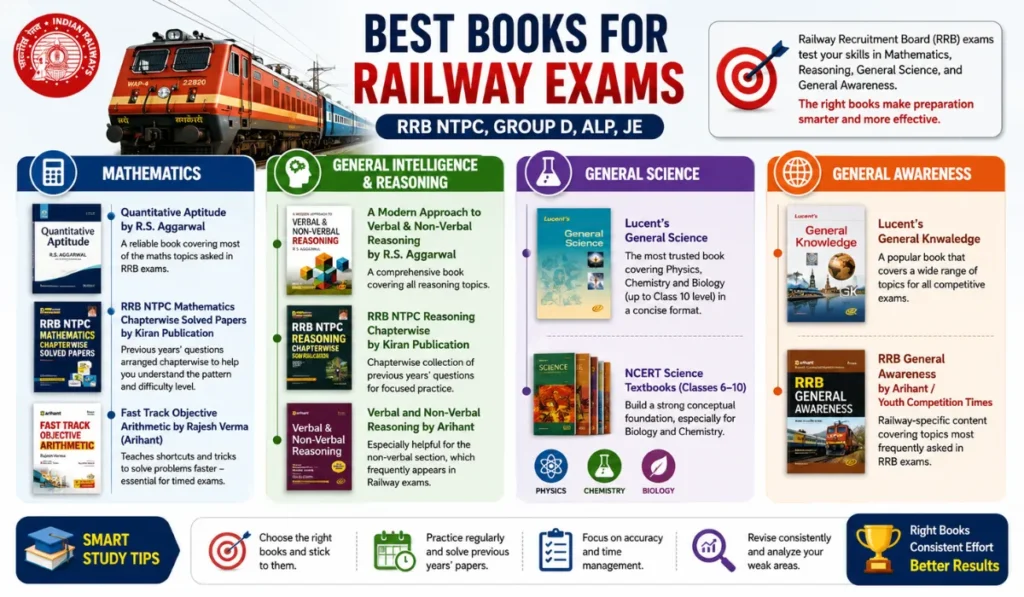
Railway Recruitment Board (RRB) exams attract a massive number of applicants every year. The key subjects tested are Mathematics, General Intelligence and Reasoning, General Science, and General Awareness.
Mathematics
Quantitative Aptitude by R.S. Aggarwal remains a reliable choice for RRB NTPC and Group D aspirants, covering most of the maths topics that appear in Railway exams.
For focused practice, RRB NTPC Mathematics Chapterwise Solved Papers by Kiran Publication compiles previous years’ questions by chapter, helping candidates understand the difficulty level and question pattern.
Fast Track Objective Arithmetic by Rajesh Verma (Arihant) is popular for a different reason — it teaches shortcuts and tricks to solve problems faster, which is crucial in timed exams.
General Intelligence and Reasoning
R.S. Aggarwal’s reasoning book continues to be useful here as well. For Railway-specific practice, RRB NTPC Reasoning Chapterwise by Kiran Publication is widely used by aspirants.
Verbal and Non-Verbal Reasoning by Arihant is particularly helpful for the non-verbal section, since Railway exams frequently include such questions.
General Science
Railway exams include a General Science section covering Physics, Chemistry, and Biology, up to Class 10 level.
Lucent’s General Science is the most trusted book for this section, condensing all three subjects into a compact format. Many successful candidates also recommend revisiting NCERT Science textbooks (Classes 6–10) to build a clear conceptual foundation, especially for Biology and Chemistry.
General Awareness
Just like for SSC, Lucent’s General Knowledge remains a strong choice here too. For Railway-specific content, RRB General Awareness by Arihant or Youth Competition Times covers the topics most frequently asked in these exams.
Best Books for Banking Exams (IBPS PO, IBPS Clerk, SBI PO, RBI Grade B)
Banking exams conducted by IBPS, SBI, and RBI are known for their difficulty. They test candidates across Quantitative Aptitude, Reasoning, English, General Awareness, and Computer Knowledge — often at a tougher level than SSC or Railway exams.
Quantitative Aptitude
While R.S. Aggarwal’s Quantitative Aptitude for Competitive Examinations still works as a foundational book, banking exams like SBI PO and IBPS PO demand a higher level of preparation.
Data Interpretation by Arun Sharma is considered essential, since DI is one of the most scoring — and most frequently tested — topics in banking exams.
Quantitative Aptitude by Arun Sharma is another strong pick for PO-level preparation, offering strategic shortcuts and problem-solving techniques. To sharpen calculation speed, Fast Track Arithmetic by Rajesh Verma is a useful practice companion.
Reasoning Ability
A New Approach to Reasoning: Verbal, Non-Verbal and Analytical by B.S. Sijwali and Indu Sijwali (Arihant) is highly recommended for banking exam reasoning, covering puzzles, seating arrangements, blood relations, direction sense, and coding-decoding in depth.
Since banking exams place heavy emphasis on puzzles and seating arrangements, Magical Book on Puzzles by K. Kundan (BSC Publications) is an excellent specialized resource for mastering this question type.
English Language
Objective General English by S.P. Bakshi remains a solid foundation here too. To build vocabulary — crucial for reading comprehension and cloze test sections — Word Power Made Easy by Norman Lewis is widely recommended.
For SBI PO and similar exams that include a descriptive paper, Descriptive English by S.P. Bakshi and Richa Sharma helps with essay and letter writing skills.
General and Financial Awareness
Banking exams include a dedicated Banking and Financial Awareness section. Banking Awareness by Arihant and Banking Awareness by Kiran Publication both cover this comprehensively — including RBI policies, banking terminology, and government schemes related to the financial sector.
To stay current, pair these books with monthly current affairs updates from platforms like Adda247 or Oliveboard, which track banking news, government schemes, and key appointments.
Computer Knowledge
Computer Awareness for Banking and Other Competitive Examinations by Arihant is generally sufficient for banking exams. It covers MS Office basics, internet fundamentals, computer hardware and software, and networking concepts.
Subject-Wise Quick Reference Table
| Subject | Recommended Books | Best For |
| Quantitative Aptitude | R.S. Aggarwal; Arun Sharma; Rakesh Yadav | Basic to advanced level; banking and SSC Tier 2 |
| English Language | S.P. Bakshi’s Objective General English; Wren and Martin; Norman Lewis | Grammar building and vocabulary |
| Reasoning | R.S. Aggarwal; B.S. Sijwali; K. Kundan’s Puzzles | General reasoning and banking-specific puzzles |
| General Knowledge | Lucent’s GK; Pratiyogita Darpan (monthly) | Static GK and current affairs |
| General Science | Lucent’s General Science; NCERT Class 6–10 | Railway exam science section |
| Computer Knowledge | Arihant’s Computer Awareness | Banking exam computer section |
How to Use These Books Effectively
You don’t need to buy every book on this list. In fact, trying to study from too many sources often backfires. Stick to two or three reliable books per subject, and use them thoroughly. Here are a few tips that genuinely make a difference:
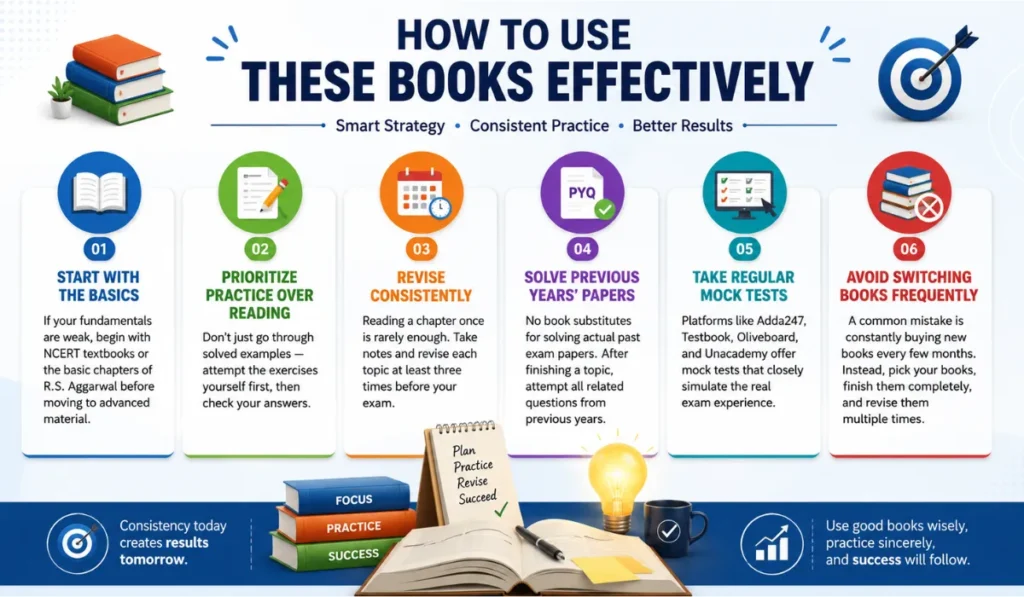
- Start with the basics. If your fundamentals are weak, begin with NCERT textbooks or the basic chapters of R.S. Aggarwal before moving to advanced material.
- Prioritize practice over reading. Don’t just go through solved examples — attempt the exercises yourself first, then check your answers.
- Revise consistently. Reading a chapter once is rarely enough. Take notes and revise each topic at least three times before your exam.
- Solve previous years’ papers. No book substitutes for solving actual past exam papers. After finishing a topic, attempt all related questions from previous years.
- Take regular mock tests. Platforms like Adda247, Testbook, Oliveboard, and Unacademy offer mock tests that closely simulate the real exam experience.
- Avoid switching books frequently. A common mistake is constantly buying new books every few months. Instead, pick your books, finish them completely, and revise them multiple times.
Online Resources to Complement Your Books
Books alone may not be enough in 2025 — pairing them with the right online resources can significantly speed up your learning.
| Resource Type | Examples | Best Use |
| YouTube Channels | Unacademy, Adda247, StudyIQ, Khan Sir’s GK channel | Free video lectures simplifying tough concepts |
| Mobile Apps | Adda247, Gradeup, Testbook | Quizzes, current affairs, and practice tests |
| Telegram Channels | Coaching institute channels | Free notes, study material, and previous papers |
| Join Yuva Safar WhatsApp Group for Latest Job Updates | Click Here |
| Join Our Telegram Channel for Daily Government & Private Job Alerts | Click Here |
Frequently Asked Questions (FAQ)
Q1. Which single book is best for SSC CGL preparation? There’s no single book that covers everything, but if you had to pick one per subject, the most recommended combination would be R.S. Aggarwal for Maths, S.P. Bakshi for English, R.S. Aggarwal for Reasoning, and Lucent’s GK for General Awareness.
Q2. Is Lucent’s GK enough for SSC and Railway exams? For static GK, Lucent’s is generally sufficient. However, you’ll still need to stay updated with current affairs through a monthly magazine or app.
Q3. Are NCERT books necessary for competitive exam preparation? For Railway exams, NCERT Science (Classes 6–10) is genuinely helpful. For Banking and SSC, NCERT isn’t mandatory, but reading Class 10–12 History, Geography, and Polity textbooks can strengthen your overall GK base.
Q4. Which book is best for Data Interpretation in banking exams? Arun Sharma’s Data Interpretation (McGraw Hill) is widely regarded as the best resource for banking DI preparation.
Q5. How many months of preparation are required for SSC CGL? For a fresh aspirant, 6 to 12 months of dedicated preparation is generally recommended. With prior knowledge or a strong academic background, 4 to 6 months may be sufficient.
Q6. Should I buy English-medium or Hindi-medium books? Choose whichever medium you’re most comfortable with. Most major titles, including R.S. Aggarwal and Lucent’s, are available in both English and Hindi.
Q7. Is Kiran Publication or Arihant better? Both are excellent in their own way. Kiran is known for its previous-year question compilations, while Arihant excels at theory and concept building. Ideally, use Arihant to learn topics and Kiran to practice.
Q8. Are online mock tests enough, or should I also study from books? Both are necessary. Books help build your conceptual foundation, while mock tests sharpen your speed, accuracy, and time management. Don’t skip either.
Q9. Which book is best for Banking Awareness? Both Arihant’s and Kiran’s Banking Awareness books are reliable. Supplement them with monthly current affairs updates for the best results.
Q10. Can a self-study candidate clear SSC or Banking exams without coaching? Absolutely. Thousands of candidates clear these exams every year through self-study, relying on standard books, structured planning, and regular mock tests. Coaching isn’t a requirement — consistency and the right resources are.
Conclusion
Preparing for SSC, Railway, or Banking exams doesn’t require stacking your desk with dozens of books. What it really takes is choosing around five to eight reliable titles, understanding them thoroughly, and practicing consistently.
The books covered in this guide have stood the test of time — recommended by toppers and coaching experts alike, and still relied upon by serious aspirants across India today.
So start your preparation today, and stay consistent. Every person who has ever landed a government job in India once sat exactly where you are now — with a book in hand and a dream to chase.
Your path to success starts with the right resources. Now you have everything you need to take the next step.