If you’ve grown up in India, you already know the pull of a government job. Your parents probably mentioned it, your relatives definitely have an opinion on it, and at some point, you probably found yourself wondering whether you should give it a shot too. And why not? Job security, a respectable salary, social standing, and a pension waiting at the end of it all — it’s a combination that’s hard to find anywhere else right now.
But wanting a government job and actually understanding how to get one are two very different things.
Here’s the truth nobody tells you upfront: the selection process is long, structured, and unforgiving of small mistakes. Miss one eligibility detail, mess up one form field, skip one stage — and you’re out, no matter how well you would’ve done on the actual exam. That’s why understanding the full process matters just as much as studying the syllabus.
So whether you’re a college graduate just starting to explore your options, or someone who’s already a year or two deep into preparation, this guide walks you through exactly how the government recruitment process works in India — from the day the notification drops to the day you walk into your new office.
So, What Does “Government Job Selection Process” Actually Mean?
Here’s something a lot of first-time aspirants don’t realise: there isn’t one single body that hires for all government jobs in India. Instead, you’ve got several organisations running the show — UPSC, SSC, Railway Recruitment Board, IBPS, and a whole list of State Public Service Commissions, among others.
Each one runs things a little differently. Different exam patterns, different cut-offs, different timelines. But strip away the specifics, and the underlying structure is surprisingly similar across almost all of them. That’s intentional — the whole system is built to be merit-based and transparent, so that a candidate from a small town with zero connections has just as fair a shot as anyone else.
Let’s go through it stage by stage.
Step 1: The Official Notification Drops
Everything starts here. A recruiting body releases an official notification (sometimes just called an “advertisement”) on its website, and usually in newspapers and employment portals too.
This one document tells you almost everything you need to know:
- The job title and how many vacancies are open
- Who’s eligible to apply (education, age, and so on)
- The application fee and how to pay it
- Key dates — when applications open, when the exam happens
- The exam pattern and syllabus
- What the selection process actually involves
- Salary and where you’d be posted
Honestly, this is the document people skim through the fastest and regret it the most. A missed line about age relaxation, a wrong assumption about eligibility — these things get candidates disqualified before they’ve even sat for an exam. Read it properly, straight from the official website. Not from a forwarded WhatsApp message, not from some random job portal screenshot.
Step 2: Check If You’re Actually Eligible
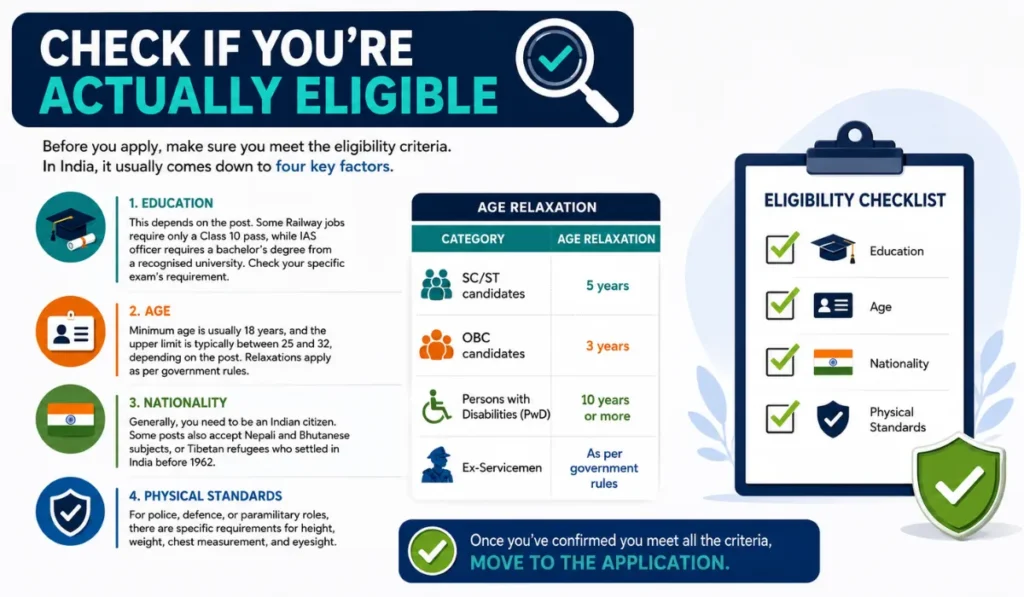
Before you even open the application form, sit down and check the eligibility criteria properly. In India, this usually comes down to four things.
Education. This depends entirely on the post. Some Railway jobs only ask for a Class 10 pass. Becoming an IAS officer? You’ll need a bachelor’s degree from a recognised university. There’s no universal rule here — check what your specific exam demands.
Age. Most government jobs start at a minimum of 18 years, with the upper limit somewhere between 25 and 32, depending on the post. But there’s relaxation built in for certain groups:
| Category | Age Relaxation |
| SC/ST candidates | 5 years |
| OBC candidates | 3 years |
| Persons with Disabilities (PwD) | 10 years or more |
| Ex-Servicemen | As per government rules |
Nationality. You’ll generally need to be an Indian citizen. A few posts also accept Nepali and Bhutanese subjects, or Tibetan refugees who settled in India before 1962.
Physical Standards. If you’re eyeing police, defence, or paramilitary roles, expect specific requirements around height, weight, chest measurement, and eyesight.
Once you’ve confirmed you check all these boxes — and only then — move to the application.
Step 3: Fill Out the Application Form
Almost all government recruitment in India happens online now, through the recruiting body’s own portal. Before you sit down to fill it out, keep these ready:
- A working mobile number and email ID
- A scanned passport-size photo (in the exact size/format asked for)
- A scanned signature
- Your educational certificates and mark sheets
- Category certificate, if you’re applying under SC/ST/OBC/EWS
- ID proof — Aadhaar or PAN works
- Bank details for the fee payment
A few things worth remembering here, because people genuinely trip up on these:
- Type everything exactly as it appears on your documents — no shortcuts, no nicknames
- Triple-check your name, date of birth, and category before submitting
- Most portals lock the form the moment you hit submit, so there’s no fixing typos later
- Pay the fee before the deadline — don’t leave it for the last hour
- Always save a copy of your submitted form. You’ll need it later, trust me.
Fees vary depending on the recruiter and your category. SC/ST and PwD candidates are usually exempted altogether.
Step 4: Download Your Admit Card
Once your application clears, the next thing you’re waiting for is the admit card. No admit card, no exam — it’s that simple.
It usually comes out two to four weeks before the exam date, and you download it from the official website using your registration number and date of birth (or a password you set earlier).
Your admit card will have:
- Your photo
- Your roll number
- The exam centre address
- Your reporting time
One thing people forget constantly: carry a printed copy along with a valid photo ID — Aadhaar, voter ID, anything official. Exam centres won’t let you in without both, no exceptions, no matter how good your excuse is.
Step 5: The Preliminary Exam (Prelims)
Most government exams in India run in phases, and Prelims is usually the first filter. It’s typically an objective, multiple-choice paper meant to narrow down a massive applicant pool into a manageable number.
It usually tests:
- General Knowledge and current affairs
- Quantitative aptitude (basic math)
- English or Hindi
- Reasoning ability
- Computer knowledge, for some posts
Here’s how a few popular ones compare:
| Exam | Pattern |
| UPSC Prelims | Two papers — General Studies and CSAT |
| SSC CGL Tier 1 | 100 questions, 60 minutes |
| IBPS PO Prelims | 100 questions, 60 minutes |
Negative marking is the norm here — usually 0.25 or 0.33 marks deducted per wrong answer. So that instinct to guess every question you’re unsure about? Resist it. It costs more than it helps.
Clear the cut-off, and you move on. Miss it, and your attempt ends right here, regardless of how the rest of your preparation looks.
Step 6: The Main Exam (Mains)
This is where things get serious. Mains is longer, harder, and far more comprehensive than Prelims. Depending on the exam, you might face:
- Objective papers
- Descriptive papers where you actually write detailed answers
- Subject-specific papers for technical roles
- Essay writing
- Language papers
The UPSC Civil Services Mains, for instance, runs across nine papers, including General Studies and an Essay paper. SSC CGL Mains, on the other hand, leans heavily on quantitative skills and English.
And here’s why Mains matters so much — for most state PSC exams and UPSC CSE, your Mains score gets added directly to your final merit. This isn’t a stage you can afford to take lightly.
Step 7: Skill Test, Typing Test, or Practical Round
For certain posts, clearing the written exam isn’t the finish line — there’s a skill test waiting too.
| Post | What’s Tested |
| Lower Division Clerk (LDC) | Typing speed in English or Hindi |
| Data Entry Operator (DEO) | Data entry speed and accuracy |
| Stenographer | Shorthand dictation and transcription |
| Junior Engineer | Practical/technical skills |
Most of these are qualifying in nature — clear the minimum benchmark, and you move ahead. But for roles like DEO and Stenographer, your actual performance here can shape the final outcome, so don’t treat it as a box-ticking exercise.
Step 8: Physical Fitness Test and Medical Exam
If you’re going for defence, police, or paramilitary roles — CRPF, BSF, CISF, SSB, ITBP, and similar forces — there’s a Physical Fitness Test (PFT) standing between you and the next stage. Typically, that means:
- A timed run (1.6 km or 5 km, depending on the post)
- Long jump and high jump
- Pull-ups, push-ups, and other physical drills
- Measurements — height, weight, chest
Clear the PFT, and a medical exam follows, conducted by government doctors. They’ll check your vision (including colour vision in some cases), hearing, and overall fitness, screening for any condition that might disqualify you.
If you’re found medically unfit here, that’s it — selection stops, regardless of how well you did on paper.
Step 9: Interview / Personality Test
Not every government job has an interview round. But for the bigger ones — IAS, IPS, IFS, bank officer posts, PSU jobs, Group A and B positions — yes, you’ll face one. It’s often called a Personality Test, and it’s exactly what it sounds like.
A panel will assess things like:
- How well you communicate
- Your awareness of current affairs
- How you make decisions under pressure
- Whether you’re genuinely suited for the role
- Your general demeanour
For context, the UPSC interview alone carries 275 marks — enough to shift your final rank significantly. People preparing for this stage usually read the newspaper daily, practice mock interviews, and stay genuinely plugged into what’s happening around them.
Worth knowing: after recommendations from the 7th Pay Commission, interviews were dropped from the selection process for most Group C and D posts — a move meant to cut down on subjectivity and keep things fairer.
Step 10: Document Verification
Clear every exam stage, and you’ll be called in for Document Verification — the point where everything you’ve claimed gets checked against the real thing. Expect to bring:
- Class 12 mark sheets and certificates
- Degree and graduation mark sheets
- Birth certificate
- Category certificate, where applicable
- Domicile certificate, if required
- NOC from your current employer, if you’re already in a government job
- ID and address proof
- Experience certificates, if relevant
If anything doesn’t match up — or worse, turns out fake — your selection gets cancelled on the spot, and in serious cases, legal trouble can follow. This is exactly why recruiters take this stage so seriously. It’s the last checkpoint before someone actually gets the job.
Step 11: Final Merit List and Joining
Once every round wraps up, the recruiting body releases the Final Merit List, based on your combined performance across all the stages you cleared. It goes up on the official website, listing roll numbers or names of those selected.
If you’re on it, here’s what follows:
- Offer Letter — your official confirmation
- Joining Date — when you need to report to your posting
- Training — could be a few weeks, could stretch to a couple of years, depending on the role
- Probation Period — usually 1 to 2 years before your appointment becomes permanent
A Few Honest Tips for Cracking Government Exams
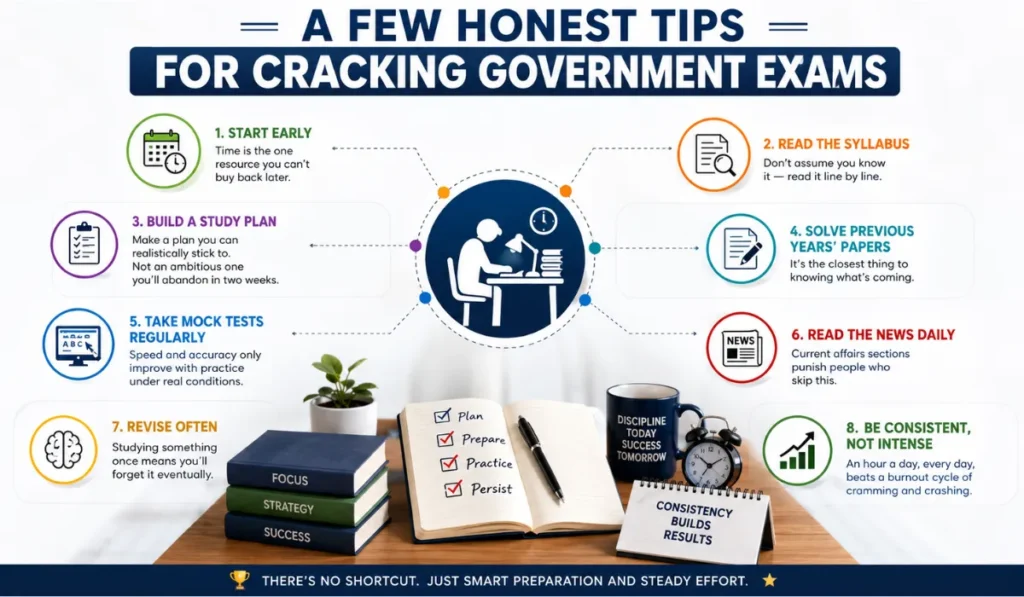
There’s no shortcut here, but there is a smarter way to prepare:
- Start early. Time is the one resource you can’t buy back later.
- Actually read the syllabus. Don’t assume you know it — read it line by line.
- Build a study plan you can realistically stick to. Not an ambitious one you’ll abandon in two weeks.
- Solve previous years’ papers. It’s the closest thing to knowing what’s coming.
- Take mock tests regularly. Speed and accuracy only improve with practice under real conditions.
- Read the news daily. Current affairs sections punish people who skip this.
- Revise often. Studying something once means you’ll forget it eventually.
- Be consistent, not intense. An hour a day, every day, beats a burnout cycle of cramming and crashing.
Popular Government Job Exams in India
| Exam | Conducted By | Posts Offered |
| UPSC CSE | UPSC | IAS, IPS, IFS, and other Group A services |
| SSC CGL | SSC | Inspector, Auditor, Examiner, and others |
| SSC CHSL | SSC | LDC, DEO, PA/SA |
| IBPS PO/Clerk | IBPS | Bank PO and Clerk roles in public sector banks |
| RRB NTPC | RRB | Station Master, Goods Guard, Clerk |
| RRB Group D | RRB | Track Maintainer, Helper, Porter |
| State PSC Exams | State PSCs | State civil services (SDM, BDO, etc.) |
| NDA/CDS | UPSC | Indian Army, Navy, Air Force Officers |
| CAPF AC | UPSC | Assistant Commandant in paramilitary forces |
| Join Yuva Safar WhatsApp Group for Latest Job Updates | Click Here |
| Join Our Telegram Channel for Daily Government & Private Job Alerts | Click Here |
Frequently Asked Questions
Q1. What’s the minimum qualification needed for a government job? Depends entirely on the post. Some need just Class 10, others Class 12, and the bigger roles ask for a bachelor’s degree. The notification will always spell this out.
Q2. Is there an age limit? Yes — typically 18 to somewhere between 25 and 32, with relaxation for SC/ST, OBC, PwD, and ex-servicemen.
Q3. How many attempts does UPSC allow? General category gets 6, OBC gets 9, and SC/ST candidates can keep attempting until they hit the upper age limit.
Q4. Can I take these exams in Hindi? Yes, most central exams — SSC, Railways, UPSC — let you choose between Hindi and English.
Q5. Do I need coaching to crack these exams? Not necessarily. Plenty of people clear these purely through self-study. Coaching helps with structure, but it’s not mandatory.
Q6. What happens once the merit list is out? You get an offer letter and joining date, followed by training, and then your appointment gets confirmed.
Q7. Can someone already working in the private sector apply? Yes, as long as they meet eligibility. They might need an NOC from their current employer during document verification.
Q8. How long does the whole process usually take? Anywhere from 6 months to 18 months, depending on the exam. UPSC CSE tends to be on the longer end.
Q9. What’s the real difference between Group A, B, C, and D jobs? It comes down to pay scale and seniority — Group A (IAS/IPS level) is the top tier, Group B includes roles like Income Tax Inspector, Group C covers clerical jobs, and Group D is support staff.
Q10. Can I apply for more than one exam at the same time? Absolutely — as long as you meet the eligibility criteria for each one separately.
Final Thoughts
The government job selection process in India isn’t easy, and honestly, it’s not supposed to be. That difficulty is what makes the job worth having in the first place. It takes patience, a fair amount of grit, and a clear-headed understanding of how each stage actually works — not just what to study, but how the whole system is structured.
If you’re serious about this path, start by picking the exam that genuinely fits your strengths, not just the one everyone around you is attempting. Understand the process properly, build a plan you can actually follow, and stick with it even on the days it feels slow.
Thousands of people clear these exams every single year. There’s no reason you can’t be one of them — as long as you keep showing up for it.