If you’ve ever opened a newspaper, read three pages, and then completely forgotten what you read by the next morning — you’re not alone. Almost every aspirant preparing for UPSC, SSC CGL, IBPS, state PSC exams, or Railway recruitment goes through this phase. Current affairs feels endless, and unlike history or polity, you can’t “finish” it once and move on.
The good news is that you don’t need five hours a day or a stack of magazines to stay on top of it. You need a routine you can actually repeat, day after day, without it feeling like a burden. That’s exactly what this guide walks you through — a home-based system that fits around college, a job, or family responsibilities, and still keeps you exam-ready.
Why Current Affairs Carries So Much Weight in Government Exams
Before getting into the “how,” it helps to understand why this section deserves daily attention rather than last-minute cramming.
Current affairs shows up almost everywhere in competitive exams:
- UPSC Prelims – Recent events are woven directly into GS Paper 1 questions.
- SSC exams – The General Awareness section leans heavily on what’s happened in the news.
- Banking exams (IBPS PO, SBI PO) – The Banking and Economy portion is built almost entirely around recent developments.
- Interviews and Group Discussions – UPSC interviews and SSB rounds frequently test how well you understand ongoing issues.
- Essay and Mains papers – Strong essays and policy-based answers almost always reference current developments.
On top of the exam value, staying updated simply makes you a more informed citizen — which is its own reward.
The real challenge is that current affairs never pauses. You can’t study it once like a history chapter and tick it off. It demands a daily habit, which is exactly what the rest of this guide builds for you.
Block Out a Fixed Time Slot Every Day
The single biggest factor that separates students who stay consistent from those who give up after a week is having a fixed time slot. When current affairs doesn’t have a dedicated place in your day, it gets pushed aside by everything else.
You don’t need hours of free time — 60 to 90 minutes spread across the day is plenty if you do it daily. Here’s a sample breakdown:
| Time of Day | Duration | What to Do |
| Morning | 30–45 minutes | Read a newspaper (print or e-paper) |
| Evening | 20–30 minutes | Go through a current affairs app or daily digest |
| Night | 10–15 minutes | Quickly revise what you covered earlier |
If you’re a working professional with limited time, even 45 minutes a day works — as long as you show up for it every single day. Skipping a day here and there is where most people lose the thread.
Pick the Right Newspaper and Stick With It
Reading the newspaper daily is still one of the most reliable ways to build a strong current affairs base, but not every newspaper serves exam preparation equally well.
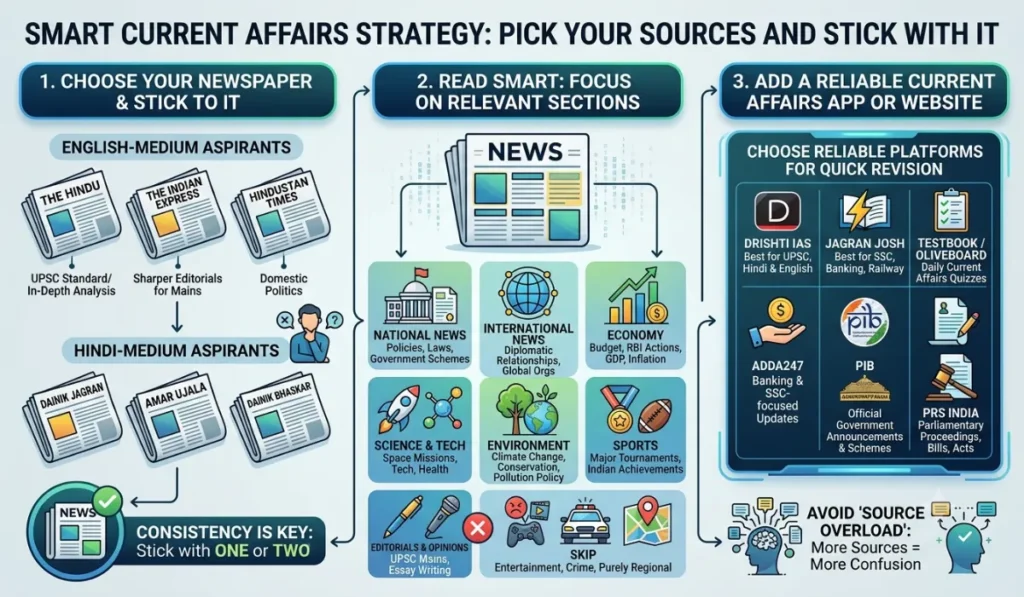
For English-medium aspirants:
- The Hindu – Widely considered the go-to choice for UPSC and state PSC preparation, thanks to its depth on national and international news, science, and the economy.
- The Indian Express – Known for sharp editorials and analytical pieces that help with Mains-level answer writing.
- Hindustan Times – A solid option for tracking domestic politics and general national news.
For Hindi-medium aspirants:
- Dainik Jagran
- Amar Ujala
- Dainik Bhaskar
Read Smart, Not Cover-to-Cover
Reading a newspaper front to back every day is a guaranteed way to burn out within a week. Instead, focus your attention on sections that actually matter for exams:
- National news – New policies, laws, and government schemes
- International news – India’s diplomatic relationships and global organizations
- Economy – Budget updates, RBI actions, GDP, inflation, and trade data
- Science and technology – Space missions, emerging tech, and health policy
- Environment – Climate change, wildlife conservation, and pollution-related policy
- Sports – Major tournaments and notable achievements by Indian athletes
- Editorial and opinion – Especially valuable for UPSC Mains and essay writing
Entertainment news, crime reports, and purely regional political stories can usually be skipped unless they tie directly into a topic relevant to your exam.
Add a Reliable Current Affairs App or Website
Newspapers give you depth, but a good current affairs app fills in the gaps on days when you’re short on time. These platforms are especially useful for quick daily revision.
| Platform | Best For |
| Drishti IAS (drishtiias.com) | UPSC aspirants; available in Hindi and English |
| Jagran Josh | SSC, Banking, and Railway exam preparation |
| Testbook / Oliveboard | Daily current affairs quizzes |
| Adda247 | Banking and SSC-focused updates |
| PIB (Press Information Bureau) | Official government announcements and schemes |
| PRS India (prsindia.org) | Parliamentary proceedings, bills, and acts |
A common mistake is trying to follow four or five sources at once, hoping to “cover everything.” In practice, this usually leads to confusion and burnout rather than better recall. Pick one or two sources that suit your exam and stay consistent with them.
Make Notes in Your Own Words — Every Day
Reading without writing is one of the fastest ways to forget. You don’t need an elaborate system here — a simple A4 notebook or a small diary is enough.
A few practical habits make this far more effective:
- Write the date at the top of each page.
- Note headlines as short bullet points, not full sentences.
- Capture key facts — names, numbers, dates, and places.
- Use short forms to save time (PM for Prime Minister, SC for Supreme Court, and so on).
- Underline names and figures you’re likely to forget.
Here’s what that looks like in practice. Instead of writing:
“The Prime Minister of India inaugurated the new metro line in Pune today, which will help reduce traffic congestion in the city.”
Write it as:
“PM inaugurated Pune Metro Line — Phase 1 — [date].”
This single habit makes revision dramatically faster. When exam day approaches, you’ll be flipping through your own notes instead of re-reading entire newspapers.
Use Monthly Magazines to Pull Everything Together
Daily reading builds the foundation, but monthly magazines help you see the bigger picture — connecting events that might otherwise feel scattered across thirty different days.
| Magazine | Why It Helps |
| Pratiyogita Darpan | Available in Hindi and English; broad coverage |
| Yojana | Published by the Government of India; strong for UPSC and government schemes |
| Kurukshetra | Focused on rural development and related schemes |
| Competition Success Review (CSR) | General competitive exam coverage |
| Manorama Yearbook | Ideal for a full-year revision sweep |
Setting aside two to three hours at the end of each month to go through a magazine like Yojana or Pratiyogita Darpan helps cement what you’ve already read, and often fills in details that daily sources skip over.
Use TV and YouTube Selectively, Not as Your Main Source
News channels and YouTube can be useful, but they can also quietly eat up hours of your day with very little exam value — especially debate shows and political slugfests.
A few better options worth your time:
- DD News – Reliable for government schemes and policy updates
- Rajya Sabha TV / Sansad TV – Useful for parliamentary debates and policy discussions
- Coaching institute YouTube channels – Drishti IAS, Study IQ, and Unacademy all publish current affairs analysis videos
Keep this to 20–30 minutes a day at most, treating it as a supplement to your reading rather than your primary source.
Test Yourself With Daily and Weekly Quizzes
Reading current affairs without testing yourself on it is a bit like preparing a meal and never tasting it. You need to know whether the information is actually sticking.
- Attempt 20–30 current affairs MCQs daily through apps like Testbook, Oliveboard, or Adda247.
- Take a consolidated weekly test every Sunday covering the full week’s events.
- Go back through your mistakes and identify which topics you consistently get wrong.
This habit does two things: it strengthens recall, and it trains you to answer faster under exam conditions — which matters just as much as knowing the answer.
Build a Revision Plan That Spans the Whole Year
Government exams typically draw current affairs questions from the past 12 to 18 months, not just the last few weeks. That means your revision strategy needs to work in layers rather than relying on a single read-through.
| Frequency | Activity | Approximate Time |
| Daily | Read the newspaper and jot down notes | ~1 hour |
| Weekly (Sundays) | Revise the week’s notes and attempt a weekly quiz | ~1.5 hours |
| Monthly | Read a magazine and revise monthly notes | ~2–3 hours |
| Pre-exam | Review all notes and solve previous years’ papers (last 3–5 years) | As needed |
This layered approach is what prevents the common last-minute scramble where students realize, two weeks before the exam, that they’ve forgotten half of what they read months ago.
Don’t Ignore Static Current Affairs
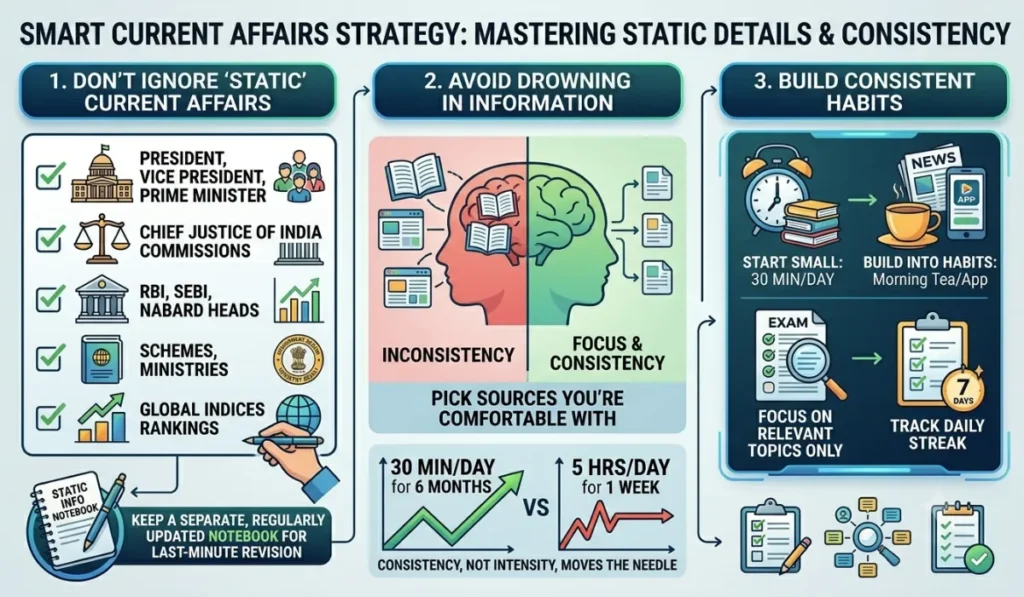
Indian competitive exams don’t just test what’s happening right now — they also test the “fixed” details that sit alongside current events: who holds which position, which organization is responsible for what, and so on.
Make sure you can confidently answer questions like:
- Who currently holds the positions of President, Vice President, and Prime Minister of India
- Who is the current Chief Justice of India, and who heads major commissions
- Who leads institutions like the RBI, SEBI, and NABARD
- Which new government schemes have been launched, and which ministry runs them
- Where India ranks on global indices such as the HDI or Press Freedom Index
- Which major summits or meetings India has recently hosted or attended
- Which key agreements India has signed with other countries
Keeping a small, separate notebook just for this static information — and updating it regularly — makes last-minute revision much less stressful.
Stay Consistent and Avoid Drowning in Information
Inconsistency is the single biggest reason students fall behind in current affairs. Some start strong and stop after a week. Others try to follow too many sources at once and end up more confused than informed.
A few things that genuinely help:
- Start small — even 30 minutes a day is fine when you’re just getting started.
- Pick sources you’re comfortable with and stick to them rather than constantly switching.
- Focus only on topics relevant to your specific exam instead of trying to read everything.
- Build it into an existing habit, like reading while having your morning tea.
- Track your daily streak — it’s a simple way to stay motivated.
Thirty minutes a day for six months will take you further than five hours a day for one week followed by silence. Consistency, not intensity, is what actually moves the needle here.
Mistakes That Quietly Derail Most Aspirants
A few patterns show up again and again among students who struggle with this section:
- Reading too many newspapers — one or two is genuinely enough.
- Skipping notes entirely — without them, most of what you read fades within a week.
- Skipping revision — reading alone doesn’t build retention.
- Ignoring monthly magazines — they’re what tie loose threads together.
- Only reading, never practicing MCQs — recognition and recall are different skills.
- Starting too close to the exam — current affairs needs months, not weeks.
Tailoring Your Approach by Exam Type
For UPSC: Stick with The Hindu and Yojana, and check PIB regularly. Try to connect recent events with concepts from your NCERT books, and in Mains answers, link current developments with the Constitution, history, or economics wherever relevant.
For SSC and Railway exams: A current affairs app like Adda247 or Jagran Josh works well. Focus on science and technology, sports, national awards, government schemes, and recruitment-related news.
For banking exams (IBPS, SBI): Pay close attention to RBI policies, banking sector news, economic indicators, government financial schemes, the Union Budget, and updates from international financial organizations.
| Join Yuva Safar WhatsApp Group for Latest Job Updates | Click Here |
| Join Our Telegram Channel for Daily Government & Private Job Alerts | Click Here |
Bringing It All Together
Preparing current affairs from home doesn’t have to be overwhelming. A consistent daily routine, the right sources, regular note-making, and periodic revision will take you much further than expensive coaching or a dozen different apps ever could. One good newspaper, one reliable app, and a notebook — used daily — are genuinely enough.
Start today. Read one newspaper article and jot down five points if that’s all you can manage. Keep that habit going, and within a few months, you’ll notice a real difference — both in how informed you feel and in how you perform in your exams. In this particular area of preparation, showing up consistently matters far more than any single resource you choose.
Frequently Asked Questions
Q1. How many hours should I spend on current affairs daily? About 1 to 1.5 hours a day is sufficient if you’re consistent. Regularity matters more than the number of hours.
Q2. Which newspaper is best for current affairs in India? The Hindu is widely preferred for UPSC. For SSC and banking exams, Hindustan Times or Times of India work just as well.
Q3. Can I rely on an app instead of reading the newspaper? Yes, to an extent. Apps like Adda247 or Testbook are great for quick daily updates. However, for UPSC specifically, newspaper reading adds analytical depth that apps typically don’t provide.
Q4. How far back do exams usually test current affairs? Generally the last 12 months, though UPSC sometimes draws from up to 18 months of events.
Q5. Is making notes really necessary? Yes. Short, point-form notes make revision significantly faster and help you retain far more than reading alone.
Q6. Is Yojana magazine important for UPSC preparation? Yes, it’s highly recommended. Yojana covers government schemes and policies in detail and is published monthly by the government.
Q7. Can I prepare current affairs without joining a coaching institute? Absolutely. With the right sources and a consistent daily habit, self-study at home works well for thousands of aspirants every year.
Q8. Which current affairs topics matter most for Indian exams? Government schemes, national and international awards, sports achievements, science and technology, the economy and budget, key appointments, and India’s foreign relations are tested most frequently.
Q9. What’s the best way to retain current affairs long-term? Regular revision is the key — weekly note reviews, monthly magazine reading, and daily MCQ practice all reinforce memory over time.
Q10. Is watching TV news useful for exam preparation? Short, focused viewing — like 20–30 minutes of Sansad TV or DD News — can help. Long debate shows tend to waste time without adding much exam value.