Serving in India’s defence forces or police is one of the most honourable careers a young person can pursue. Whether you aspire to join the Indian Army, Air Force, Navy, or a state police department, physical fitness is not optional — it is the foundation of your selection. Every year, thousands of well-prepared candidates get eliminated not because they failed the written exam, but because their body was not ready for the physical demands.
This guide covers everything you need to know about physical fitness test (PFT) requirements across major defence and police recruitments in India — the standards, scoring criteria, medical benchmarks, and a practical preparation roadmap.
Why Physical Fitness Tests Matter in Defence & Police Recruitment
India’s defence forces and police departments operate in some of the most demanding environments in the world — from high-altitude Himalayan patrols to urban anti-crime operations. Every recruit must be physically capable from day one. The Physical Fitness Test (PFT) is the gate that ensures only the fittest candidates move forward.
Unlike the written exam, the PFT cannot be crammed at the last minute. It requires months of consistent, disciplined training. Understanding the exact requirements in advance is the most important step you can take toward clearing it.
Indian Army Physical Fitness Test Requirements
Soldier General Duty (GD) & Common Entry Schemes
The Indian Army is the largest recruiter in the country’s defence sector, and the Soldier GD category attracts the highest number of applicants. Here are the detailed PFT standards:
1.6 km Run — Scoring Breakdown
| Performance | Time | Marks Awarded |
| Group 1 | Under 5 minutes 30 seconds | 60 marks |
| Group 2 | 5:31 – 5:45 minutes | 48 marks |
| Disqualified | Above 5 minutes 45 seconds | Eliminated |
Pull-Ups (Beam) — Scoring Breakdown
| Pull-Ups Completed | Marks Awarded |
| 10 | 40 marks |
| 9 | 33 marks |
| 8 | 27 marks |
| 7 | 21 marks |
| 6 | 16 marks |
| Less than 6 | Disqualified |
Additional Physical Tasks:
- Zigzag Balance Test — Pass/Fail. Candidates must navigate a zigzag course while maintaining controlled balance.
- 9-Foot Ditch Jump — Pass/Fail. Candidates must successfully leap across a 9-foot-wide ditch.
Height, Weight & Chest Standards:
| Category | Minimum Height | Minimum Chest | Chest Expansion |
| General / Most Regions | 170 cm | 77 cm | Minimum 5 cm |
| Hill Regions & Tribal Areas | 165 cm | 77 cm | Minimum 5 cm |
NDA (National Defence Academy) Physical Standards
The NDA is the premier pathway to commissioned officer ranks across the Army, Navy, and Air Force. Rather than a standalone PFT, physical standards are assessed during the five-day SSB (Services Selection Board) process, which includes obstacle courses, group physical tasks, and individual activities.
| Branch | Minimum Height | Additional Notes |
| Army & Navy | 157 cm | Weight proportional to height |
| Air Force | 162.5 cm – 196 cm | Strict vision and medical criteria apply |
Indian Navy Physical Fitness Test Requirements
For Agniveer (Navy) and other sailor entry schemes, candidates must meet the following fitness benchmarks:
| Test | Minimum Standard |
| 1.6 km Run | Under 7 minutes |
| Pull-Ups | Minimum 6 repetitions |
| Sit-Ups | Minimum 20 repetitions |
| Squats | Minimum 20 repetitions |
| Minimum Height | 157 cm |
The Navy also conducts a thorough medical examination. Conditions such as colour blindness, flat feet, visible tattoos, or physical deformities can be grounds for rejection depending on the branch and role applied for.
Indian Air Force (IAF) Physical Fitness Test Requirements
For Agniveer Vayu (Airmen) recruitment, candidates are assessed on the following:
| Test | Minimum Standard |
| 1.6 km Run | Under 6 minutes 30 seconds |
| Push-Ups | Minimum 10 repetitions |
| Sit-Ups | Minimum 10 repetitions |
| Squats | Minimum 20 repetitions |
| Minimum Height | 152.5 cm |
| Chest Expansion | Minimum 5 cm |
Candidates applying for flying branch roles must meet more rigorous vision and physical standards compared to ground duty positions. The IAF medical examination is among the most thorough in the entire defence sector.
Central Armed Police Forces (CAPF) Physical Tests
CAPFs include the BSF, CRPF, CISF, SSB, and ITBP. Recruitment is conducted through SSC CPO for Sub-Inspector posts and UPSC CAPF for Assistant Commandant posts.
SSC CPO — Sub-Inspector in CAPFs & Delhi Police
| Test | Male Standard | Female Standard |
| 100m Sprint | Under 16 seconds | Under 18 seconds |
| Run | 1.6 km in 6.5 minutes | 800m in 4 minutes |
| Long Jump | 3.65 m (3 chances) | 2.7 m (3 chances) |
| High Jump | 1.2 m (3 chances) | 0.9 m (3 chances) |
| Shot Put | 7.26 kg — throw 4.5 m | 4 kg — throw 3 m |
| Minimum Height | 170 cm / Chest: 80–85 cm | 157 cm |
UPSC CAPF — Assistant Commandant (Physical Efficiency Test)
| Test | Male Standard | Female Standard |
| 100m Race | Under 16 seconds | Under 18 seconds |
| 800m Race | Under 3 minutes 45 seconds | Under 5 minutes |
| Long Jump | 3.5 metres | 3.0 metres |
| High Jump | 1.1 metres | 0.9 metres |
| Shot Put (4 kg) | 4.5 metres | 3.0 metres |
Note: Relaxations in height, chest, and weight standards are available for SC, ST, OBC candidates and those from hill states. Always refer to the official notification for exact relaxation details.
State Police Physical Tests in India
Each Indian state conducts its own police recruitment with broadly similar core tests but different benchmarks and distances. Below is an overview:
Common Physical Tests Across States:
| Test | Male Standard | Female Standard |
| Running | 1,600m in 5–6 minutes (varies) | 800m in 3–4 minutes (varies) |
| Long Jump | Present in many states | Present in many states |
| High Jump | Present in several states | Present in several states |
| Pull-Ups / Push-Ups | Haryana, Punjab, HP | Not typically required |
| Minimum Height (General) | 165–170 cm (state-specific) | 155–160 cm (state-specific) |
Notable State-Wise Standards:
| State | Key Physical Test | Height Requirement |
| Uttar Pradesh | 25 km walk in 4 hrs (men); 14 km in 4 hrs (women) | Men: 168 cm / Women: 152 cm |
| Haryana | 2.5 km run in 12 minutes | Men: 170 cm / Chest: 83–87 cm |
| Rajasthan | 5 km run in 25 minutes (men) | As per official notification |
| Maharashtra | 800m run + long jump + high jump | As per official notification |
Key Medical Fitness Standards Across Defence & Police
Clearing the physical fitness test is only half the battle. Candidates must also pass a detailed medical examination. Here are the most commonly assessed parameters:
| Medical Parameter | Standard / Disqualifying Condition |
| Eyesight (Army GD) | 6/6 vision in both eyes without glasses |
| Eyesight (Police) | 6/6 corrected vision generally acceptable (state-specific) |
| Eyesight (IAF Flying) | Very strict; no significant refractive error permitted |
| Flat Feet (Pes Planus) | Generally disqualifying for Army and CAPF |
| Colour Blindness | Disqualifying for Air Force and many Navy roles |
| Knock Knees / Bow Legs | Assessed; may result in rejection |
| Tattoos | Face, neck, and hands typically disqualify; check official rules |
| Dental | Must have the required number of healthy teeth |
| Skin Conditions | Certain chronic conditions may lead to rejection |
Always be completely honest about your medical history. Concealing a condition that is later discovered during examination will result in permanent disqualification.
How to Prepare for Defence & Police Physical Tests
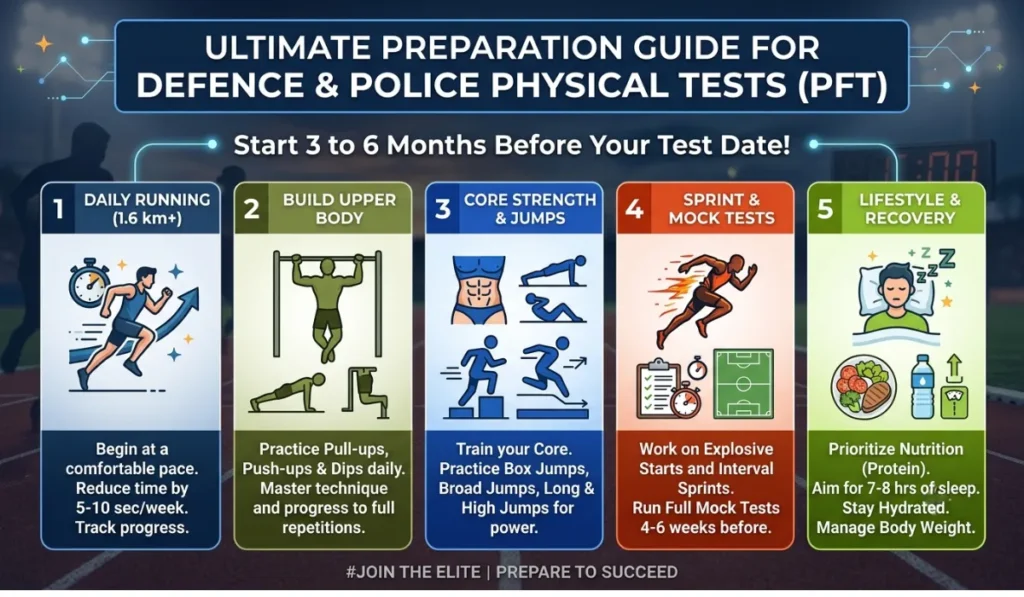
Serious preparation should begin at least 3 to 6 months before your scheduled test date. Here is a structured approach:
- Start running daily. Most tests include a 1.6 km run or longer. Begin at a comfortable pace and reduce your time by 5–10 seconds every week. Track your progress with a stopwatch.
- Build upper body strength. Practice pull-ups, push-ups, and dips every day. If you cannot manage a full pull-up yet, start with assisted or negative pull-ups and progress steadily.
- Train your core. Sit-ups, planks, and leg raises strengthen your core, which directly supports running performance and jumping ability.
- Sprint practice. For CAPF and police exams that include 100m sprints, work on explosive starts and interval sprints at least three times a week.
- Jump training. Long jump and high jump require both lower-body power and correct technique. Incorporate box jumps and broad jumps, and practise the actual jump mechanics regularly.
- Prioritise nutrition and rest. Aim for 7–8 hours of sleep, eat a high-protein balanced diet, and stay well-hydrated. Muscles grow during recovery, not during the workout itself.
- Manage your body weight. Excess weight slows your run time and drains stamina. A lean, strong physique is the goal.
- Simulate test conditions. In the 4–6 weeks before your rally or PFT date, run mock tests at the same time of day, wearing the same clothing, in the same sequence as the actual test.
Common Reasons for Disqualification
Knowing why candidates fail is just as valuable as knowing what to train for. The most frequent disqualification reasons include:
- Run time exceeding the cut-off, even by a few seconds
- Insufficient pull-ups (fewer than the minimum required)
- Failing to meet height or chest measurement standards
- Medical conditions detected during examination — flat feet, colour blindness, or poor uncorrected vision
- Tattoos on prohibited body parts (face, neck, or hands)
- Being overweight relative to height and age norms
- Undisclosed or incompletely healed past injuries
Reservations & Relaxations in Physical Standards
The Indian government provides relaxations in physical standards for candidates from specific categories. These typically include:
- SC (Scheduled Caste) and ST (Scheduled Tribe) candidates
- OBC (Other Backward Class) candidates
- Candidates from hill states and tribal areas
- Ex-servicemen and certain state domicile categories
Relaxations may apply to height, chest measurement, and in some cases run timings. Always refer to the official recruitment notification for the exact relaxation criteria applicable to your category and the specific post.
| Join Yuva Safar WhatsApp Group for Latest Job Updates | Click Here |
| Join Our Telegram Channel for Daily Government & Private Job Alerts | Click Here |
Frequently Asked Questions (FAQs)
Q1. What is the minimum height for Indian Army recruitment? For most categories, the minimum height is 170 cm. For hill and tribal regions, it is 165 cm.
Q2. How many pull-ups are needed to pass the Army PFT? A minimum of 6 pull-ups is required to avoid disqualification, but you need 10 pull-ups to earn full marks.
Q3. What is the run time required for the SSC CPO exam? Male candidates must complete 1.6 km in 6 minutes 30 seconds. Female candidates must complete 800m in 4 minutes.
Q4. Can I join the police if I wear glasses? Many state police departments allow corrected vision up to a certain limit. Check the specific official notification for your state and role.
Q5. Is flat foot a permanent disqualification in the Army? Yes. Flat foot (pes planus) is generally a disqualifying condition for Indian Army recruitment.
Q6. Are there separate physical standards for women in police and CAPF jobs? Yes. Female candidates have adjusted benchmarks for height, run distance, and strength tests across all departments.
Q7. How early should I start training before the physical test? Ideally, begin training at least 3–6 months before your test date. Consistent long-term training delivers far better results than last-minute intensive preparation.
Q8. Can tattoos get me disqualified? Yes, if they are on the face, neck, or hands. Some departments permit small cultural or religious tattoos on other body parts. Always refer to the official guidelines before your test.
Q9. What should I eat during PFT preparation? Focus on a high-protein, balanced diet with whole grains, vegetables, and fruits. Stay well-hydrated. Avoid junk food, excessive sugar, and alcohol throughout your preparation period.
Q10. Are age relaxations available for the physical test? Age relaxations typically apply to written exam eligibility. Physical standards may vary by age in some specific recruitments — always check the official notification for details.
Final Thoughts
Serving in India’s defence forces or police is a calling that demands more than ambition — it demands a body that is ready for the challenge. The Physical Fitness Test is tough by design, but it is entirely achievable with structured preparation, the right mindset, and the discipline to show up every single day.
The candidates who succeed are rarely the most naturally talented. They are the ones who started early, trained with purpose, and refused to quit. Don’t wait for the recruitment announcement. Start now. The uniform is waiting — but you have to earn it.