Every year, millions of students across India complete their Class 12 board exams and find themselves at a crossroads. Some head straight to college, while a growing number of ambitious young people start exploring a different path altogether: government jobs. The best part? You don’t always need a college degree to land a secure, well-paying government job in India.
Whether you studied Science, Commerce, or Arts, there’s a wide range of sarkari naukri options open to you right after 12th. These jobs typically come with a fixed salary, job security, pension benefits, accommodation, medical coverage, and a level of social respect that’s often harder to find in private-sector roles.
This guide covers the top government jobs available after 12th, along with expected salaries, eligibility criteria, and how to apply for each one.
Why Government Jobs Remain a Top Choice in India
Before diving into the list, it helps to understand why a sarkari naukri continues to be the preferred career path for so many young Indians, even when private-sector salaries can sometimes look more attractive on paper.
- Job security: Once selected, government employees are rarely terminated, offering long-term stability that’s hard to match elsewhere.
- Improved pay structures: While starting salaries used to lag behind the private sector, the 7th Pay Commission has significantly improved government pay scales.
- Strong perks and allowances: House Rent Allowance (HRA), Dearness Allowance (DA), Travel Allowance (TA), subsidized medical care, and pension benefits add real value to the total compensation package.
- No expensive degree required: Many government jobs don’t require a costly, multi-year college education, which makes them especially attractive to students from middle-class families who want financial independence sooner.
For these reasons, millions of Indian youth continue to choose a government job as their pathway to a stable and secure future.
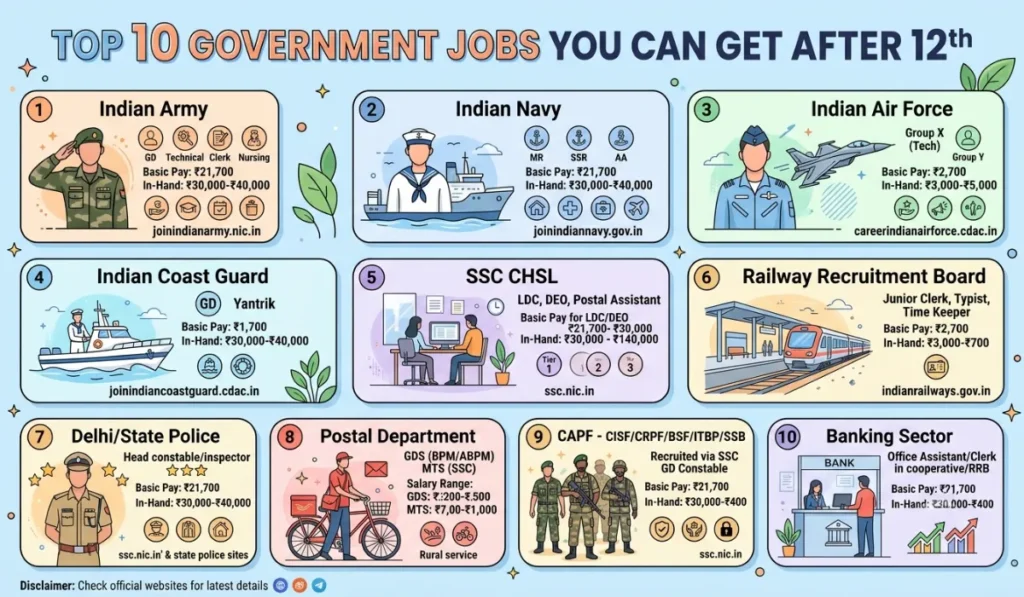
Top 10 Government Jobs You Can Get After 12th
1. Indian Army (Soldier GD / Technical / Clerk / Nursing Assistant)
The Indian Army recruits 12th-pass candidates for several roles, including Soldier General Duty (GD), Soldier Technical, Soldier Clerk, and Soldier Nursing Assistant. Selection happens through Army Recruitment Rallies held at the district and state level throughout the year.
| Detail | Information |
| Eligibility | 10th pass (GD); 12th pass (Clerk, Technical, Nursing Assistant) |
| Starting Basic Pay | ₹21,700/month (Pay Level 3) |
| In-Hand Salary (with allowances) | ₹30,000 – ₹40,000/month |
| Selection Process | Physical fitness test, medical exam, written test |
| Official Website | joinindianarmy.nic.in |
Beyond salary, Army personnel receive free accommodation in cantonments, medical care for themselves and their families, children’s education allowances, 60 days of annual leave, canteen facilities for discounted purchases, and a pension after 15 years of service.
2. Indian Navy (Sailor – MR / SSR / AA)
Like the Army, the Indian Navy recruits 12th-pass candidates through three primary entry schemes:
- Matric Recruit (MR): Minimum qualification is 10th pass, though many 12th-pass candidates also apply.
- Senior Secondary Recruit (SSR): Requires 12th pass with Physics and Mathematics.
- Artificer Apprentice (AA): Also requires 12th pass with Physics and Mathematics.
| Detail | Information |
| Eligibility | 12th pass with Physics & Maths (SSR/AA) |
| Starting Basic Pay | ₹21,700 – ₹29,200/month |
| In-Hand Salary (with allowances) | ₹35,000 – ₹50,000/month |
| Selection Process | Written exam, physical fitness test, medical test |
| Official Website | joinindiannavy.gov.in |
Sailors also receive housing, free medical treatment, leave travel concessions, a strong pension system, and the opportunity to travel internationally as part of naval deployments.
3. Indian Air Force (Airman – Group X and Group Y)
The Indian Air Force recruits Airmen under two categories. Group X requires 12th pass with Physics and Mathematics, while Group Y accepts 12th pass in any stream. Candidates go through the Airmen Selection Test, which includes a written exam, physical test, and medical examination.
| Detail | Information |
| Eligibility | 12th pass (Group Y – any stream; Group X – Physics & Maths) |
| Starting Basic Pay | ₹21,700/month |
| In-Hand Salary (with allowances) | ₹33,000 – ₹55,000/month |
| Selection Process | Written test, physical test, medical test |
| Official Website | careerindianairforce.cdac.in |
Group X Airmen earn a higher technical pay due to the specialized nature of their roles, and there are clear promotion pathways that allow Airmen to eventually qualify for officer-level positions.
4. Indian Coast Guard (Navik / Yantrik)
The Indian Coast Guard, operating under the Ministry of Defence, safeguards India’s maritime boundaries and assists in sea rescue operations. It recruits 12th-pass candidates for two main roles:
- Navik (General Duty): 12th pass in any stream, with good command of English and Mathematics.
- Yantrik (Technical): 12th pass with Physics and Mathematics, or a diploma in engineering.
| Detail | Information |
| Eligibility | 12th pass (stream depends on post) |
| Starting Basic Pay | ₹21,700/month (Pay Level 3) |
| In-Hand Salary (with allowances) | ₹30,000 – ₹50,000/month |
| Official Website | joinindiancoastguard.cdac.in |
5. SSC CHSL (Combined Higher Secondary Level)
The SSC CHSL exam, conducted annually by the Staff Selection Commission, is one of the most popular options for 12th-pass students. It recruits candidates for posts like Lower Division Clerk (LDC), Data Entry Operator (DEO), Postal/Sorting Assistant, and Court Clerk across central government ministries and departments.
| Post | Pay Level | Starting Basic Pay | Approx. In-Hand Salary |
| Lower Division Clerk | Pay Level 2 | ₹19,900/month | ₹28,000 – ₹35,000/month |
| Data Entry Operator | Pay Level 4 | ₹25,500/month | ₹35,000 – ₹42,000/month |
Eligibility: 12th pass from a recognized board; age 18–27 years (with relaxation for SC/ST/OBC candidates).
Selection Process: Tier 1 (computer-based exam), Tier 2 (descriptive paper), Tier 3 (skill or typing test).
To prepare, focus on General Intelligence, English Language, Quantitative Aptitude, and General Awareness. Notifications are released on ssc.nic.in.
6. Railway Recruitment Board (RRB) – Group D / NTPC
Indian Railways is one of the country’s largest employers and offers several stable career options for 12th-pass candidates, including Junior Clerk cum Typist, Junior Time Keeper, Accounts Clerk cum Typist, and (in some cases) Junior Station Master under RRB NTPC. Group D posts typically require a 10th pass or ITI qualification, but many 12th-pass candidates apply for these roles as well.
| Detail | Information |
| Eligibility | 10th/12th pass or ITI (post-dependent) |
| Pay Level | Pay Level 2 – 3 |
| Starting Basic Pay | ₹19,900 – ₹21,700/month |
| In-Hand Salary (with allowances) | ₹30,000 – ₹40,000/month |
| Official Website | indianrailways.gov.in |
Railway employees also receive travel passes for themselves and their families, an added benefit that makes these positions especially popular.
7. Delhi Police / State Police Constable
Police constable recruitment happens at both the central and state level. The Delhi Police Constable exam is conducted by SSC, while individual states like Uttar Pradesh, Madhya Pradesh, Rajasthan, and Bihar run their own recruitment drives.
| Detail | Information |
| Eligibility | 12th pass |
| Starting Basic Pay | ₹21,700/month (Pay Level 3) |
| In-Hand Salary (with allowances) | ₹30,000 – ₹42,000/month |
| Official Website | ssc.nic.in (Delhi Police); respective state police websites |
Constables receive housing quarters, free uniforms, and clear promotion pathways toward ranks such as Head Constable and Inspector.
8. Postal Department – Gramin Dak Sevak (GDS) and MTS
India Post recruits Gramin Dak Sevaks (GDS) to serve its extensive rural network, with selection based primarily on Class 10 marks. GDS roles include Branch Postmaster (BPM) and Assistant Branch Postmaster (ABPM). The department also hires Multi-Tasking Staff (MTS), a role also recruited centrally through SSC for 12th-pass candidates.
| Post | Eligibility | Approx. Salary Range |
| GDS (BPM/ABPM) | 10th pass | ₹12,000 – ₹29,380/month |
| MTS (SSC) | 12th pass | ₹22,000 – ₹28,000/month |
9. CISF / CRPF / BSF / ITBP / SSB – Central Armed Police Forces (CAPF)
India’s Central Armed Police Forces include the Central Industrial Security Force (CISF), Central Reserve Police Force (CRPF), Border Security Force (BSF), Indo-Tibetan Border Police (ITBP), and Sashastra Seema Bal (SSB). These forces recruit Constables through the SSC GD Constable exam, open to 10th and 12th-pass candidates. (Note: Sub-Inspector posts under SSC CPO require a graduation degree.)
| Detail | Information |
| Eligibility | 10th/12th pass |
| Starting Basic Pay | ₹21,700/month (Pay Level 3) |
| In-Hand Salary (with allowances) | ₹30,000 – ₹45,000/month |
| Official Website | ssc.nic.in |
10. Banking Sector – Office Assistant / Clerk (Select Posts)
While most banking jobs require a graduation degree, certain posts in cooperative banks, state cooperative banks, and Regional Rural Banks (RRBs) accept 12th-pass candidates. The IBPS RRB Office Assistant role is one such opportunity, though availability depends on state-specific requirements.
| Detail | Information |
| Eligibility | 12th pass (varies by state/bank) |
| Starting Basic Pay | ₹15,000 – ₹19,900/month |
| In-Hand Salary (with allowances) | ₹25,000 – ₹35,000/month |
These positions offer steady growth, with pay and responsibilities increasing as employees gain experience.
Salary Comparison at a Glance
| Job Category | Starting Basic Pay | Approx. In-Hand Salary |
| Indian Army | ₹21,700 | ₹30,000 – ₹40,000 |
| Indian Navy | ₹21,700 – ₹29,200 | ₹35,000 – ₹50,000 |
| Indian Air Force | ₹21,700 | ₹33,000 – ₹55,000 |
| Indian Coast Guard | ₹21,700 | ₹30,000 – ₹50,000 |
| SSC CHSL (LDC/DEO) | ₹19,900 – ₹25,500 | ₹28,000 – ₹42,000 |
| RRB Group D / NTPC | ₹19,900 – ₹21,700 | ₹30,000 – ₹40,000 |
| Police Constable | ₹21,700 | ₹30,000 – ₹42,000 |
| Postal GDS / MTS | ₹12,000 – ₹18,000 | ₹22,000 – ₹29,380 |
| CAPF Constable | ₹21,700 | ₹30,000 – ₹45,000 |
| Banking (RRB Office Assistant) | ₹15,000 – ₹19,900 | ₹25,000 – ₹35,000 |
Tips to Crack Government Job Exams After 12th
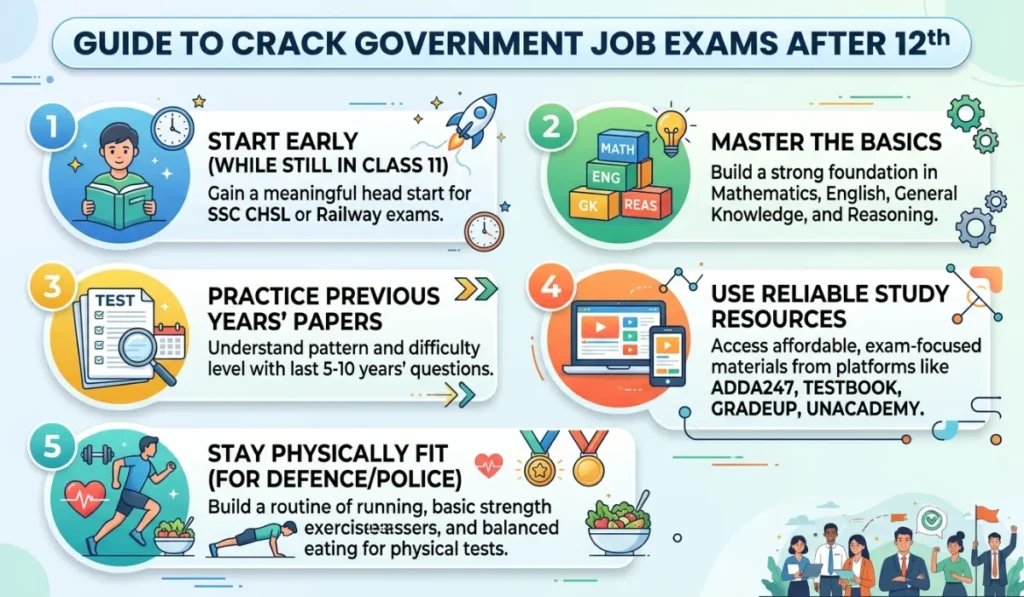
- Start early. Many successful candidates begin preparing for SSC CHSL or Railway exams while still in Class 11, giving themselves a meaningful head start.
- Master the basics. Most government exams test core areas: Mathematics, English, General Knowledge, and Reasoning. Build a strong foundation in these subjects first.
- Practice previous years’ papers. Solving the last 5 to 10 years of question papers for your target exam is one of the most effective ways to understand the pattern and difficulty level.
- Use reliable study resources. Platforms like Adda247, Testbook, Gradeup, and Unacademy offer affordable, exam-focused study material for SSC, Railways, and defence recruitment.
- Stay physically fit. For defence and police roles, physical fitness is just as important as written exam performance. Build a routine of running, basic strength exercises, and balanced eating well in advance of your physical test.
| Join Yuva Safar WhatsApp Group for Latest Job Updates | Click Here |
| Join Our Telegram Channel for Daily Government & Private Job Alerts | Click Here |
Frequently Asked Questions (FAQs)
Q1. What is the best government job after 12th in India? It depends on your interests. If you’re drawn to discipline, adventure, and service, defence roles in the Army, Navy, or Air Force are excellent choices. If you prefer office-based work, SSC CHSL or Railway NTPC roles offer strong stability and growth.
Q2. How much salary do government jobs offer after 12th? Most entry-level government jobs after 12th offer an in-hand salary ranging from ₹25,000 to ₹50,000 per month, depending on the specific role, location, and applicable allowances.
Q3. Can Arts or Commerce students apply for these jobs? Yes. Students from all academic streams, Science, Commerce, and Arts, are eligible to apply for most of these positions, including SSC CHSL, Railway NTPC, Police Constable, and Postal Department roles.
Q4. Is coaching necessary to clear these exams? No, coaching is not mandatory. Many candidates successfully clear these exams through self-study, using textbooks, online resources, and previous years’ question papers.
Q5. How many times can I attempt government exams after 12th? This varies by exam. SSC CHSL, for instance, allows attempts until the age of 27 (with relaxations for reserved categories). Defence exams have their own specific age limits, so it’s important to check each notification individually.
Q6. Are there government job opportunities for women after 12th? Yes. Women are eligible for SSC CHSL, Railway NTPC, Postal GDS, Police Constable, and various other roles. The Indian Army, Navy, and Air Force also actively recruit women for several positions.
Q7. Do these jobs offer a pension after retirement? Defence personnel are covered under a pension scheme. Most civilian government employees are enrolled in a contributory pension scheme, where both the employee and the government contribute over the course of employment.
Q8. What documents are required to apply for a government job after 12th? Commonly required documents include your Class 12 mark sheet, date of birth proof, Aadhaar card, caste certificate (if applicable), domicile certificate, and recent passport-size photographs.
Final Thoughts
Passing Class 12 isn’t the end of the road, it’s the beginning of a genuine opportunity for those who are willing to prepare and stay committed. The Indian government continues to look for talented, hardworking young people to serve in defence, police, railways, postal services, and administrative roles across the country.
Whether you see yourself in a uniform serving in the Army, Navy, or Air Force, or working in a government office with steady pay and long-term security, there’s a path suited to your goals. A sarkari naukri remains one of the most reliable routes to a financially secure future in India.
Start preparing today, stay consistent, and the right opportunity will follow. Best of luck to every student working toward a government job this year.