If you’re planning to apply for a government job in India, salary is probably one of the first things on your mind — and that’s completely fair. But here’s the thing: a government job is rarely about a single number on a payslip. It’s a mix of basic pay, allowances, deductions, and long-term benefits that together make up your real earnings.
The problem is that the terminology can feel like a maze. Basic Pay, Pay Matrix, Grade Pay, DA, HRA, CTC — if you’re seeing these terms for the first time, it’s easy to feel lost.
This guide breaks down exactly how a government employee’s salary in India is calculated, what the Pay Commission does, and how each component — from Basic Pay to final deductions — adds up to your actual take-home amount. By the end, you’ll know exactly what to expect from a government job offer, no matter which exam or department you’re aiming for.
What Is a Government Job Salary in India?
A government job salary isn’t a single fixed figure — it’s a combination of several components that together decide what lands in your bank account every month.
When you read a job notification from UPSC, SSC, IBPS, or any State Public Service Commission, the salary mentioned is usually the Basic Pay or the Pay Level. This is not the amount you’ll actually receive in hand.
Your real, in-hand salary is calculated as:
Basic Pay + Allowances − Deductions = Net In-Hand Salary
Let’s break this down step by step.
What Is the Pay Commission?
The Pay Commission is a body set up by the Central Government of India to review the pay structure of government employees and recommend revisions. India has had seven Pay Commissions so far, the most recent being the 7th Pay Commission, implemented from January 2016.
The 7th Pay Commission replaced the older Basic Pay + Grade Pay system with a more transparent Pay Matrix structure, making it much easier for employees to understand exactly how their salary is calculated.
The 8th Pay Commission has now been formally announced and is expected to bring fresh revisions to the pay structure for central government employees. As with earlier commissions, it is expected to revise the fitment factor — the multiplier used to calculate the new Basic Pay — which could lead to a notable increase in salaries once implemented.
Note: Since DA rates and Pay Commission timelines are revised periodically by the government, always check the latest figures on the official DoPT website or the Ministry of Finance notifications before relying on exact numbers for your calculations.
Understanding the Pay Matrix
The Pay Matrix is a table that shows the Basic Pay of a government employee based on their Pay Level (ranging from Level 1 to Level 18) and their Stage within that level. As you receive increments or promotions, you move up either a stage or an entire level.
| Post/Role | Pay Level | Approximate Starting Basic Pay |
| Multi-Tasking Staff (MTS) | Level 1 | ₹18,000 per month |
| Junior Assistant / Clerk | Level 2 to Level 4 | ₹19,900 – ₹25,500 per month |
| Inspector / Sub-Inspector | Level 6 to Level 7 | ₹35,400 – ₹44,900 per month |
| IAS / IPS Officer | Level 10 and above | ₹56,100 per month onwards |
Your Pay Level is determined by the post you’re recruited for, as mentioned in the official job advertisement. Once you know your Pay Level, you can look up your exact starting Basic Pay in the official Pay Matrix table.
Key Components of a Government Salary
Once you understand the Pay Matrix, the next step is learning what actually makes up your monthly salary.
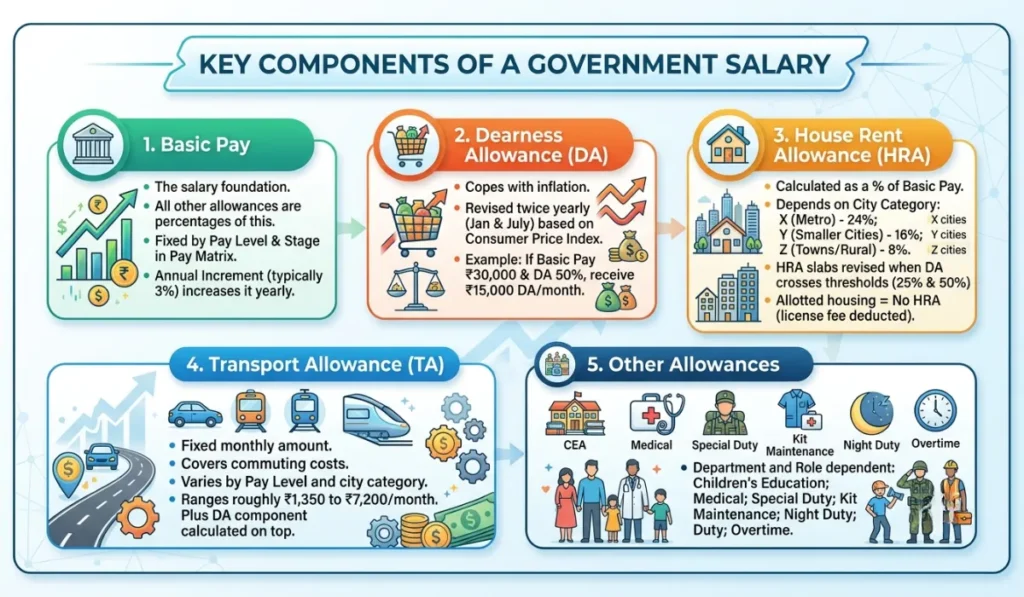
1. Basic Pay
This is the foundation of your salary. Every other allowance is calculated as a percentage of your Basic Pay. It is fixed by your Pay Level and Stage in the Pay Matrix, and it increases slightly each year through an Annual Increment (typically 3% of Basic Pay).
2. Dearness Allowance (DA)
DA is meant to help government employees and pensioners cope with inflation. It is revised twice a year — in January and July — based on changes in the Consumer Price Index. For example, if your Basic Pay is ₹30,000 and DA stands at 50%, you would receive ₹15,000 as DA every month. When DA crosses certain thresholds, a portion is often merged into Basic Pay, and this also triggers a revision in HRA slabs.
3. House Rent Allowance (HRA)
HRA helps employees manage housing costs and is calculated as a percentage of Basic Pay, depending on the city of posting.
| City Category | Examples | HRA (% of Basic Pay) |
| X (Metro Cities) | Delhi, Mumbai, Kolkata, Chennai, Bengaluru, Hyderabad | 24% |
| Y (Smaller Cities) | Lucknow, Jaipur, Patna, Bhopal | 16% |
| Z (Towns/Rural Areas) | Smaller towns and rural postings | 8% |
Note: HRA slabs are revised upward once DA crosses specific thresholds (typically 25% and 50%), so always confirm current rates with your department.
If you’re allotted government housing, you won’t receive HRA — instead, a small license fee is deducted from your salary.
4. Transport Allowance (TA)
This is a fixed monthly amount meant to cover commuting costs. It varies by Pay Level and city category, generally ranging between ₹1,350 and ₹7,200 per month, along with a DA component calculated on top of it.
5. Other Allowances
Depending on your department and role, you may also be eligible for:
- Children’s Education Allowance
- Medical Allowance or reimbursement
- Special Duty Allowance (for specific regions)
- Kit Maintenance Allowance (for defence, police, and paramilitary posts)
- Night Duty Allowance
- Overtime Allowance
Gross Salary vs. In-Hand Salary
A common mistake candidates make is assuming their Gross Salary is the same as what they’ll actually receive. It isn’t.
Gross Salary = Basic Pay + All Allowances
From this Gross Salary, certain mandatory deductions are subtracted to arrive at your Net In-Hand Salary — the amount that actually gets credited to your account.
| Deduction | Applicable To | Approximate Amount |
| National Pension System (NPS) | Employees who joined after 1 January 2004 | 10% of (Basic Pay + DA) |
| Central Government Health Scheme (CGHS) | All eligible central government employees | ₹250 – ₹650 per month |
| Group Insurance (CGEGIS) | All central government employees | ₹30 – ₹120 per month |
| Income Tax (TDS) | If salary exceeds the tax exemption limit | Varies by income slab |
The government also contributes an additional 14% of (Basic Pay + DA) toward NPS on the employer’s side — this doesn’t reduce your salary but adds to your retirement corpus.
A Practical Example: Calculating an SSC CGL Salary
Let’s walk through a real-world example. Suppose a candidate has qualified for SSC CGL and is appointed as an Assistant Section Officer in a Central Government Ministry in Delhi (an X-category city), placed at Pay Level 6.
| Component | Calculation | Amount |
| Basic Pay | Level 6, Stage 1 | ₹35,400 |
| Dearness Allowance (DA) | 50% of Basic Pay (illustrative rate) | ₹17,700 |
| House Rent Allowance (HRA) | 24% of Basic Pay (X-category city) | ₹8,496 |
| Transport Allowance (TA + DA on TA) | Fixed + DA component | ₹10,800 |
| Gross Salary | ₹72,396 | |
| NPS Deduction | 10% of (Basic + DA) | −₹5,310 |
| CGHS Deduction | Standard slab | −₹350 |
| Group Insurance | Standard slab | −₹120 |
| Net In-Hand Salary | ≈ ₹66,600 |
Note: DA, HRA, and other figures are illustrative and based on commonly cited rates. Actual amounts depend on the DA percentage applicable at the time, your department’s rules, and any deductions specific to your service.
What About Pension?
Pension rules in India depend on when you joined government service:
- Old Pension Scheme (OPS): Available to employees who joined before 1 January 2004. It offers a guaranteed pension equal to 50% of the last drawn salary — widely considered one of the biggest advantages of a government job.
- New Pension Scheme / NPS: Applicable to employees who joined after 2004. Here, your pension depends on your contributions and market performance rather than being a fixed amount.
Some states have reintroduced the Old Pension Scheme for their employees, and the OPS-vs-NPS debate remains an active political and policy discussion in India.
Salary Increments and Promotions
Every year, on 1 January or 1 July, employees receive an Annual Increment equal to 3% of their Basic Pay, moving them one stage up in the Pay Matrix.
Promotions, on the other hand, move you up an entire Pay Level (and therefore a higher Basic Pay). Promotions are typically earned through departmental exams, seniority, or a combination of both, following service rules specific to each department.
State Government Salaries vs. Central Government Salaries
State governments set their own pay rules, broadly modeled on the Central Pay Commission framework but not identical to it.
- States like Maharashtra, Kerala, Tamil Nadu, and Karnataka generally offer pay close to central government levels.
- Smaller states or those facing financial constraints may delay DA revisions or offer comparatively lower allowances.
In general, central government jobs tend to offer more consistent salary revisions, clearer transfer policies, and well-defined promotion timelines — which is why many candidates prefer them over state government roles, even when the Pay Level is similar.
The 8th Pay Commission: What to Expect
The 8th Pay Commission has been announced and is expected to bring revised pay scales for central government employees. As with previous Pay Commissions, the fitment factor — the multiplier applied to existing Basic Pay to determine the new Basic Pay — is expected to be higher than the 7th Pay Commission’s factor of 2.57.
A higher fitment factor would mean a meaningful jump in Basic Pay across all levels once the commission’s recommendations are implemented. However, exact figures, including the final fitment factor and implementation date, are subject to official government notification — candidates should rely on updates from the Ministry of Finance or DoPT rather than unofficial estimates.
Why Government Job Salaries Are Considered Attractive
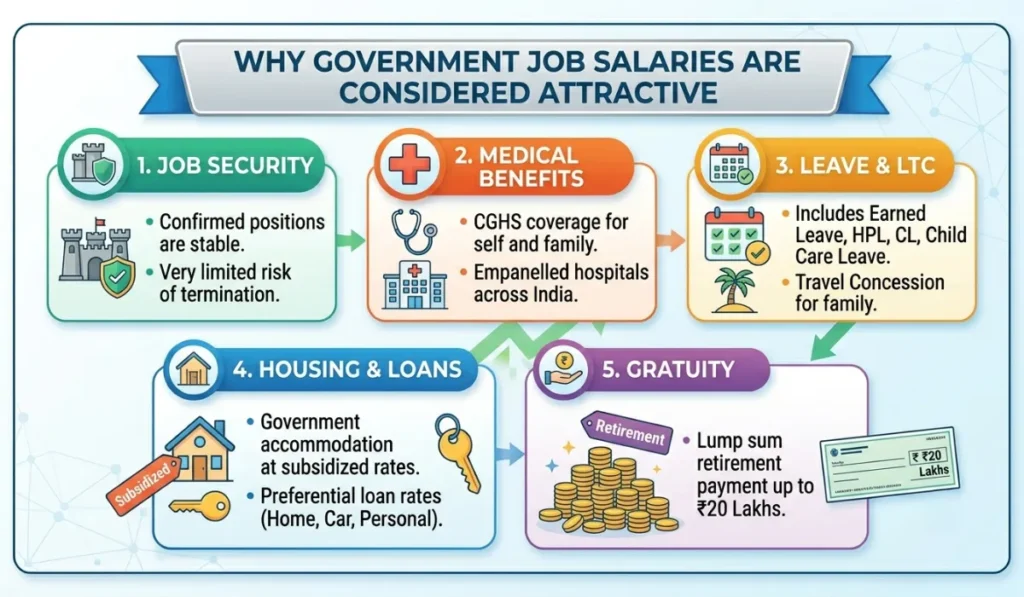
A government salary is about much more than the number credited to your account each month. The complete package typically includes:
- Job Security – Once confirmed, government positions are notoriously stable, with very limited risk of termination.
- Medical Benefits – CGHS coverage extends to you and your family, with access to empanelled hospitals across India.
- Leave Benefits – Includes Earned Leave, Half Pay Leave, Casual Leave, Child Care Leave, and more.
- Housing – Many departments offer government accommodation at subsidized rates.
- Loan Facilities – Easier access to home, vehicle, and personal loans, often at preferential interest rates.
- Gratuity – A lump sum payment on retirement, which can go up to ₹20 lakhs.
- Leave Travel Concession (LTC) – Financial support for travel to your hometown or other destinations in India.
When you factor in all these benefits, a government job’s true value extends well beyond the monthly take-home figure.
Tips for Candidates Preparing for Government Jobs
- Always check the Pay Level and Pay Scale mentioned in the official notification before applying.
- Don’t confuse Basic Pay with your final take-home salary — they’re very different numbers.
- Refer to the official Pay Matrix table on the DoPT website or the 7th Pay Commission report to confirm your exact starting pay.
- Remember that your posting city significantly affects your HRA and Transport Allowance.
- Use official or verified 7th Pay Commission salary calculators to estimate your in-hand salary before making a career decision.
| Join Yuva Safar WhatsApp Group for Latest Job Updates | Click Here |
| Join Our Telegram Channel for Daily Government & Private Job Alerts | Click Here |
Conclusion
Understanding a government job salary in India doesn’t have to be complicated. Once you’re familiar with the Pay Matrix, the major allowances (DA, HRA, TA), and the standard deductions (NPS, CGHS, Group Insurance), you can confidently estimate your real take-home pay for almost any government post.
Government jobs continue to be a preferred career path in India — not just for the income, but for the stability, respect, and long-term benefits that come with them. If you’re preparing for UPSC, SSC, IBPS, Railways, or any state-level exam, understanding how your salary will actually work can help you stay motivated and make a more informed career decision.
Frequently Asked Questions (FAQ)
Q1. What is the minimum salary in a Central Government job in India? The minimum Basic Pay for the lowest post (Level 1, MTS) is ₹18,000 per month. With DA, HRA, and other allowances added, the gross salary typically comes to around ₹30,000–₹35,000 per month, depending on the city of posting.
Q2. What is the difference between Basic Pay and Gross Salary? Basic Pay is the fixed base amount defined in the Pay Matrix. Gross Salary is Basic Pay plus all applicable allowances such as DA, HRA, and TA.
Q3. What is DA, and how often is it revised? DA stands for Dearness Allowance. It is revised twice a year — in January and July — by the Central Government to help offset the impact of inflation.
Q4. Is pension available for all government employees? Employees who joined before 1 January 2004 are covered under the Old Pension Scheme (a guaranteed pension). Those who joined after that date fall under the New Pension Scheme (NPS), which is market-linked.
Q5. Do state government employees get the same salary as central government employees? Not always. State governments follow their own Pay Commissions, and while the structure is similar, DA revisions and other benefits can vary from state to state.
Q6. What is HRA, and who decides how much I get? HRA stands for House Rent Allowance. It is calculated as 24%, 16%, or 8% of Basic Pay, depending on whether your posting city falls under the X, Y, or Z category.
Q7. What is the 8th Pay Commission? It is the upcoming pay revision body for central government employees, expected to bring fresh salary revisions. Candidates should follow official government notifications for exact implementation details and figures.
Q8. How much is deducted from a government salary every month? The main deductions typically include NPS (10% of Basic + DA), CGHS (₹250–₹650), Group Insurance (₹30–₹120), and Income Tax, if applicable.
Q9. Can I check the exact Pay Matrix online? Yes. The Pay Matrix table is available on the official website of the Department of Personnel and Training (DoPT) and in the published 7th Pay Commission report.
Q10. Is in-hand salary the same as gross salary? No. In-hand salary is your Gross Salary minus all deductions — it’s the actual amount credited to your bank account every month.