
Finishing college is a major milestone. There’s real joy in holding that degree in your hand — but soon after, a bigger question takes over: what next? In a country where millions of students graduate every year, choosing the right career path can feel overwhelming. Add well-meaning advice from family and friends into the mix, and the confusion only grows.
The good news? India’s job market has never offered more variety. Whether you studied commerce, science, arts, or engineering, there’s a career path suited to your strengths and interests. This guide walks you through the best career options after graduation in India, covering both traditional choices and emerging fields, so you can make a decision that’s right for your future.
Quick Overview: Career Options at a Glance
| Career Path | Best Suited For | Average Starting Salary (₹/year) | Key Requirement |
| Government Jobs | All graduates | 3–8 LPA | Competitive exams (UPSC, SSC, IBPS) |
| MBA & Higher Education | Commerce, Science, Engineering | Varies (post-MBA: 6–25 LPA) | CAT, GATE, or relevant entrance exams |
| IT & Software | Engineering, BCA, B.Sc. (CS) | 3.5–8 LPA | Technical/programming skills |
| Banking & Finance (BFSI) | Commerce, Finance | 3–7 LPA | IBPS, SBI PO, CA, CFA |
| Entrepreneurship | Self-starters, innovators | Variable | Idea, funding, persistence |
| Digital Marketing | Any stream | 2.5–6 LPA | SEO, content, and ad certifications |
| Law | Any stream (with LLB) | 4–15 LPA | 3-year or 5-year LLB |
| Teaching & EdTech | Education-focused graduates | 2.5–6 LPA | B.Ed, CTET, UGC NET |
| Healthcare | Science (Biology, Nursing, Pharmacy) | 3–6 LPA | Relevant degree + licensing |
| Defence Services | Physically fit, disciplined candidates | 5.5–10 LPA + benefits | NDA, CDS, AFCAT, SSB |
Let’s look at each of these in detail.
1. Government Jobs (Sarkari Naukri)
For millions of Indian graduates, a government job remains the gold standard of career stability. Beyond job security, it offers a pension, social respect, and a range of benefits that few private-sector roles can match.
Some of the most popular government exams include:
- UPSC Civil Services Examination – leads to prestigious roles like IAS, IPS, and IFS officers
- State Public Service Commission exams – for state-level administrative positions
- IBPS and SBI exams – for jobs in public sector banks
- SSC CGL and SSC CHSL – for central government departments like the Income Tax Department and CBI
- RRB Railway Recruitment Exam – offering thousands of vacancies every year
Preparing for these exams typically takes one to three years, and competition is intense. Coaching hubs in cities like Delhi, Patna, Jaipur, and Hyderabad have built entire ecosystems around exam preparation. While the path demands patience and discipline, a government job continues to offer one of the most secure long-term careers available in India.
2. MBA and Higher Education
Many graduates choose to continue their education rather than jump straight into the workforce — and an MBA (Master of Business Administration) is among the most popular routes, especially for those from commerce, science, or engineering backgrounds who aspire to management roles.
Top MBA Institutes in India:
| Institute | Location | Entrance Exam |
| IIM Ahmedabad, Bangalore, Calcutta | Multiple cities | CAT |
| XLRI Jamshedpur | Jharkhand | XAT |
| FMS Delhi | Delhi | CAT |
| MDI Gurgaon | Haryana | CAT |
| NMIMS Mumbai | Maharashtra | NMAT |
For those inclined toward science and technology, an M.Sc. or M.Tech can open doors to research, academia, or specialized industry roles. Admission to top engineering institutes like the IITs and NITs requires clearing GATE (Graduate Aptitude Test in Engineering).
Graduates interested in subjects like economics, history, or sociology can pursue an MA, which can lead to careers in teaching, journalism, policy-making, or government service.
Higher education does more than add a qualification to your resume — it deepens your expertise and gives you time to explore your interests, ultimately improving your long-term career prospects.
3. Information Technology and Software Industry
India is the world’s largest exporter of IT services, and the software industry remains one of the biggest employers of fresh graduates — particularly those from engineering and computer science backgrounds. Companies like TCS, Infosys, Wipro, HCL, and Cognizant continue to hire extensively through campus placements.
The good news for non-tech graduates: IT careers are no longer limited to B.Tech holders. With the right certifications in programming, data science, cloud computing, cybersecurity, or UI/UX design — available on platforms like Coursera, Udemy, and NPTEL — graduates from any background can break into tech roles.
In-Demand IT Skills for 2025:
| Skill Area | Examples |
| Programming Languages | Python, Java |
| Data & AI | Data Analytics, Machine Learning |
| Web & Mobile Development | Full-stack development, app development |
| Cloud & DevOps | AWS, Microsoft Azure |
Entry-level salaries in IT typically range from ₹3.5 lakh to ₹8 lakh per year, with strong growth potential as skills and experience increase. Beyond the IT giants, product-based companies and startups like Google, Microsoft, Amazon, and Zomato also actively recruit fresh graduates.
4. Banking, Finance, and Insurance (BFSI)
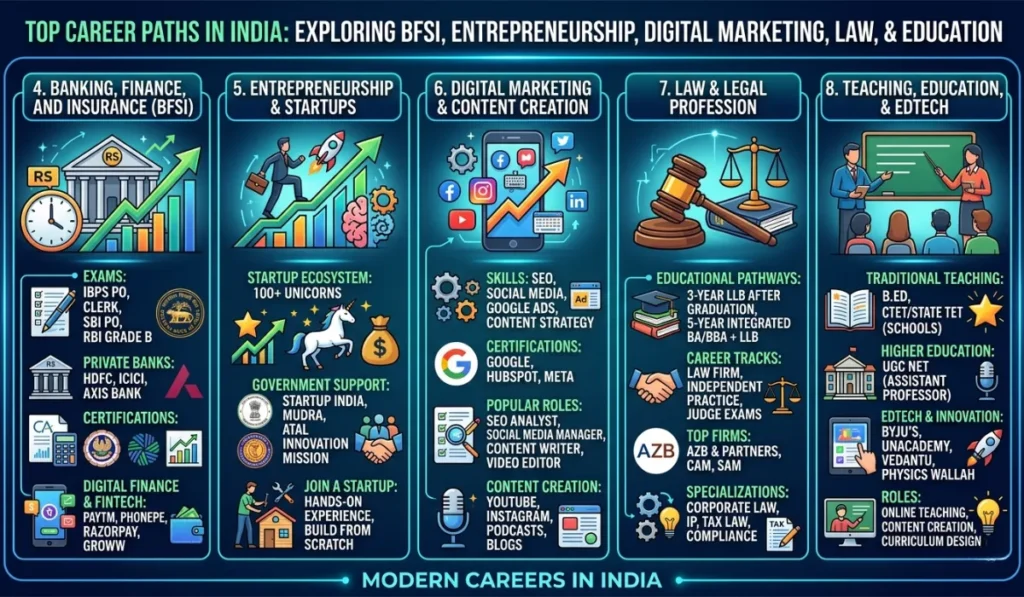
The BFSI sector is one of India’s largest employers, offering multiple entry points for graduates. Clearing exams like IBPS PO, IBPS Clerk, SBI PO, or RBI Grade B can land you a stable banking career. Private banks such as HDFC, ICICI, and Axis Bank also hire graduates directly through campus placements and off-campus interviews.
For those drawn to financial markets, professional certifications offer specialized career tracks:
- Chartered Accountant (CA) – a highly respected qualification requiring candidates to clear three rigorous exams conducted by ICAI
- Chartered Financial Analyst (CFA) – a globally recognized certification ideal for careers in investment banking and wealth management
Insurance companies and Non-Banking Financial Companies (NBFCs) also offer numerous roles in sales, operations, underwriting, and customer service. With fintech companies like Paytm, PhonePe, Razorpay, and Groww reshaping the financial landscape, the BFSI sector now offers exciting opportunities in digital finance as well.
5. Entrepreneurship and Startups
India’s startup ecosystem has grown dramatically over the past decade. With over 100 unicorns and thousands of funded startups, India now ranks among the largest startup ecosystems in the world — making this an exciting time for graduates with entrepreneurial ambitions.
Starting a business doesn’t always require significant capital. Many successful Indian startups began as passion projects backed by hard work and persistence. Government initiatives like Startup India, MUDRA loans, and the Atal Innovation Mission provide funding and mentorship support for aspiring entrepreneurs.
Alternatively, joining an early-stage startup as an employee offers hands-on experience in building something from scratch — a kind of learning no classroom or MBA program can fully replicate. While the risks are higher, so are the potential rewards, making this path well-suited to graduates who are adaptable and eager to learn quickly.
6. Digital Marketing and Content Creation
Digital marketing is one of the fastest-growing career fields in India, driven by businesses of all sizes shifting online. Companies are actively seeking professionals skilled in SEO, social media marketing, Google Ads, email campaigns, and content strategy.
The best part? Any graduate can enter this field with the right certifications and a strong portfolio. Affordable, industry-recognized certifications from Google, HubSpot, and Meta can help you build credibility quickly.
Popular Digital Marketing Roles:
- SEO Analyst
- Social Media Manager
- Content Writer
- Video Editor
- Performance Marketer
These roles are available across agencies, startups, and large corporations. Content creation — through YouTube, Instagram, podcasts, or blogs — has also emerged as a legitimate career path. Creators like Bhuvan Bam, Nikhil Kamath, and Ranveer Allahbadia have proven that consistent, creative content can build a thriving business. It isn’t an easy path, but for those who are creative and disciplined, it’s a genuinely viable career option.
7. Law and Legal Profession
Graduates from non-law backgrounds can still build a career in law by pursuing a three-year LLB after their bachelor’s degree. Alternatively, students can opt for a five-year integrated course combining a BA or BBA with an LLB.
Legal professionals in India have diverse career paths available, including:
- Working at a law firm or practicing independently
- Becoming a judge through competitive judicial exams
- Working as in-house legal counsel for corporations
- Pursuing further studies, such as an LLM or international bar exams
Top law firms like AZB & Partners, Cyril Amarchand Mangaldas, and Shardul Amarchand Mangaldas recruit heavily from premier law schools and offer competitive compensation. As India’s economy continues to grow, demand for specialized legal professionals — corporate lawyers, IP attorneys, tax lawyers, and compliance experts — keeps rising steadily.
8. Teaching, Education, and EdTech
Teaching remains a respected and stable career choice in India. After graduation, a B.Ed (Bachelor of Education) qualifies you to teach in schools. Clearing the CTET (Central Teacher Eligibility Test) or state-level TET exams opens doors to government school teaching positions, which come with strong job security and government benefits.
For those aspiring to teach at the college level, clearing the UGC NET opens up Assistant Professor roles at universities and colleges. Beyond personal fulfillment, teaching offers a healthy work-life balance and long-term job security.
The rise of EdTech has also created new opportunities. Companies like BYJU’S, Unacademy, Vedantu, and Physics Wallah now offer roles in online teaching, content creation, and curriculum design — generating thousands of new jobs for education professionals beyond the traditional classroom.
9. Healthcare and Paramedical Fields
Graduates with a science background — B.Sc. in Biology, Nursing, Pharmacy, or Physiotherapy — have access to a rapidly expanding healthcare sector. Rising incomes, an aging population, and increased government spending on healthcare infrastructure are fueling this growth.
Career options in healthcare include:
| Specialization | Career Path |
| Hospital Administration | Healthcare/hospital management roles |
| Medical Research | Clinical research, lab work |
| Medical Coding | Healthcare documentation and billing |
| Pharmaceuticals | Medical sales, pharmacy roles |
| Public Health | Disease control, health policy |
Graduates who pair a science degree with an MBA in Healthcare Management are well-positioned for leadership roles in hospitals and healthcare companies. Public health has also gained renewed importance post-COVID-19, with growing demand for professionals who understand disease prevention, community health, and health policy.
10. Defence Services
For graduates who are physically fit, patriotic, and possess strong leadership qualities, a career in the Indian Armed Forces offers a unique and respected path. Depending on your age and eligibility, you can apply through:
- National Defence Academy (NDA) – for younger candidates
- Combined Defence Services (CDS) Exam
- Air Force Common Admission Test (AFCAT)
- Services Selection Board (SSB) – for the Army, Navy, and Air Force
A career in the defence forces is more than just employment — it’s a disciplined way of life that offers camaraderie, adventure, and the honor of serving the nation. It also comes with a competitive pay scale, housing, medical benefits, and strong post-retirement opportunities, making it a fulfilling choice for the right candidate.
How to Choose the Right Career Path
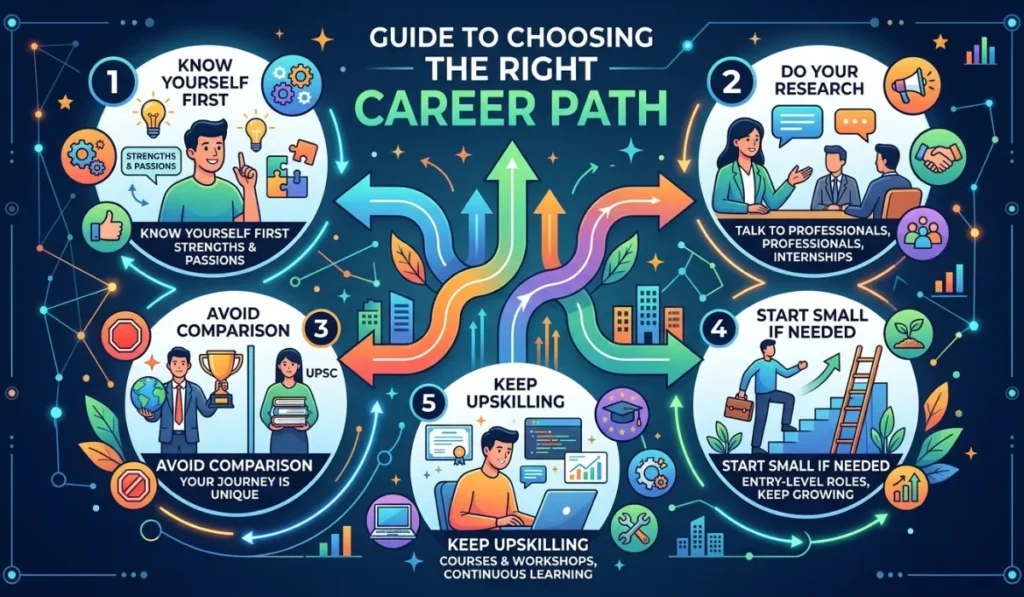
With so many options available, making the right choice comes down to aligning your passion, strengths, and market demand. Here are a few practical tips:
- Know yourself first. Identify what you genuinely enjoy and where your strengths lie — long-term career satisfaction starts here.
- Do your research. Talk to professionals already working in fields you’re considering, and try internships or part-time roles while still in college.
- Avoid comparison. Just because a friend is preparing for UPSC or pursuing a master’s abroad doesn’t mean that path is right for you.
- Start small if needed. Most successful professionals began with entry-level roles. Don’t wait for the “perfect” job — start working and keep growing.
- Keep upskilling. In India’s competitive job market, professionals who continuously update their skills through courses and workshops tend to advance faster.
| Join Yuva Safar WhatsApp Group for Latest Job Updates | Click Here |
| Join Our Telegram Channel for Daily Government & Private Job Alerts | Click Here |
Frequently Asked Questions (FAQs)
Q1: What is the best job to pursue after graduation in India? There’s no single “best” job — it depends on your field of study, interests, and career goals. Government jobs offer stability, IT roles offer strong pay, and entrepreneurship offers independence. Choose what aligns with your strengths and aspirations.
Q2: Can arts graduates find good jobs in India? Yes, absolutely. Arts graduates have strong opportunities in government services, law, teaching, content writing, marketing, human resources, and more. Many of these fields are currently in high demand.
Q3: Is an MBA necessary after graduation? No, it’s not mandatory. An MBA is useful if you want to move into management roles or switch industries, but many professionals build successful careers without one.
Q4: What are the highest-paying jobs in India after graduation? Software engineering, investment banking, data science, government services (like IAS or IPS), chartered accountancy, and management consulting are generally among the highest-paying career paths.
Q5: What should I do if I’m unsure which career to choose? Explore internships, online courses, and conversations with professionals in different fields. It’s completely normal not to have everything figured out right after graduation — most career paths evolve over time.
Q6: Is digital marketing a good career choice after graduation? Yes. Digital marketing is one of India’s fastest-growing fields, and with the right certifications and portfolio, graduates from any background can start a well-paying career.
Q7: How long does it typically take to get a government job after graduation? It varies by exam and individual preparation. Some candidates secure government jobs within one to two years, while others may take three to four years. Starting early and staying consistent significantly improves your chances.
Q8: Can I study abroad after completing graduation in India? Yes, many Indian students pursue master’s degrees in the USA, UK, Canada, Australia, or Germany. Depending on the country and course, you’ll typically need to clear exams like GRE, GMAT, IELTS, or TOEFL.
Final Thoughts
India stands at a pivotal point in its economic growth story, on track to becoming one of the world’s largest economies — a shift that will continue to create new opportunities for skilled, motivated graduates. Whether your goal is to serve the nation as an IAS officer, build a successful startup, inspire students as an educator, or write code used by millions, the opportunity is there for you to seize.
What matters most is taking that first step. Build a plan, understand the effort it requires, stay consistent, and be willing to adapt when something isn’t working. Graduation isn’t the end of your journey — it’s the beginning of the most important chapter of your life. Choose a path that excites you, work hard, and the rest will follow.