Preparing for a competitive exam while holding down a full-time job is one of the hardest things a working professional in India can take on. Between office hours, the daily commute, family responsibilities, and the basic need for sleep, finding time to study can feel almost impossible.
And yet, every single year, thousands of working professionals across India clear exams like UPSC, SSC, IBPS, and GATE while still showing up to their 9-to-5 jobs. What sets them apart usually isn’t raw talent. It’s a realistic time table that they actually stick to.
Most aspirants don’t fail because they lack intelligence. They fail because they never built a routine that fit their actual life. This guide walks you through exactly how to build that routine, with a practical hour-by-hour breakdown you can start using from tomorrow morning.
Why a Fixed Time Table Matters More Than You Think
Without a structured plan, study sessions become unpredictable. You might put in four hours on a Tuesday and then skip the next three days entirely. For exams that demand consistent revision and conceptual clarity, this on-and-off pattern simply doesn’t work.
A solid time table does three things for you:
- It removes the daily mental burden of deciding what to study and when.
- It builds accountability, so you can’t quietly skip studying without noticing it.
- It trains your brain to expect study sessions at fixed times, which makes starting easier over time.
Nearly every successful IAS officer, bank PO, or GATE topper who prepared while working will tell you the same thing: they had a plan, and they followed it even on days they didn’t feel like it.
Step One: Get Honest About How Much Time You Actually Have
Before building any schedule, you need a realistic picture of your day. Here’s what a typical work routine looks like for most professionals in Indian metros:
| Activity | Typical Time Spent |
| Morning routine | 6:00 AM – 7:00 AM |
| Office hours (incl. commute) | 9:00 AM – 7:00 PM (varies by city) |
| Commute (Delhi, Mumbai, Bengaluru, Hyderabad) | 30 minutes – 2 hours each way |
| Dinner and winding down | 8:30 PM – 9:30 PM |
| Free time available for study (weekdays) | Roughly 2–3 hours |
| Free time available for study (weekends) | Roughly 5–6 hours per day |
If you can consistently manage 2 hours on weekdays and 5–6 hours each day on weekends, you’re looking at around 20–22 hours of focused study per week. Over a few months, that adds up to genuine, exam-ready preparation.
The goal isn’t to “find” more time in your day. It’s to use the hours you already have with more intention.
The Golden Rule: Consistency Beats Intensity
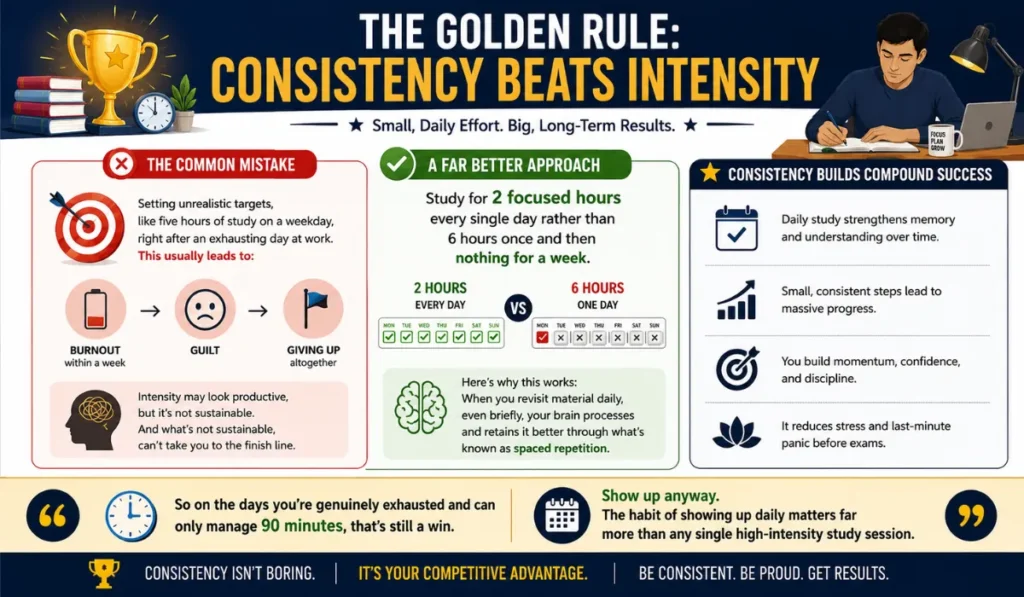
One of the most common mistakes working professionals make is setting unrealistic targets, like five hours of study on a weekday, right after an exhausting day at work. This usually leads to burnout within a week, followed by guilt, followed by giving up altogether.
A far better approach: study for two focused hours every single day rather than six hours once and then nothing for a week. Here’s why this works. When you revisit material daily, even briefly, your brain processes and retains it better through what’s known as spaced repetition.
So on the days you’re genuinely exhausted and can only manage 90 minutes, that’s still a win. Show up anyway. The habit of showing up daily matters far more than any single high-intensity study session.
Sample Weekday Time Table for Working Professionals
This is a realistic breakdown for someone working a standard 9-to-6 or 9-to-7 office job in India.
| Time Slot | Activity |
| 5:30 AM – 7:00 AM | Morning study block — tackle difficult subjects like Maths or Reasoning when your mind is freshest |
| 7:00 AM – 9:00 AM | Get ready and commute — use this time for audio lectures or quick revision on your phone |
| 9:00 AM – 6:30 PM | Office hours — stay focused on work; avoid mixing study stress into your job |
| 6:30 PM – 8:00 PM | Travel home and light revision of morning topics |
| 8:00 PM – 9:00 PM | Dinner and family time |
| 9:00 PM – 10:30 PM | Evening study block — practice and reinforce what you covered earlier; avoid starting new topics if you’re tired |
| 10:30 PM – 11:00 PM | Wind down — skim the newspaper or revise notes lightly |
| 11:00 PM – 5:30 AM | Sleep — non-negotiable for memory retention |
During office hours, resist the urge to think about your preparation. Giving your job your full attention during the day actually makes your evening study sessions more effective, since you’re not mentally split between two things at once.
Sample Weekend Time Table
Weekends are where working professionals make up real ground. With 10–12 hours of potential study time across Saturday and Sunday, planning these two days well can significantly accelerate your preparation.
Saturday
| Time Slot | Focus |
| 6:00 AM – 9:00 AM | Deep study on your weakest subject (3 hours) |
| 9:00 AM – 10:00 AM | Breakfast, light exercise, short break |
| 10:00 AM – 1:00 PM | New topic or syllabus coverage (3 hours) |
| 1:00 PM – 3:00 PM | Lunch and rest (a short nap helps) |
| 3:00 PM – 5:00 PM | Mock test or practice paper |
| 5:00 PM – 7:00 PM | Review test results and identify weak areas |
| 7:00 PM onwards | Family time, dinner, light reading |
Sunday
| Time Slot | Focus |
| 6:00 AM – 9:00 AM | Cover the subject you skipped on Saturday |
| 9:00 AM – 11:00 AM | Weekly revision across all topics covered |
| 11:00 AM – 1:00 PM | Current affairs, general knowledge, or optional subject |
| 1:00 PM – 3:00 PM | Lunch |
| 3:00 PM – 5:00 PM | Light revision — notes, vocabulary, formulas |
| Evening | Rest and recharge before the new week begins |
How to Divide Your Time Across Subjects
Not every subject deserves equal attention. Your study hours should reflect both the exam pattern and your personal strengths and weaknesses.
| Exam | Where to Focus Your Time |
| Bank PO (SBI PO, IBPS PO) | Start with Quantitative Aptitude and English; shift toward Reasoning and General Awareness closer to the exam |
| UPSC Civil Services | Prioritize General Studies Paper I and II; dedicate 30–45 minutes daily to current affairs |
| SSC CGL | Allocate roughly 60% of study time to Mathematics and English |
| GATE | Build strong fundamentals in core engineering subjects; solve previous years’ papers weekly |
| All exams | Set aside at least one weekly slot for your weakest subject, even if you’d rather avoid it |
Practical Techniques That Make a Real Difference
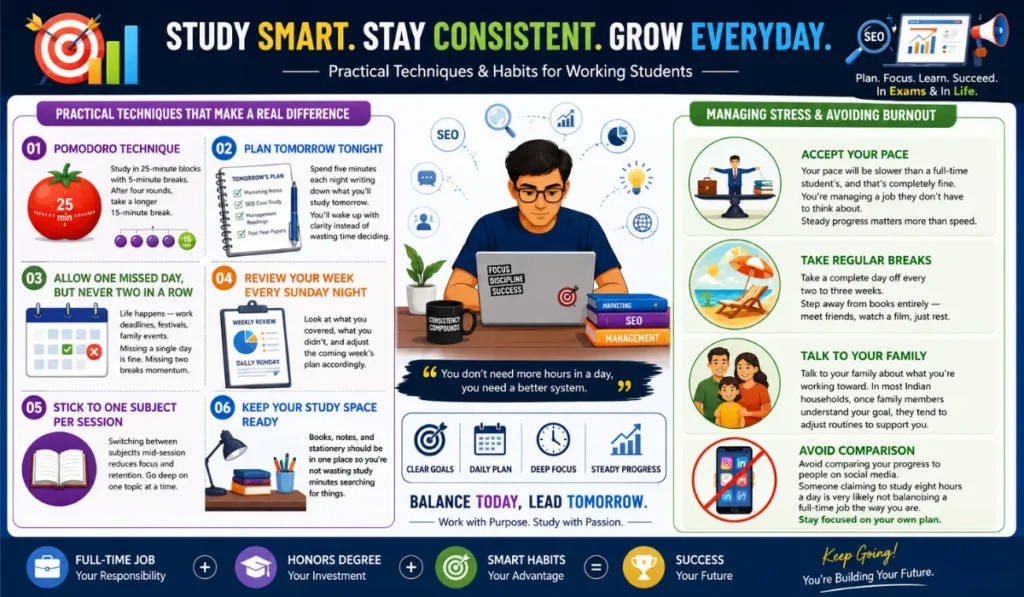
A few small habits can meaningfully improve how much you retain and how consistent you stay:
- Use the Pomodoro Technique. Study in 25-minute blocks with 5-minute breaks. After four rounds, take a longer 15-minute break. This works especially well during tired evening sessions.
- Plan tomorrow tonight. Spend five minutes each night writing down what you’ll study the next morning. You’ll wake up with clarity instead of wasting time deciding.
- Allow one missed day, but never two in a row. Life happens — work deadlines, festivals, family events. Missing a single day is fine. Missing two breaks momentum.
- Review your week every Sunday night. Look at what you covered, what you didn’t, and adjust the coming week’s plan accordingly.
- Stick to one subject per session. Switching between subjects mid-session reduces focus and retention. Go deep on one topic at a time.
- Keep your study space ready. Books, notes, and stationery should be in one place so you’re not wasting study minutes searching for things.
Managing Stress and Avoiding Burnout
Preparing for exams while working full-time takes a toll on your mental health if you’re not careful. Here’s how to protect yourself through the process:
- Accept that your pace will be slower than a full-time student’s, and that’s completely fine. You’re managing a job they don’t have to think about. Steady progress matters more than speed.
- Take a complete day off every two to three weeks. Step away from books entirely — meet friends, watch a film, just rest.
- Talk to your family about what you’re working toward. In most Indian households, once family members understand your goal, they tend to adjust routines to support you.
- Avoid comparing your progress to people on social media. Someone claiming to study eight hours a day is very likely not balancing a full-time job the way you are. Stay focused on your own plan.
Useful Tools and Apps for Working Professionals
Used well, technology can meaningfully speed up your preparation:
| Tool/Platform | Best Used For |
| Anki | Flashcards for vocabulary, dates, and formulas during short breaks |
| Notion or Google Keep | Organizing notes across devices |
| YouTube channels (Physics Wallah, Unacademy, etc.) | Free conceptual lectures |
| The Hindu app, Indian Express app | Daily current affairs reading during commute |
| Testbook, Byju’s Exam Prep, AffairsCloud | Mock tests and practice papers |
How Far in Advance Should You Start Preparing?
As a working professional, you generally need more lead time than a full-time student, simply because your daily study hours are limited.
| Exam | Recommended Preparation Time |
| UPSC Civil Services | 12–18 months before the prelims |
| Bank PO (SBI PO, IBPS PO) | 4–6 months |
| SSC CGL / CHSL | 3–6 months, depending on your base knowledge |
| GATE | 6–8 months of consistent preparation |
| MBA Entrance (CAT) | 8–10 months, with early months focused on concept-building |
| Join Yuva Safar WhatsApp Group for Latest Job Updates | Click Here |
| Join Our Telegram Channel for Daily Government & Private Job Alerts | Click Here |
Final Thoughts
There’s no single time table that works for every working professional. The best one is simply the one you’ll actually follow day after day. Use this guide as a starting framework, then adjust it to fit your real routine, your office hours, and your energy patterns.
Thousands of working professionals across India have cleared genuinely tough exams while holding full-time jobs — not because they were exceptionally gifted, but because they followed a simple, realistic plan without fail.
You already have the discipline to hold down a job. Now point that same discipline toward your exam goals. Set your alarm for tomorrow morning, and start.
Frequently Asked Questions
Q1. How many hours should a working professional study per day for competitive exams? Two to three hours on weekdays is generally sufficient if the time is used well. Quality matters more than quantity. Weekends can be used for longer sessions of 5–6 hours.
Q2. Is it possible to clear UPSC while working a full-time job? Yes. Many IAS officers have cleared UPSC while employed full-time. It requires a realistic preparation timeline and strict daily discipline rather than unlimited free time.
Q3. Is it better to study in the morning or at night? Mornings generally work better since the mind is fresher and there are fewer distractions. That said, if you’re naturally more alert at night, study then instead. Consistency matters more than the specific time you choose.
Q4. How do I avoid feeling sleepy while studying after work? A short 20-minute power nap after returning home, a glass of water before you begin, sitting upright, and studying in a well-lit room all help. Avoid studying while lying down, as it makes drowsiness worse.
Q5. Should I take leave from work before the exam? Taking 2–4 days of leave before the exam for final revision and mental preparation is generally a good idea. A full month off isn’t necessary if your preparation has been consistent throughout.
Q6. How important are mock tests in preparation? Extremely important. Aim for at least one full mock test every week. Mock tests help with time management, highlight weak areas, and build the confidence needed for the actual exam.
Q7. Can I prepare for these exams without joining a coaching institute? Yes. Many candidates clear competitive exams through self-study using books, free YouTube lectures, and online test platforms. Coaching can help, but it isn’t mandatory.
Q8. What should I do if I miss a day of studying? Don’t panic. Simply make up for the missed topic over the weekend. The one rule to follow strictly: never miss two days of studying in a row.
Q9. How do I balance family responsibilities with exam preparation? Communicate your goals clearly with your family, fix specific study hours, and keep the rest of your time available for them. Clear boundaries tend to improve both your preparation and your relationships.
Q10. Which exam is best suited for working professionals in India? It depends on your background and career goals. Bank exams like IBPS PO and SBI PO are popular due to their relatively shorter preparation cycles. SSC CGL, State PSC exams, and GATE are also widely pursued by working professionals.