Let’s be honest — if you’re a young Indian trying to figure out your career, the government job space can feel overwhelming. Everyone around you seems to have an opinion. Your parents want you to “crack UPSC.” Your college friend is preparing for banking. Your neighbor’s son just got into Railways. And somewhere in the middle, someone mentions SSC.
So where do you even begin?
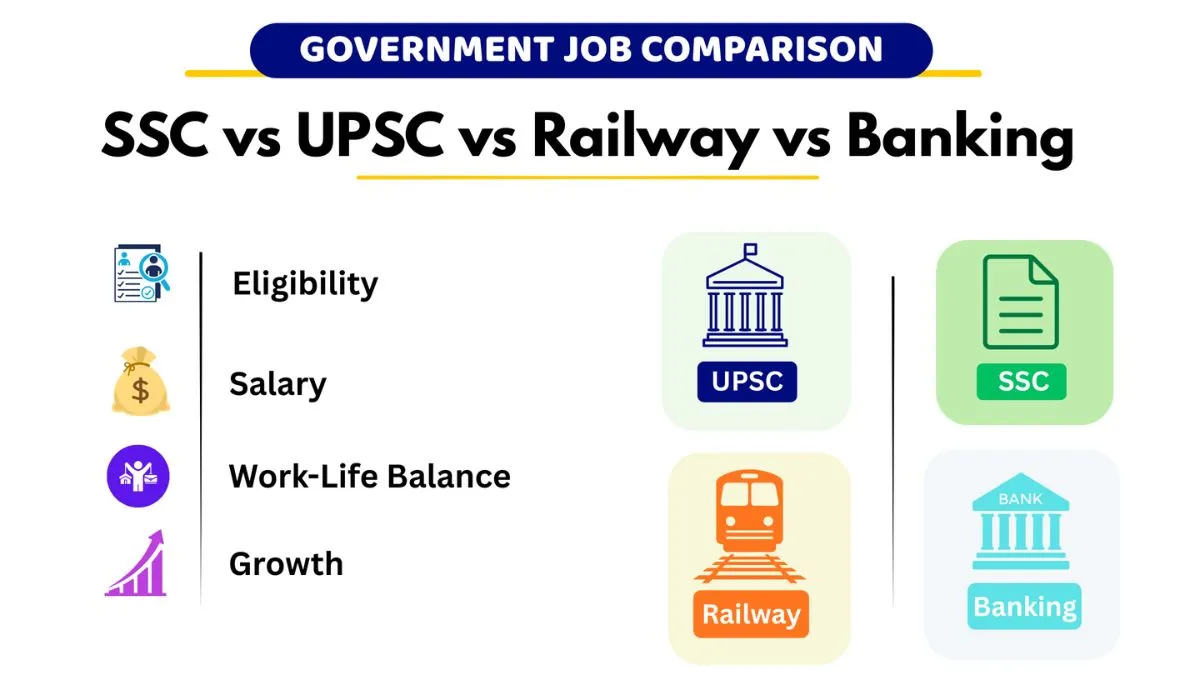
The truth is, SSC, UPSC, Railway, and Banking jobs are four very different career paths. They test different skills, offer different lifestyles, and suit different kinds of people. Before you pick up a book and start studying, it’s worth taking a step back and understanding what each of these actually means for your life — not just your resume.
That’s exactly what this article is here to do.
What Is SSC (Staff Selection Commission)?
Think of SSC as the backbone of central government staffing. The Staff Selection Commission operates under the Ministry of Personnel, Public Grievances and Pensions, and its job is simple — find the right people to fill roles across India’s central government departments and ministries.
If you’ve ever interacted with an Income Tax Inspector, an Assistant in a central government office, or a paramilitary constable, there’s a good chance that person came through SSC.
Key SSC Exams
- SSC CGL (Combined Graduate Level) – The most popular SSC exam, aimed at graduates. Covers Group B and Group C posts like Income Tax Inspector, Assistant Section Officer, and Auditor.
- SSC CHSL (Combined Higher Secondary Level) – For candidates who have completed 10+2. Covers posts like Lower Division Clerk (LDC) and Data Entry Operator.
- SSC MTS (Multi Tasking Staff) – Entry-level posts for 10th pass candidates.
- SSC GD Constable – For those interested in joining paramilitary forces like CRPF, BSF, or CISF.
- SSC CPO – For Sub-Inspector level posts in Delhi Police and Central Armed Police Forces (CAPF).
Who Should Apply for SSC?
SSC is a great fit if you want a stable, respectable central government job without the brutal competition of UPSC or the fast-paced pressure of banking. The work culture is generally calm, the hours are predictable, and the benefits — HRA, TA, DA — add up to a solid overall package.
It’s especially popular among candidates from smaller cities and towns who want a government job that doesn’t require relocating every two years or working odd hours.
SSC Salary Range
| Post Level | Approximate Basic Pay |
| Entry-Level (e.g., MTS, Group C) | ₹18,000/month |
| Mid-Level (e.g., SSC CGL posts) | ₹35,000–₹50,000/month |
| Senior/Top-Level Posts | Up to ₹1,42,400/month |
Once you add in allowances like HRA, TA, and DA, the actual in-hand salary becomes significantly more attractive than the basic pay suggests.
What Is UPSC (Union Public Service Commission)?

UPSC is the big one. If SSC is the backbone of central government staffing, UPSC is its brain — and its highest ambition.
The Union Public Service Commission selects candidates for the most powerful and prestigious administrative roles in the country — the Indian Administrative Service (IAS), Indian Police Service (IPS), Indian Foreign Service (IFS), Indian Revenue Service (IRS), and dozens of other Group A and Group B services.
When people talk about “cracking the civil services,” they’re talking about UPSC.
Key UPSC Exams
- Civil Services Examination (CSE) – The flagship exam that leads to IAS, IPS, IFS, IRS, and other top services
- CAPF Exam – For Assistant Commandant posts in Central Armed Police Forces
- NDA & CDS – Entry into the Indian Army, Navy, and Air Force through the defence services route
- Engineering Services Exam (ESE) – For technically qualified candidates seeking senior government engineering roles
Who Should Apply for UPSC?
UPSC is for people who want to do more than just hold a job — they want to shape how the country runs. If the idea of being a District Collector managing an entire district, or an IFS officer representing India abroad, genuinely excites you, then UPSC is worth every bit of the effort it demands.
But let’s be real — this is not a path you take casually. The Civil Services Examination is one of the hardest competitive exams in the world. It has three stages (Prelims, Mains, and Interview), and typically only 0.1% to 0.2% of applicants make it through. Most successful candidates spend two to four years preparing full-time.
If you have the drive, the discipline, and the patience — UPSC can be life-changing. If you’re looking for a shortcut, it isn’t the right fit.
UPSC Salary Range
| Position | Basic Pay | Approximate In-Hand (with Allowances) |
| IAS Officer (Entry Level – Pay Level 10) | ₹56,100/month | ₹1,00,000+/month |
| Senior IAS / Additional Secretary Level | Higher pay scales | Significantly more |
| Cabinet Secretary (Top of the ladder) | ₹2,50,000/month | Highest in the civil services |
What Are Railway Jobs (RRB – Railway Recruitment Board)?
Indian Railways isn’t just a mode of transport — it’s one of the largest employers on the planet. With millions of employees across hundreds of roles and railway zones, the Railway Recruitment Board (RRB) releases tens of thousands of vacancies every year.
If you’ve ever felt overwhelmed by limited government job opportunities, Railway recruitment cycles might change that feeling entirely.
Key Railway Exams
- RRB NTPC (Non-Technical Popular Categories) – Covers clerical, traffic, and accounts roles; one of the most applied-for exams in India
- RRB Group D – For roles like track maintainer, helper, porter, and gateman
- RRB JE (Junior Engineer) – For diploma or degree holders in engineering
- RRB ALP (Assistant Loco Pilot) – The gateway to becoming a locomotive driver
- RPF (Railway Protection Force) – For candidates interested in railway security roles
Who Should Apply for Railway Jobs?
Railway jobs are genuinely inclusive — whether you’ve passed 10th grade or hold an engineering degree, there’s likely a railway post for you. They’re especially popular in smaller towns and rural areas, where the combination of job security, free railway passes, and housing benefits makes them incredibly appealing.
If you want a government job, don’t want to go through years of intense preparation, and are comfortable with operational or technical work environments, Railways is a strong and sensible choice.
Railway Salary Range
| Post | Approximate Monthly Salary |
| Group D Staff | ₹18,000–₹22,000 |
| RRB NTPC (Junior Level) | ₹25,000–₹35,000 |
| Junior Engineer / Senior Technical Roles | ₹50,000–₹1,00,000+ |
| Senior Engineers and Officers | Up to ₹2,50,000 |
What Are Banking Jobs (IBPS, SBI, RBI)?
Banking jobs occupy a special place in India’s government job landscape. They’re professional, urban, well-paying, and come with one of the fastest promotion tracks in the entire public sector.
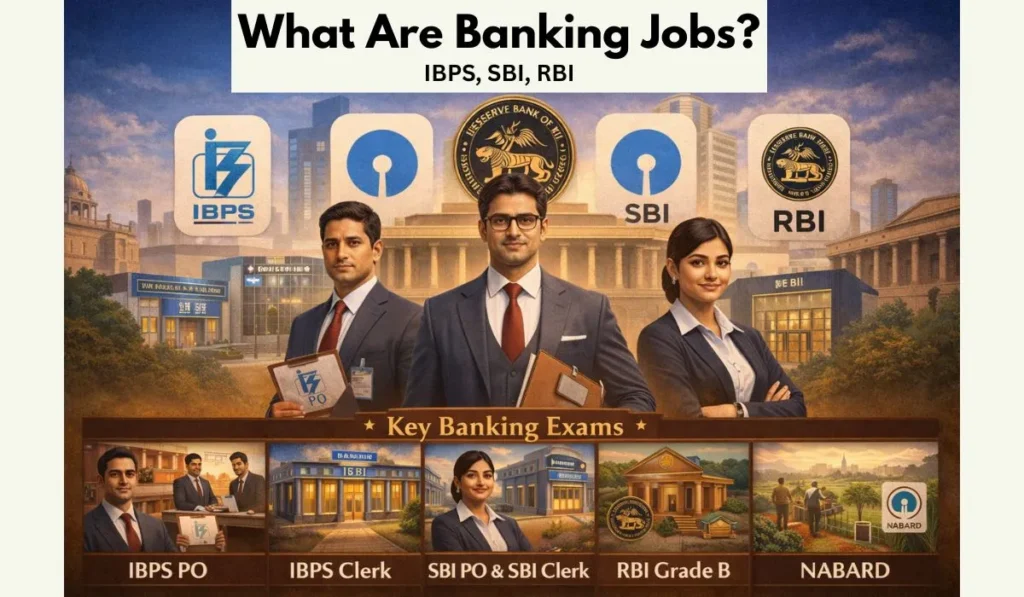
Recruitment into public sector banks happens primarily through three bodies — the Institute of Banking Personnel Selection (IBPS), the State Bank of India (SBI), and the Reserve Bank of India (RBI). For commerce graduates and general-stream students who want a white-collar career with real growth potential, banking is often the first choice.
Key Banking Exams
- IBPS PO – Probationary Officer posts across public sector banks
- IBPS Clerk – Clerical cadre positions in public sector banks
- SBI PO & SBI Clerk – The same roles, but specifically for India’s largest bank
- RBI Grade B – One of the most sought-after officer-level roles in Indian banking
- IBPS RRB – Officer and clerk positions in Regional Rural Banks
- NABARD – Roles focused on agriculture finance and rural development banking
Who Should Apply for Banking Jobs?
If you’re comfortable with numbers, enjoy working in a structured professional environment, and want a career where hard work is rewarded with visible growth, banking is tailor-made for you.
Here’s what makes it particularly attractive — the promotion ladder in banking is genuinely fast. A Clerk can become a Probationary Officer through internal exams in just three to five years. From there, you can rise to Branch Manager, Regional Manager, and beyond. In most other government sectors, that kind of growth takes decades.
Banking Salary Range
| Post | Approximate Monthly In-Hand Salary |
| IBPS Clerk | ₹23,000–₹30,000 |
| IBPS PO | ₹40,000–₹52,000 |
| SBI PO | ₹52,000–₹60,000 |
| RBI Grade B Officer | ₹80,000–₹1,00,000+ |
SSC vs UPSC vs Railway vs Banking: Side-by-Side Comparison
| Feature | SSC | UPSC | Railway | Banking |
| Full Form | Staff Selection Commission | Union Public Service Commission | Railway Recruitment Board | IBPS / SBI / RBI |
| Difficulty Level | Moderate | Very High | Easy to Moderate | Moderate |
| Minimum Education | 10th / 12th / Graduation | Graduation | 10th / 12th / Graduation | Graduation |
| Type of Jobs | Central Govt Desk Jobs | IAS, IPS, IFS, Group A Services | Railway Operations & Technical | Bank Clerk, PO, Officer |
| Exam Frequency | Annual | Annual | Irregular (Large Batches) | Annual |
| Starting Salary | ₹18,000–₹50,000 | ₹56,100+ | ₹18,000–₹35,000 | ₹23,000–₹52,000 |
| Promotion Speed | Slow to Moderate | Moderate (Merit-Based) | Moderate | Fast |
| Transfer Policy | All-India Transfer | All-India Transfer | Within Railway Zone | Within Bank Zone |
| Job Security | Very High | Very High | Very High | Very High |
| Social Prestige | Good | Highest | Good | Good |
7 Key Parameters — A Deeper Look
1. Exam Difficulty
This is usually the first thing aspirants want to know — and honestly, it matters a lot when you’re planning your preparation timeline.
| Exam | Difficulty Level | Approximate Selection Rate |
| UPSC CSE | Extremely High | ~0.1%–0.2% |
| SSC CGL | Moderate to High | ~1%–2% |
| IBPS PO / RBI Grade B | Moderate | Varies by year |
| Railway Group D / NTPC | Easy to Moderate | Relatively Higher |
UPSC sits in a league of its own. The sheer depth and breadth of its syllabus — combined with a three-stage selection process — makes it the hardest exam most aspirants will ever face.
SSC CGL is no walk in the park either. It demands solid reasoning ability, strong English, and broad general knowledge. But it’s manageable with a few months of dedicated preparation.
Banking exams, particularly IBPS PO, are moderately tough. RBI Grade B is significantly harder but highly rewarding. Railway Group D and NTPC are generally considered the most accessible entry points into government jobs.
2. Number of Vacancies
This is where Railways completely dominates every other sector.
- Railways regularly releases over 1 lakh vacancies in a single notification — the RRB NTPC and Group D cycles are proof of that scale.
- SSC announces thousands of vacancies each year across its various exams.
- Banking (IBPS) releases a consolidated notification covering vacancies across multiple public sector banks simultaneously.
- UPSC Civil Services has the fewest seats by far — typically between 800 and 1,000 posts per year, making competition extraordinarily intense.
3. Age Limit
| Sector | General Category Age Limit | Maximum Attempts (General) |
| SSC | 18–32 years (varies by post) | Multiple |
| UPSC CSE | 21–32 years | 6 attempts |
| Railway | 18–33 years (varies by post) | Multiple |
| Banking PO | 20–30 years | Multiple |
| Banking Clerk | 20–28 years | Multiple |
SC/ST/OBC/PWD candidates receive age relaxations across all sectors as per government guidelines.
4. Promotion and Career Growth
Let’s talk about something most aspirants don’t think about enough — what happens after you get the job.
- Banking wins here, hands down. A diligent banker can go from Clerk to PO in three to five years through internal promotions and performance. The trajectory from there to Branch Manager, Regional Manager, and beyond is well-defined and achievable.
- UPSC officers move up through time-bound promotions, but the seniority system means patience is essential. The reward, however, is enormous authority and influence at senior levels.
- SSC promotions are department-dependent and generally slower. Don’t expect rapid growth here.
- Railway promotions follow a structured system but can feel sluggish, especially for non-technical staff in lower grades.
5. Work-Life Balance
| Sector | Typical Hours | Shift Work | Overall Stress Level |
| SSC | 9 AM–6 PM, fixed | No | Low to Moderate |
| UPSC (IAS/IPS) | Long and irregular | During crises/elections | High |
| Railway | Shift-based for some roles | Yes (ALP, Station Master) | Moderate |
| Banking | Fixed but intense at times | No | High during audits/year-end |
SSC jobs genuinely offer one of the best work-life balances in the government sector. UPSC officers, on the other hand, often find themselves working through the night during elections, natural disasters, or administrative emergencies. Banking can feel demanding during audits, quarter-end targets, and loan recovery cycles.
6. Job Location and Transfer Policy
- UPSC officers serve across India — and IFS officers even get international postings. Expect all-India transfers throughout your career.
- SSC employees can be posted in central government offices anywhere in the country.
- Railway employees typically spend their careers within their assigned railway zone, which many find reassuring.
- Banking employees generally serve within their bank’s regional zone. However, large banks like SBI do post employees across states.
7. Social Status and Perks
- UPSC officers — especially IAS and IPS — command the highest social respect in India. Government bungalows, official vehicles, protocol privileges, and significant administrative authority make this the most prestigious career in the public sector.
- Banking jobs are deeply respected in urban India. Beyond the professional reputation, perks like subsidized home loans, annual bonuses, and medical benefits make them financially rewarding.
- SSC and Railway jobs carry tremendous respect in Tier 2 and Tier 3 cities and rural areas. In many families, landing an SSC or Railway post is considered a major achievement — and rightly so.
Which Government Job Is Right for You?
Still unsure? Here’s a simple way to think about it:
| Your Profile and Priorities | Best Fit |
| Passionate about governance, policy, and public service; willing to prepare for 2–4 years | UPSC |
| Want a stable central government job, predictable hours, and moderate competition | SSC |
| Need high vacancy count; open to operational or technical roles; diverse educational backgrounds | Railway |
| Commerce background, fast promotion aspirations, professional urban environment | Banking |
Tips Every Government Job Aspirant Should Know
- Start early. Don’t wait until you’ve graduated to begin. Your final year of college is the perfect time to lay the groundwork.
- Understand the syllabus before you study. Every exam has a unique syllabus. Mixing up SSC and UPSC prep, for example, will waste months of your time.
- Mock tests are non-negotiable. Especially for Quantitative Aptitude, Logical Reasoning, and English — these sections reward practice over theory.
- Current affairs matter more than you think. This holds true for UPSC, SSC CGL, and almost every banking exam. Make it a daily habit.
- One failure is not the end. Most exams allow multiple attempts. The candidates who succeed are rarely the ones who got it right the first time — they’re the ones who didn’t quit.
- Use smart study platforms. Unacademy, Adda247, and Testbook have excellent subject-specific and exam-specific content. Use them wisely, not just for motivation.
| Join Yuva Safar WhatsApp Group for Latest Job Updates | Click Here |
| Join Our Telegram Channel for Daily Government & Private Job Alerts | Click Here |
Conclusion
Here’s the honest truth — there’s no universally “best” government job in India. The right choice is the one that aligns with who you are, what you want from life, and how much you’re genuinely willing to put in.
UPSC gives you authority, prestige, and the rare opportunity to leave a lasting impact on the country — but it will test you like nothing else will.
SSC offers reliability, dignity, and a work-life balance that most private sector jobs can’t match. It’s not glamorous, but it’s solid.
Railways opens its doors wider than anyone else — with high vacancies, flexible eligibility, and a job that millions of Indian families have relied on for generations.
Banking is where ambition meets opportunity. If you want to grow fast, earn well, and work in a professional environment, banking delivers on all three.
Choose the path that fits you — not your relatives’ expectations, not your college group’s consensus. Then build a daily routine around that choice, stay consistent, and trust the process.
Your sarkari job is closer than you think. Go get it.
Frequently Asked Questions (FAQs)
Q1. Which is easier — SSC, Railway, or Banking exam? Railway Group D is generally the most accessible entry point. SSC and Banking exams sit at a moderate difficulty level. UPSC is in a category of its own — the hardest of the four by a significant margin.
Q2. Can I appear for UPSC after working in a bank? Absolutely. As long as you meet the age limit and have attempts remaining, your current employment doesn’t stop you from applying. Many successful IAS officers previously worked in banks or private companies.
Q3. Which government job has the highest salary? Senior UPSC officers — IAS and IFS at joint secretary level and above — earn the most. Among non-IAS government roles, RBI Grade B officers are among the best compensated.
Q4. Is graduation necessary for Railway jobs? Not for all posts. RRB Group D only requires a 10th-pass certificate. RRB NTPC requires either 12th pass or graduation depending on the specific post you’re applying for.
Q5. Which exam releases the most vacancies? Railway exams consistently release the highest number of vacancies — sometimes crossing 1 lakh positions in a single notification cycle.
Q6. Can I prepare for SSC and Banking at the same time? Yes, and many aspirants do this successfully. The syllabi overlap significantly in Quantitative Aptitude, Logical Reasoning, and English — making simultaneous preparation both practical and efficient.
Q7. What is the age limit for banking exams? For PO posts, the general category age limit is 20–30 years. For Clerk posts, it’s 20–28 years. SC/ST/OBC/PWD candidates receive standard age relaxations as per government norms.
Q8. Is UPSC only for IAS aspirants? Not at all. UPSC conducts examinations for IPS, IFS, IRS, CAPF, NDA, CDS, Engineering Services, and many more services. The Civil Services Exam is just one of its many recruitment processes.
Q9. Do Railway employees get free train passes? Yes — and it’s one of the most valued perks in the sector. Railway employees and their immediate family members receive free or heavily subsidized railway travel passes throughout their service life.
Q10. Which government job is best for women in India? All four sectors welcome women on completely equal terms. That said, SSC and Banking jobs are particularly popular among female aspirants due to regular working hours, urban or semi-urban postings, and structured, safe work environments.