When applying for a government job in India, the age limit is often the first thing candidates check. But what many people do not realize is that the government offers a provision called age relaxation, which allows certain categories of applicants to apply even after crossing the standard upper age limit.
Age relaxation is not universal — it depends on your category, background, disability status, service history, and the type of exam. This article breaks down all the age relaxation rules for Indian government jobs in a clear, category-wise format, so you know exactly how much extra time you have.
What Is Age Relaxation in Government Jobs?
Age relaxation refers to an extension of the upper age limit granted to specific groups of candidates. For example, if the general upper age limit for a post is 30 years, an OBC candidate may be eligible to apply up to 33 years.
Key points to understand:
- Age relaxation rules are not uniform across all government jobs — they can vary by exam and recruiting body.
- The Department of Personnel and Training (DoPT), Government of India, sets the standard rules for central government jobs.
- These rules are then adopted (with minor variations) by UPSC, SSC, Indian Railways, IBPS, and state governments.
Standard Upper Age Limits (Without Relaxation)
Before understanding relaxations, here are the general upper age limits for some major central government exams:
| Exam | General Category Age Limit |
| UPSC Civil Services (IAS/IPS/IFS) | 32 years |
| SSC CGL (Group B & C posts) | 32 years (varies by post) |
| SSC CHSL | 27 years |
| Railway Group D | 33 years |
| IBPS Bank PO | 30 years |
| NDA / CDS (Defence Services) | 19–25 years |
Age Relaxation Category Wise
1. OBC (Other Backward Classes) — 3 Years
OBC candidates listed in the central OBC list are entitled to 3 years of age relaxation over the general upper age limit.
- If the general age limit is 30 years, OBC candidates can apply up to 33 years.
- This benefit applies only to OBC (Non-Creamy Layer) candidates. Those falling under the creamy layer are not eligible.
- Applicable for SSC, UPSC, Railways, and IBPS-based banking recruitments.
2. SC/ST (Scheduled Caste / Scheduled Tribe) — 5 Years
SC and ST candidates receive 5 years of age relaxation on the upper age limit.
- If the general age limit is 30 years, SC/ST candidates can apply up to 35 years.
- For posts reserved specifically for SC/ST candidates, additional relaxations may apply.
- In UPSC Civil Services, SC/ST candidates face no limit on the number of attempts, compared to 9 attempts for OBC and 6 for General category.
This relaxation is applicable across all central government departments, PSUs, Railways, SSC, UPSC, and most state government recruitments.
3. PwD (Persons with Disabilities) — 10 Years
Candidates with benchmark disabilities (as defined under the Rights of Persons with Disabilities Act, 2016) are entitled to 10 years of age relaxation for central government jobs. The disability must be certified at 40% or above.
| Category | Total Age Relaxation |
| General + PwD | 10 years |
| OBC + PwD | 13 years (10 + 3) |
| SC/ST + PwD | 15 years (10 + 5) |
Candidates must submit a valid disability certificate issued by a recognized medical authority at the time of application.
4. Ex-Servicemen (Defence Personnel) — Variable Relaxation
Ex-Servicemen (ESM) — those who have completed service in the Indian Army, Navy, or Air Force — are eligible for a formula-based age relaxation:
Formula: (Actual Age) − (Years of Service) + 3 = Effective Age
This effective age must be equal to or less than the prescribed upper age limit for the post.
Example: An ex-serviceman aged 35 who served for 8 years: 35 − 8 = 27 → 27 + 3 = 30 If the upper age limit is 30 or above, this candidate is eligible.
Additional benefits:
- Ex-Servicemen with 3+ years of service may receive greater relaxation for Group C and D (clerical) posts.
- Some states also extend relaxation to widows and dependents of defence personnel killed in action.
5. Central Government Employees (Departmental Candidates) — 5 Years
Existing employees of central government departments or central public sector undertakings are eligible for 5 years of age relaxation when applying for higher-grade posts.
- Particularly beneficial for Group C and D employees seeking promotion through competitive exams.
- Also applicable to UPSC exams — a General category government employee can apply up to 37 years instead of the standard 32.
- A minimum qualifying period of service is usually required; check the specific notification for details.
6. Widows, Divorced Women, and Judicially Separated Women
Women who are widowed, divorced, or judicially separated and have not remarried are eligible for a higher age limit in many central government recruitments:
| Category | Maximum Age Allowed |
| General | 35 years |
| OBC | 38 years |
| SC/ST | 40 years |
This provision acknowledges the personal and financial challenges these women face, giving them additional time to prepare and compete. However, not all recruiting bodies adopt this rule, so candidates should carefully check each notification.
7. Jammu & Kashmir Domicile Candidates — 5 Years
Candidates who were domiciled in Jammu & Kashmir between 1 January 1980 and 31 December 1989 are entitled to 5 years of age relaxation.
- This was introduced to compensate for opportunities lost due to the unrest in the region during that period.
- Applicable for central government jobs and some state government posts.
- Available to all categories (General, OBC, SC/ST) and is cumulative with other applicable relaxations.
8. Victims of the 1984 Riots — 5 Years
Candidates who were victims of the 1984 anti-Sikh riots are eligible for 5 years of age relaxation in central government jobs. This is a one-time special provision offered as relief to those affected by the violence.
9. Hill Area / Tribal Area Candidates — State-Specific
Several state governments provide age relaxation for candidates from:
- Hill areas
- Tribal regions
- Remote or underserved districts
The number of relaxation years varies by state. States like those in the Northeast, Uttarakhand, Himachal Pradesh, Jharkhand, and Chhattisgarh have their own dedicated policies. Always refer to the official state recruitment notification for the applicable rules in your region.
10. Sportspersons — Up to 5 Years
Candidates who have represented India or their state in recognized national or international sporting events may receive up to 5 years of age relaxation from many government departments and PSUs.
This benefit serves two purposes:
- It gives athletes a viable career path after retiring from sport.
- It acknowledges their contribution to the nation through sports.
How Is Cumulative Age Relaxation Applied?
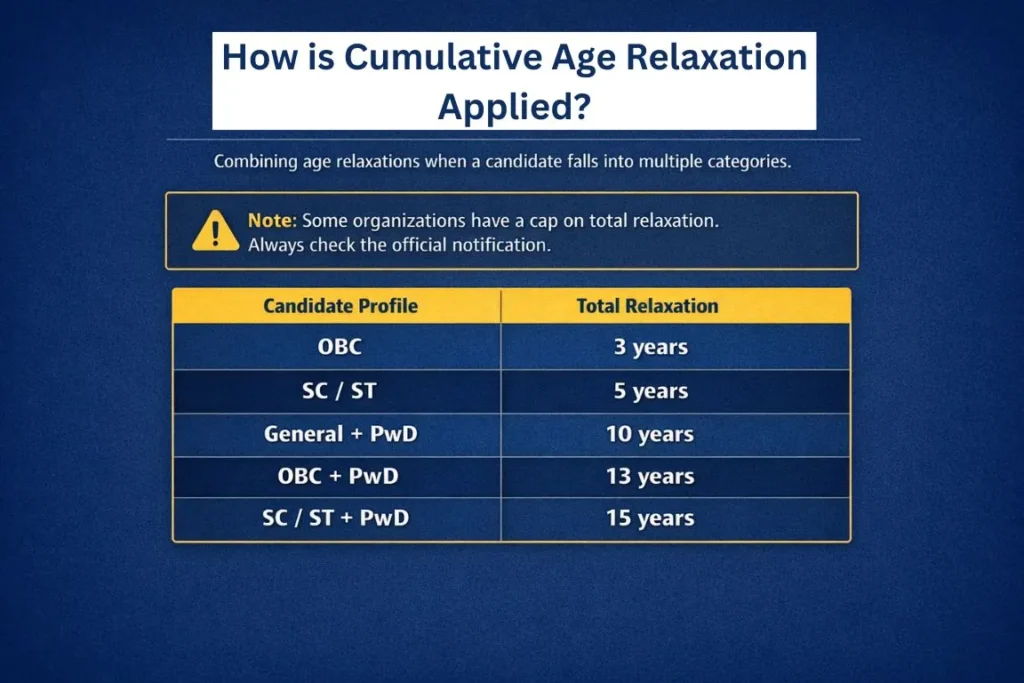
When a candidate belongs to more than one eligible category, the relaxations are added together (cumulative). However, some recruiting organizations apply a cap on the total relaxation. Always verify this in the official notification.
| Candidate Profile | Total Relaxation |
| OBC | 3 years |
| SC/ST | 5 years |
| General + PwD | 10 years |
| OBC + PwD | 13 years |
| SC/ST + PwD | 15 years |
Age Relaxation in the Banking Sector (IBPS / SBI)
Banking recruitment generally follows the standard DoPT guidelines:
| Category | Age Relaxation |
| OBC (Non-Creamy Layer) | 3 years |
| SC/ST | 5 years |
| General + PwD | 10 years |
| OBC + PwD | 13 years |
| SC/ST + PwD | 15 years |
| Ex-Servicemen | As per government formula |
For SBI PO, the standard upper age limits are:
- General: 30 years
- OBC: 33 years
- SC/ST: 35 years
Age Relaxation in UPSC Civil Services
UPSC Civil Services (IAS, IPS, IFS, and allied services) has clearly defined age limits and attempt limits per category:
| Category | Upper Age Limit | Maximum Attempts |
| General | 32 years | 6 |
| OBC (Non-Creamy Layer) | 35 years | 9 |
| SC/ST | 37 years | Unlimited |
| General + PwD | 42 years | 9 |
| OBC + PwD | 45 years | 9 |
| SC/ST + PwD | 47 years | Unlimited |
UPSC is one of the few Indian recruitment bodies that provides comprehensive, well-documented age and attempt relaxations across all categories.
Important Points to Remember
- Age relaxation always applies to the upper age limit only. The lower age limit is fixed and non-negotiable for all categories.
- Always carry your category certificate (OBC/SC/ST/PwD/ESM certificate) when applying.
- Your OBC Non-Creamy Layer certificate must be recently issued (typically within the last financial year) and valid on the application closing date.
- Age relaxation rules may differ for state government jobs — always read the official notification before applying.
- Some posts also offer relaxation based on relevant work experience in specific fields.
Why Does India Have Age Relaxation Rules?
India is a deeply diverse country, and not every citizen has equal access to education, infrastructure, or career opportunities. Marginalized communities, persons with disabilities, defence veterans, and women facing difficult life circumstances often need more time to prepare and qualify for competitive government exams.
Age relaxation policies exist to:
- Create a more level playing field for candidates from all backgrounds.
- Ensure that government jobs are accessible across all sections of Indian society.
- Reflect the government’s commitment to inclusive employment and social equity.
These policies are not a compromise on merit — they are a recognition that not everyone starts from the same position.
| Join Yuva Safar WhatsApp Group for Latest Job Updates | Click Here |
| Join Our Telegram Channel for Daily Government & Private Job Alerts | Click Here |
Frequently Asked Questions (FAQ)
Q1. What is age relaxation in government jobs? Age relaxation is an increase in the upper age limit extended to certain categories of candidates, giving them additional time to apply for government positions.
Q2. How many years of relaxation do OBC candidates get? OBC (Non-Creamy Layer) candidates receive 3 years of age relaxation in central government jobs.
Q3. How many years of relaxation do SC/ST candidates get? SC and ST candidates receive 5 years of age relaxation in central government jobs.
Q4. How much relaxation do PwD candidates get? Persons with Disabilities (benchmark disability of 40% or more) receive 10 years. OBC-PwD candidates get 13 years, and SC/ST-PwD candidates get 15 years.
Q5. Can I claim two relaxations at the same time? Yes, in most cases relaxations are cumulative — for example, OBC + PwD gives 13 years total. However, always check the specific notification for any maximum cap.
Q6. Does age relaxation apply to the lower age limit too? No. Age relaxation applies only to the upper age limit. The lower age limit remains fixed for all categories.
Q7. Are ex-servicemen eligible for age relaxation? Yes. Ex-servicemen can subtract their years of military service from their actual age, then add 3 years to determine their effective age for eligibility purposes.
Q8. Do private banks give age relaxation like PSU banks? No. Age relaxation rules apply to government jobs and public sector banks (such as SBI and PNB). Private banks set their own age criteria independently.
Q9. Does the OBC certificate need to be recent? Yes. The OBC Non-Creamy Layer certificate must typically be issued within the current financial year and remain valid on the application closing date.
Q10. Where can I verify official age relaxation rules? Visit the official DoPT website at dopt.gov.in, or check the specific recruitment notification issued by UPSC, SSC, Railways, IBPS, or the relevant State Public Service Commission.
Conclusion
Understanding age relaxation rules is essential for every government job aspirant in India. These provisions exist to ensure that every eligible candidate — regardless of caste, disability, service background, or personal circumstances — gets a fair opportunity to compete.
If you belong to OBC, SC/ST, PwD, Ex-Servicemen, or any other eligible category, make sure you know your relaxation entitlement before applying. Always read the official notification carefully, keep your certificates updated and valid, and plan your preparation timeline accordingly.