Cracking the written exam for a government job is only half the battle. Lakhs of candidates compete every year for limited vacancies, and clearing the exam brings a mix of relief and renewed anxiety, because the interview round still stands between you and your appointment letter. For most first-time candidates, this stage feels like an unknown territory.
This guide is built specifically for beginners facing their first government job interview, whether for the SSC, UPSC, a State PSC, a public sector bank, the Railways, or any other government recruitment process. The tips below will help you prepare systematically, present yourself with confidence, and improve your chances of selection.
What Makes a Government Job Interview Different?
Government job interviews in India follow a distinct format compared to private-sector hiring. They are formal, structured, and designed to assess far more than technical knowledge. Interview panels evaluate your character, your awareness of current issues, and your suitability for a role that involves public service.
Panels typically consist of senior officials, subject-matter experts, and sometimes retired government officers. Their goal isn’t limited to testing what you know; they’re equally interested in how you communicate, how you handle pressure, and whether you genuinely understand what public service entails.
In examinations like the UPSC, this stage is officially called a “Personality Test” rather than an interview, and that name is intentional. The panel observes your thought process, your articulation, and your overall demeanor throughout the conversation. Because of this depth, government interviews carry significant weight in the final selection.
Tip 1: Know Your DAF or Application Form Inside Out
Your Detailed Application Form (DAF), or your original application, is the starting point for most government interviews. Panels frequently base their questions directly on what you’ve written: your hometown, educational background, hobbies, optional subjects, and any prior work experience.
A common mistake among candidates is writing impressive-sounding details in the DAF without being prepared to discuss them in depth. This often backfires badly during the interview.
To avoid this, review your application form multiple times before the interview. If you’ve mentioned an interest in cricket or classical music, be ready to discuss it knowledgeably. If you’ve referenced a project or a professional experience, know every relevant detail. Interview panels are highly experienced and can quickly identify inconsistencies or exaggeration.
Practice introducing yourself based on your DAF until your response sounds natural and confident, not rehearsed or memorized.
Tip 2: Stay Updated With Current Affairs, Especially Related to India
Government interviews, particularly for administrative and banking roles, almost always include questions on current affairs. Panels want to confirm that you are an informed and engaged citizen.
| Focus Area | What to Track |
| National and international news | Major developments over the past six months |
| Government schemes | PM Kisan, Ayushman Bharat, Digital India, Make in India, etc. |
| Economy and budget | Union Budget highlights, GDP trends, fiscal policy |
| Judiciary | Major Supreme Court judgments |
| State-level affairs | Relevant news if appearing for a State PSC |
| Sports and events | Major awards, tournaments, and national events |
Read a reliable newspaper daily, such as The Hindu or The Indian Express, both widely followed by serious aspirants. Supplement this with Press Information Bureau (PIB) releases and Yojana magazine for deeper insight into government initiatives.
Memorizing facts is not the goal. Interviewers want to see that you can analyze and form independent opinions on policies and events, not simply recite information.
Tip 3: Know Your Home State and District Well
This is a detail many beginners overlook. For both State PSC and UPSC interviews, panels often explore your familiarity with your home state and district, including its culture, economic challenges, geography, and political history.
For instance, a candidate from Bihar should be prepared to discuss issues like flood management and significant historical events of the state. A candidate from Rajasthan might be expected to know about tourism, water scarcity, and tribal communities in the region.
Demonstrating this knowledge signals genuine awareness and a real connection to ground-level realities, exactly the qualities expected of a public servant.
Tip 4: Prepare Your “Why Government Job?” Answer Carefully
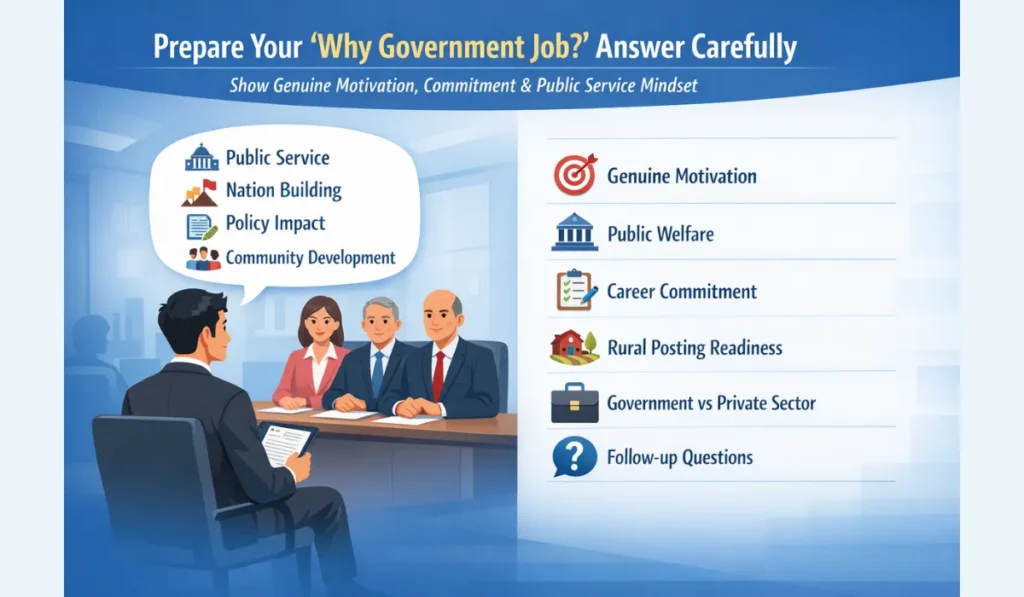
Almost every panel asks some version of: “Why do you want to join government service?” or “Why are you not pursuing a private-sector career?”
This question appears simple but trips up many candidates. Vague answers like “I just want a job” or “my parents wanted this” rarely leave a good impression.
Instead, frame your answer around a genuine motivation, such as a desire to contribute to public welfare, an interest in policy-making, or a personal experience that shaped your decision. Authenticity matters far more than a rehearsed, generic response.
Be ready for related follow-up questions as well:
- What will you do if you don’t get this job?
- Do you have private-sector offers? Why choose this over them?
- Are you willing to work in a remote or rural posting?
Think through mature, well-considered answers to these questions in advance, since they reveal your long-term commitment to public service.
Tip 5: Dress Formally and Appropriately
Government interviews in India follow a formal dress code, not because appearance is the primary criterion, but because dressing appropriately reflects respect for the process and the panel.
| Candidates | Recommended Attire |
| Men | Well-fitted shirt in white, light blue, or grey; formal trousers; formal shoes; neatly combed hair |
| Women | Saree, salwar kameez, or formal western wear; minimal jewellery; light or no perfume |
Ensure your clothes are clean and properly ironed, and carry your documents in an organized folder. These small details create an impression of seriousness and preparedness.
Tip 6: Work on Your Body Language and Voice
Many well-prepared candidates still lose marks due to poor body language. Panels begin forming impressions the moment a candidate enters the room.
- Knock before entering and greet the panel respectfully.
- Sit only when invited to do so.
- Maintain an upright but relaxed posture.
- Make natural eye contact with the panel; avoid staring or looking away constantly.
- Speak slowly and clearly, since nervousness often speeds up speech.
- Avoid fidgeting, such as tapping fingers or shaking your leg.
- Smile naturally when appropriate.
- Stop speaking once you’ve answered; don’t fill silence unnecessarily.
Practicing in front of a mirror or recording yourself can reveal habits you aren’t otherwise aware of.
Tip 7: Be Honest — Do Not Bluff or Exaggerate
Government panels consist of experienced professionals who have interviewed thousands of candidates and can usually detect dishonesty quickly. If you don’t know an answer, say so.
A response like “I’m not entirely sure, but I think…” or “I don’t have complete information on this” is far better received than an incorrect or fabricated answer. Demonstrating honesty is itself a quality panels value highly in prospective public servants.
Tip 8: Prepare for Common Interview Questions
Certain questions appear consistently across government interviews. While you shouldn’t memorize scripted answers, understanding how to approach these topics will help you respond naturally and confidently.
- Tell me about yourself.
- What are your strengths and weaknesses?
- Why do you want this particular role?
- What do you know about this department or organization?
- How do you handle pressure or difficult situations?
- What does public service mean to you?
- Describe a challenge you’ve faced and how you overcame it.
- What do you consider the biggest issue facing India today?
- How do you see yourself contributing to this organization?
Focus on understanding the intent behind each question rather than rehearsing fixed responses.
Tip 9: Research the Department or Organisation Thoroughly
Candidate preparation should extend to the specific organization they’re applying to. For an IBPS PO interview, this means understanding banking sector trends, RBI guidelines, and the bank’s recent performance. For a Forest Department role, it means knowing about India’s forest cover, wildlife protection laws, and conservation initiatives.
Department-specific knowledge immediately distinguishes serious candidates from those who appear to be applying indiscriminately. Reviewing the organization’s official website and annual report, where available, can give you a meaningful edge.
Tip 10: Practice Mock Interviews
Reading preparation tips is useful, but it cannot fully replace practical experience. Nervousness during a real interview is difficult to manage without prior exposure to a similar setting.
Consider joining a coaching institute that conducts mock interviews, or ask a mentor, teacher, or experienced acquaintance to simulate the process with you. Practicing with peers in an interview-like setting also helps.
After each mock session, review the feedback carefully. Identify weak answers, body language issues, and areas for improvement, and refine your approach with each attempt. If no one is available to assist, record yourself answering questions and review the footage critically.
Tip 11: Carry All Documents Organised and Complete
On interview day, bring all required original documents along with self-attested photocopies, organized in a proper folder.
| Document Type | Examples |
| Interview call letter | Original copy issued by the recruiting body |
| Identity proof | Aadhaar card, PAN card, or Passport |
| Academic records | Mark sheets and certificates from the qualifying level onward |
| Category certificate | SC/ST/OBC certificate, if applicable |
| Experience certificates | Proof of prior employment, if relevant |
| Photographs | As specified in the interview call letter |
Missing even one required document can be embarrassing at best and disqualifying at worst, so double-check everything the night before.
Tip 12: Manage Your Nerves on Interview Day
Nervousness is completely normal, even seasoned interviewees experience it. The objective isn’t to eliminate this feeling entirely, but to manage it effectively.
- Arrive 30 to 45 minutes early to settle in and locate the interview room.
- Avoid discussing your preparation with other waiting candidates, as it can increase anxiety.
- Take a few deep breaths before entering.
- Remember that panels are looking to select a suitable candidate, not to catch you out.
- If asked an unexpected question, pause briefly before responding. It’s perfectly acceptable to say, “May I take a moment to think about this?”
Tip 13: Close the Interview Well
Many candidates rush through the closing moments of an interview without realizing this is a final opportunity to leave a strong impression.
Thank the panel politely, for example: “Thank you for this opportunity. I’ve learned a great deal from this conversation.” Then exit calmly and confidently. Avoid asking the panel how you performed, and refrain from displaying visible relief or disappointment as you leave. Maintain composure until you’re well outside the venue.
| Join Yuva Safar WhatsApp Group for Latest Job Updates | Click Here |
| Join Our Telegram Channel for Daily Government & Private Job Alerts | Click Here |
Frequently Asked Questions
Q1. How long does a typical government job interview last? Usually between 20 and 45 minutes, depending on the post and the panel’s interest in your responses.
Q2. Which language should I speak in the interview? Hindi or English is generally acceptable. For State PSC interviews, regional languages may also be allowed. Choose whichever language you’re most fluent and comfortable in.
Q3. Should I memorize current affairs dates and statistics? Know the key facts, but focus on understanding rather than rote memorization. Panels value analytical thinking over recall.
Q4. Can I disagree with the interviewer’s opinion? Yes, as long as it’s done respectfully. A phrase like “I respect your view; however, I think…” works well. Panelists sometimes challenge candidates deliberately to assess how they handle disagreement.
Q5. What should I do if I blank out during the interview? Stay calm, take a breath, and say, “May I take a moment?” This is a completely acceptable and shows composure under pressure.
Q6. Do panels check candidates’ social media profiles? Not always, but it can happen in certain high-level interviews. It’s wise to keep your public profiles professional.
Q7. Should preparation differ for UPSC versus bank interviews? Yes. UPSC interviews are broader and more personality-focused, while bank interviews lean more heavily on banking awareness and professional background.
Q8. Is coaching necessary for interview preparation? It isn’t mandatory, but mock interview sessions at coaching institutes can be very helpful, particularly for first-time candidates.
Q9. What should I eat before the interview? Stick to a light, familiar meal. Avoid heavy or unfamiliar food that could leave you feeling uncomfortable or sluggish.
Q10. How soon are interview results typically announced? This varies by organization and can range from a few weeks to a few months. Check the official website regularly for updates.
Final Thoughts
A government job interview evaluates far more than subject knowledge; it assesses your awareness, attitude, maturity, and genuine commitment to public service. If the written exam tests what you’ve studied, the interview tests who you are.
The encouraging part is that every aspect of interview readiness, from staying informed to building confidence, can be developed with consistent effort. You don’t need to be flawless; you simply need to be prepared, honest, and authentic.
Start your preparation today: read consistently, practice articulating your thoughts clearly, dress appropriately, and walk into the interview room knowing you’ve done everything within your control to succeed.