Clearing the written exam or interview is a big achievement — but for most government jobs in India, that’s not the finish line. The Medical Fitness Test stands between you and your appointment letter, and for many candidates, it’s the most nerve-wracking part of the entire selection process.
Whether you’re aiming for the Indian Army, Railways, Police, SSC, or UPSC, a medical examination is almost certainly part of the process. This article breaks down everything you need to know — why these tests exist, what gets checked, what documents to carry, and how to prepare so you walk in with confidence.
Why Is a Medical Test Required for Government Jobs?
The Government of India mandates medical fitness tests for a straightforward reason — government roles are demanding. Fieldwork, long hours, physical activity, and postings in challenging environments are all part of the job for a large number of positions.
For forces like the Indian Army, BSF, CRPF, CISF, and Police, the physical demands are obvious. But even desk-based roles — SSC CGL, UPSC Civil Services, Bank PO — require candidates to meet basic health standards. The government wants to ensure that selected candidates can perform their duties effectively over a long career, without health issues that could interfere with their responsibilities.
In short, medical fitness is not a bureaucratic formality. It’s a genuine requirement.
When Does the Medical Test Happen?
The medical examination is almost always one of the final stages in the selection process. Here’s the typical order:
- Written Examination
- Physical Efficiency Test (PET) / Physical Standard Test (PST) — for applicable posts
- Interview / Document Verification
- Medical Examination
- Final Merit List / Appointment Letter
The exact sequence may vary slightly by department or recruiting body, but the medical test consistently appears near the end — after you’ve already been provisionally selected. Your appointment isn’t official until you clear it.
Medical Standards by Job Category
Medical requirements differ significantly depending on the nature of the job. Here’s a quick overview:
| Job Category | Medical Standard Level | Key Focus Areas |
| Indian Army / Navy / Air Force | Very Strict | Height-weight ratio, eyesight, hearing, flat feet, no major surgery history |
| Paramilitary (CRPF, BSF, CISF, ITBP, SSB) | Strict | Height, weight, chest, eyesight, overall fitness |
| Railway (RRB) | Category-Based (A1 to C2) | Vision, colour vision, hearing, general health |
| Police (State & Central) | Moderate to Strict | Vision, hearing, physical deformities, chronic illness |
| SSC (CGL, CHSL, MTS) | Moderate | General health, no disqualifying conditions |
| UPSC Civil Services (IAS, IFS) | Moderate | General fitness, doctor-certified form |
| UPSC Civil Services (IPS) | Stricter | Fieldwork fitness, physical standards |
| State Government Jobs | Varies by State | Vision, BP, blood sugar, general fitness |
1. Defence Jobs (Army, Navy, Air Force)
The Indian Army has the strictest medical standards of any civilian or paramilitary recruitment. Candidates must meet the following:
- Correct height-to-weight ratio
- Near-perfect eyesight (standards vary by role)
- No flat feet or knock knees
- No history of major surgeries or serious illness
- Normal hearing range
- No colour blindness (especially for pilots and technical roles)
The Service Selection Board (SSB) medical board conducts a thorough examination. If a candidate is found unfit, they receive a formal rejection letter with specific reasons.
2. Paramilitary Forces (CRPF, BSF, CISF, ITBP, SSB)
These forces follow strict standards as well, though they are slightly more relaxed than the Army. Height, weight, chest measurements, eyesight, and overall physical fitness are all examined in detail.
3. Railway Recruitment Board (RRB)
Railways use a medical category system to classify posts:
| Medical Category | Vision Requirement | Applicable Posts |
| A1 | Highest (best vision required) | Loco Pilot, Motorman |
| A2 | High | Assistant Loco Pilot |
| B1 | Moderate | Station Master, Guards |
| B2 | Moderate | Some technical posts |
| C1 | Standard | Technicians |
| C2 | Basic | Group D staff |
Medical tests for Railway jobs include checks for colour vision, eyesight, hearing, and general health. The category required depends entirely on the post applied for.
4. Police (State and Central)
Police medical examinations check the following:
- Visual acuity and colour vision
- Hearing ability
- Physical deformities
- Chronic illnesses
- General physical fitness
Each state’s police recruitment board sets its own standards, so requirements can vary from one state to another.
5. SSC (Staff Selection Commission)
SSC exams — including CGL, CHSL, and MTS — include a medical test, though the standards are considerably less demanding than defence or paramilitary roles. Candidates with serious health conditions that would prevent them from performing their duties may be rejected, but overall, the bar is more accessible for healthy young applicants.
6. UPSC Civil Services (IAS, IPS, IFS)
- IAS and IFS: Medical standards are relatively moderate. A registered medical practitioner fills out a prescribed UPSC fitness form.
- IPS: Standards are stricter due to the fieldwork-intensive nature of the role.
7. State Government Jobs
Each state sets its own recruitment norms. Generally, state PSC and government department medical tests cover:
- Vision and hearing
- Blood pressure and blood sugar
- Physical fitness
- Any existing medical conditions
These tests are fairly standard and are designed to confirm basic health fitness rather than military-grade physical standards.
What Is Checked in a Government Job Medical Test?
Here is a comprehensive breakdown of every parameter typically examined:
Physical Measurements
| Parameter | What’s Checked | Relevant For |
| Height & Weight | Checked against prescribed ratio | Uniformed posts, defence, paramilitary |
| Flat Feet (Pes Planus) | Ability to walk, run, march | Army, Police, paramilitary |
| Knock Knees | Leg alignment | Uniformed posts |
| Chest Measurement | Expansion and minimum size | Paramilitary, police |
Note: Relaxed standards are often applicable for SC/ST/OBC candidates and applicants from the Northeast or hilly regions.
Vision Tests
- Visual Acuity — Clarity of distance vision
- Colour Vision — Ability to distinguish colours (critical for Railway, Army, and pilots)
- Night Vision — Checked for certain defence and field posts
- Refraction — Spectacle power, if applicable
Hearing
Both ears are tested individually. Significant hearing loss in either ear may disqualify a candidate for posts where auditory function is essential.
Laboratory Tests
| Test | Purpose |
| Complete Blood Count (CBC) | Screens for anaemia, infections |
| Fasting Blood Sugar | Rules out or flags diabetes |
| Post-Prandial Blood Sugar | Further diabetes screening |
| Blood Group & Rh Factor | Recorded for official purposes |
| HIV Test | Mandatory for most central government posts |
| Sickle Cell Test | Conducted in select states |
| Urine Test (Albumin & Sugar) | Kidney function and sugar levels |
Diagnostic Tests
- Chest X-Ray — Screens for tuberculosis (TB), enlarged heart, or lung abnormalities. Required for most government job medical examinations.
- ECG (Electrocardiogram) — Required for higher-level posts to assess heart health and detect any cardiac issues.
Blood Pressure
Both high blood pressure (hypertension) and low blood pressure can lead to temporary rejection or re-examination. If stress-induced, candidates may be called for re-testing.
Dental and ENT Check
For defence and police jobs, dental health and ear-nose-throat (ENT) fitness are examined carefully, as these directly affect field performance.
Skin Conditions
Infectious or visually significant skin conditions may lead to rejection for certain posts, particularly uniformed and public-facing roles.
Neurological and Psychiatric Evaluation
For select posts — especially in the defence sector — a basic neurological and mental fitness check is conducted to confirm the candidate’s psychological readiness for the role.
Documents Required for the Medical Examination
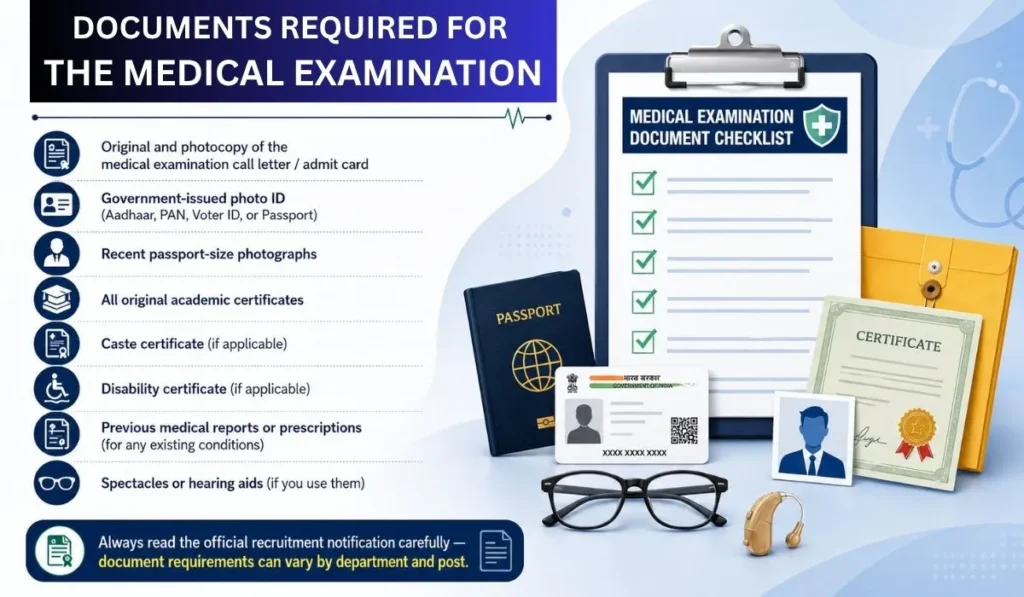
Carry the following documents on the day of your medical test:
- Original and photocopy of the medical examination call letter / admit card
- Government-issued photo ID (Aadhaar, PAN, Voter ID, or Passport)
- Recent passport-size photographs
- All original academic certificates
- Caste certificate (if applicable)
- Disability certificate (if applicable)
- Previous medical reports or prescriptions (for any existing conditions)
- Spectacles or hearing aids (if you use them)
Always read the official recruitment notification carefully — document requirements can vary by department and post.
How to Prepare for the Medical Test
Many candidates fail the medical test due to avoidable reasons. Here’s how to make sure you’re not one of them:
Check Your Vision Early
If you wear glasses, get your eyes tested well in advance. Many posts permit spectacles, but only up to a certain power. Know the limit for your specific post and plan accordingly.
Control Blood Sugar and Blood Pressure
- Avoid high-sugar foods and drinks in the weeks leading up to the test.
- If you have a history of high blood pressure, monitor it regularly and consult a doctor if needed.
- Get a full night’s sleep before the test — anxiety and fatigue can temporarily spike both BP and blood sugar.
Don’t Fast Unless Instructed
- For a fasting blood sugar test, yes — come without eating.
- For general fitness examinations, eat a proper meal beforehand. Showing up weak from hunger affects your readings and your performance.
Stay Hydrated
Drink adequate water in the days before and on the morning of the test. Dehydration can temporarily affect blood pressure readings and other results.
Avoid Smoking and Alcohol
Avoid alcohol for at least a week before the examination. Both smoking and alcohol affect lung health, blood pressure, and liver function — all of which are checked during the medical test.
Be Honest About Existing Conditions
If you have a pre-existing medical condition, declare it. Hiding a condition and having it discovered later can result in dismissal from service. In many cases, a controlled condition — such as mild asthma or well-managed diabetes — does not automatically disqualify you. Concealing it, however, always creates problems.
Rest Well the Night Before
A good night’s sleep stabilises your blood pressure, heart rate, and general health readings. Don’t underestimate this — it genuinely makes a difference on the day.
What Happens After the Medical Test?
| Outcome | What Follows |
| Declared Fit | Name added to final merit list; appointment letter issued |
| Temporarily Unfit | Given time to treat the condition; re-examination scheduled |
| Declared Unfit | Formal rejection letter issued; Review Medical Board option available |
If you’re declared unfit, don’t panic. Most government recruitment bodies allow candidates to apply for a Review Medical Board. Submit your objection — along with reports from a government hospital — within the stipulated time. A senior medical board will re-examine your case. Many candidates are cleared at this stage, especially for borderline results or temporary conditions.
Common Reasons for Rejection in Medical Tests
- Poor vision beyond the acceptable limit
- Uncontrolled high blood pressure (hypertension)
- Colour blindness (for posts where colour perception is essential)
- Flat feet or knock knees (for uniformed posts)
- Active tuberculosis (TB)
- Uncontrolled diabetes
- Significant hearing deficiency
- Underweight or overweight beyond the prescribed range
- Heart conditions detected on ECG
- HIV positive status
| Join Yuva Safar WhatsApp Group for Latest Job Updates | Click Here |
| Join Our Telegram Channel for Daily Government & Private Job Alerts | Click Here |
Final Thoughts
The government job medical test is not designed to trip you up. It exists to confirm that you’re genuinely capable of handling the demands of public service over a long career. For most healthy young candidates, passing isn’t difficult — as long as you know what to expect, prepare properly, and carry the right documents.
If you don’t clear it the first time, the Review Medical Board process exists for a reason. Temporary health issues and borderline readings are reviewed and reconsidered every year, and many candidates move forward after a second assessment.
Stay healthy, stay informed — and your dream government job is well within reach.
Frequently Asked Questions (FAQ)
Q1. What is checked in a government job medical test? A government job medical test typically includes a vision test, blood tests (CBC, blood sugar, HIV), urine test, chest X-ray, blood pressure check, height-weight measurement, and hearing test. Some posts also require an ECG.
Q2. Can I pass the medical test if I wear glasses? Yes, spectacles are permitted for many posts — but only up to a specified power limit. Posts like Army combat roles and Loco Pilot have very strict vision standards. Always check the vision requirements in the official notification for your specific post.
Q3. What should I do if I’m rejected in the medical test? You can apply for a Review Medical Board. Submit your formal objection — along with reports from a recognized government hospital — within the deadline specified in the official notification. A senior board will reassess your case.
Q4. Is blood sugar checked in the medical examination? Yes. Both fasting and post-prandial blood sugar levels are tested. Uncontrolled diabetes can result in an unfavourable report, though candidates with controlled diabetes may be assessed on a case-by-case basis.
Q5. What documents do I need to bring for the medical test? Carry your call letter, a government-issued photo ID, passport-size photographs, original academic certificates, your caste certificate (if applicable), and any existing medical reports or prescriptions.
Q6. Do flat feet automatically disqualify me from the Army? Flat feet are a common reason for rejection in Army recruitment, but the outcome depends on severity. Mild cases may pass. Candidates who are rejected can also apply to the Review Medical Board for reassessment.
Q7. How long does the government job medical test take? Most medical examinations are completed in a single day. For large-scale recruitments, the process may extend to two days.
Q8. How should I prepare for the medical test? Get adequate sleep the night before, avoid alcohol and smoking for at least a week, keep your blood pressure and blood sugar in check, stay hydrated, eat a proper meal (unless fasting is required), and have all your documents ready.
Q9. What are the Railway medical categories? Railway posts are categorised from A1 to C2 based on medical standards. A1 requires the best vision and is mandatory for Loco Pilots. Group D posts fall under lower categories where less stringent standards apply.
Q10. Does clearing the medical test confirm my government job? Once you are declared medically fit, your name is added to the final merit list and an appointment letter is issued — provided all other stages have been cleared. Medical fitness is the final major checkpoint before confirmation.