Every year, millions of young Indians face the same career dilemma: should they chase a government job or build a career in the private sector? This isn’t just a personal decision — it’s often a family discussion, a dinner-table debate, and sometimes even a factor that comes up during marriage proposals.
Parents usually push for government jobs because of the stability and social respect attached to them. Young graduates, on the other hand, are often drawn to the private sector for its higher pay, faster growth, and modern work culture.
The truth is, both paths have real advantages and real trade-offs. There’s no universal “right” answer — it depends on your personal goals, financial priorities, and the kind of lifestyle you want. This guide breaks down the government job vs private job debate across every major factor that matters: salary, job security, career growth, retirement benefits, work-life balance, and more.
What Is a Government Job in India?
A government job refers to employment under the central government, a state government, or a Public Sector Undertaking (PSU). Recruitment for these roles happens through competitive examinations conducted by bodies like UPSC, SSC, IBPS, State Public Service Commissions, and the Railway Recruitment Boards.
Common examples include IAS, IPS, and IFS officers, bank POs and clerks, railway employees, defence personnel, school and college teachers, and scientists at organisations like ISRO or DRDO. Government jobs are widely regarded as among the most secure career options in India, offering fixed salaries and long-term financial benefits.
What Is a Private Job in India?
A private job is any role offered by a privately owned company rather than the government — this includes everything from multinational corporations and IT firms to local businesses and startups. Hiring is typically based on skills, qualifications, and interview performance rather than a standardised national exam.
Private sector roles span industries such as information technology, banking and finance, manufacturing, retail, healthcare, and e-commerce. Unlike government recruitment, the hiring process is usually faster and more flexible, with companies often prioritising practical skills and adaptability over seniority.
Government Job vs Private Job: Detailed Comparison
Job Security
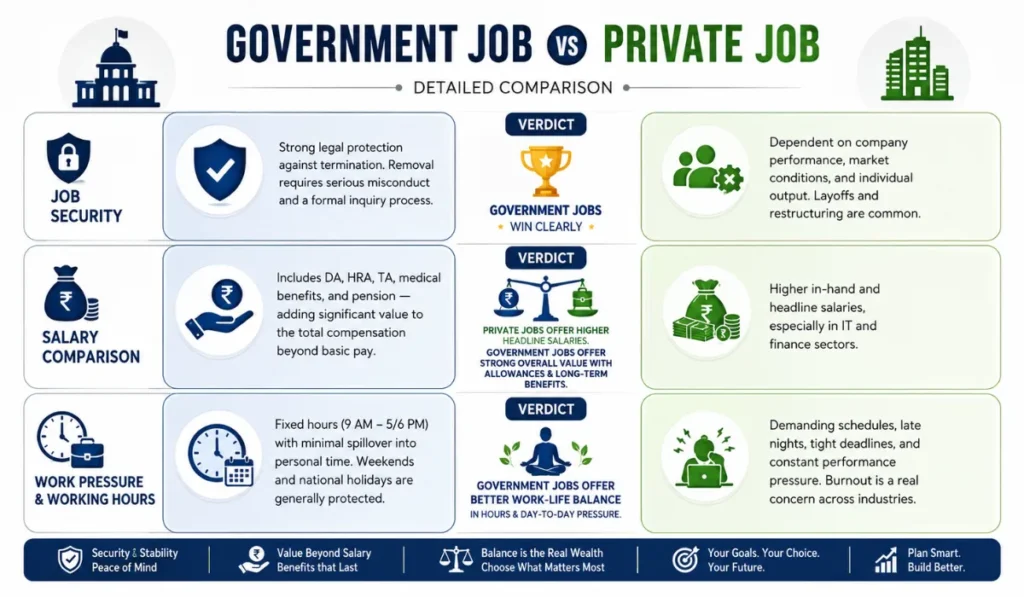
Job security is the single biggest reason most Indian families lean towards government employment. Once selected, a government employee enjoys strong legal protection against termination, and removal from service typically requires serious misconduct along with a formal inquiry process.
Private sector jobs, in contrast, are far more dependent on company performance, market conditions, and individual output. Layoffs, restructuring, and economic downturns can affect even high-performing employees.
Verdict: Government jobs win clearly on job security.
Salary Comparison
At first glance, private sector salaries appear far more attractive — but the full picture is more nuanced once allowances and benefits are factored in.
| Role/Sector | Approximate Salary Range |
| Central Govt Group C employee (entry-level) | ₹25,000 – ₹50,000/month |
| IAS/IPS officer (with allowances) | ₹1.5 lakh – ₹2.5 lakh/month |
| Private IT firm fresher (e.g., TCS, Infosys) | ₹3.5 lakh – ₹7 lakh/year |
| Top MNC engineer (e.g., Google, Microsoft, Amazon India) | ₹20 lakh – ₹50 lakh+/year |
| Senior private sector professional | Can extend into crores annually |
Government salaries also include Dearness Allowance (DA), House Rent Allowance (HRA), Travel Allowance (TA), medical benefits, and pension — additions that significantly boost the total compensation package beyond the basic pay figure.
Verdict: Private jobs, especially in IT and finance, offer higher headline salaries. Government jobs offer strong overall value once allowances and long-term benefits are included.
Work Pressure and Working Hours
Government offices typically follow fixed hours — usually 9 AM to 5 or 6 PM — with minimal spillover into personal time. Weekends and national holidays are generally protected.
Private sector roles, particularly in IT, banking, and consulting, are known for demanding schedules. Late nights, tight project deadlines, and constant performance pressure are common, and burnout remains a real concern across many industries.
Verdict: Government jobs offer significantly better work-life balance in terms of hours and day-to-day pressure.
Career Growth
| Factor | Government Jobs | Private Jobs |
| Promotion basis | Seniority, departmental exams, years of service | Performance and merit |
| Speed of growth | Slow and structured | Fast, especially for high performers |
| Time to senior role | 15–20 years (e.g., IAS to Joint Secretary) | 5–7 years possible (Associate to Director) |
| Job switching | Rare, limited scope | Common, and often used to accelerate growth |
Verdict: Private jobs offer noticeably faster, merit-driven career progression.
Pension and Retirement Benefits
This is one area where government employment holds a clear long-term advantage. Government employees benefit from structured retirement planning through the National Pension System (NPS), along with gratuity and Provident Fund contributions. Some state governments have also reinstated the Old Pension Scheme (OPS) in response to employee demand, guaranteeing a fixed pension after retirement.
Private sector employees, on the other hand, primarily rely on the Employees’ Provident Fund (EPF). There is no guaranteed pension, which means retirement planning becomes the individual’s responsibility — through instruments like NPS, mutual funds, or other long-term investments.
Verdict: Government jobs offer far stronger and more predictable retirement security.
Social Status and Respect
In smaller cities, towns, and rural India, a government job still carries significant social weight. Being addressed as a “government officer” often brings respect not just to the individual but to their entire family — and remains a sought-after qualification in marriage discussions, particularly for roles like IAS, IPS, or bank officer positions.
In metro cities such as Bengaluru, Mumbai, and Delhi, this gap is narrowing. A software engineer at a top tech company or a finance professional at a leading firm is now seen as equally accomplished.
Verdict: Government jobs continue to hold higher social status across most of India, especially outside major metros.
Work Environment and Perks
| Government Jobs | Private Jobs |
| Subsidised or provided housing | Modern office spaces and amenities |
| Travel allowance with reimbursement | Free meals, cab facilities |
| Medical benefits | Health insurance coverage |
| Subsidised canteen facilities | On-site gyms (larger companies) |
| Study/training leave | International travel opportunities |
| — | ESOPs (especially at startups) |
Verdict: Private companies offer more modern, lifestyle-oriented perks, while government perks tend to offer steady, long-term value.
Leave Policy
Government employees generally enjoy a more generous leave structure, including Casual Leave, Earned Leave, Medical Leave, Half-Pay Leave, and Maternity/Paternity Leave — typically totalling 30 to 40 days annually, in addition to state holidays.
Private sector leave policies tend to be more limited, usually ranging from 15 to 24 paid leave days per year. Taking leave during critical project phases can also be operationally difficult and, in some cases, may influence performance reviews.
Verdict: Government jobs offer a more flexible and generous leave policy overall.
Recruitment Process
Government recruitment is notoriously competitive. For instance, SSC CGL 2023 received applications from over 3.7 crore candidates competing for a limited number of vacancies. The UPSC Civil Services Examination sees more than 10 lakh applicants annually, with only around 1,000 candidates ultimately selected — a process that can take two to five years of dedicated preparation.
Private sector hiring, by comparison, tends to be quicker and more accessible through multiple channels:
- Campus placements
- Job platforms like LinkedIn and Naukri
- Employee referrals
- Hackathons and skill-based assessments
A strong resume, good communication skills, and the right technical expertise are often sufficient to secure a private sector role.
Verdict: Private sector recruitment is faster and easier to access than government recruitment.
Corruption and Office Politics
Government offices can sometimes face challenges related to bureaucratic delays, internal politics, and occasional favouritism in transfers or promotions, particularly at lower levels of the hierarchy.
Private companies are not immune to office politics either — favouritism from managers does occur. However, performance metrics and measurable targets often introduce a layer of objectivity into evaluations.
Verdict: Both sectors have their share of internal politics; neither is entirely free of it.
Who Should Choose What?
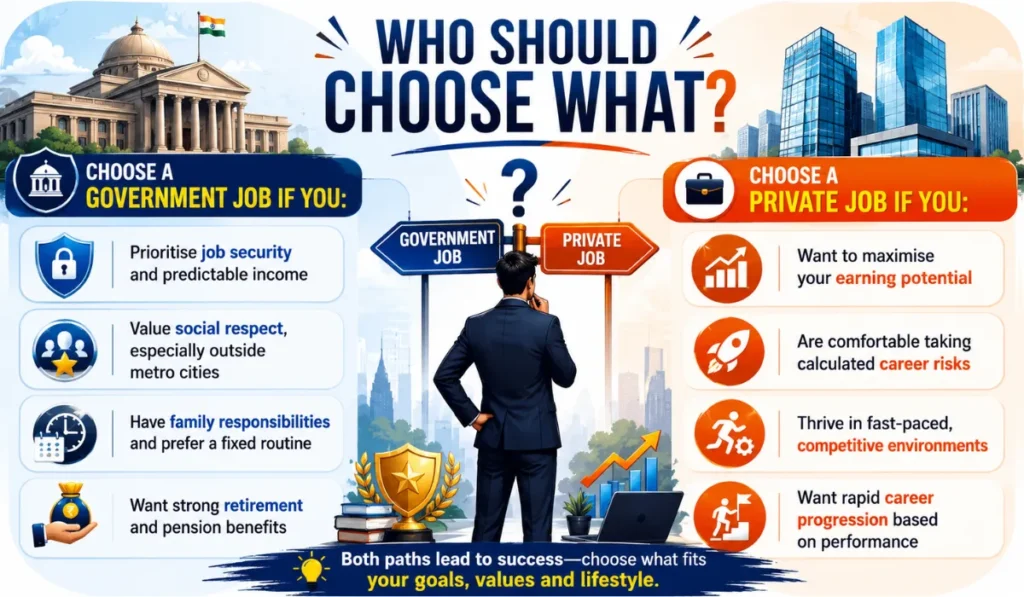
Choose a government job if you:
- Prioritise job security and predictable income
- Value social respect, especially outside metro cities
- Have family responsibilities and prefer a fixed routine
- Want strong retirement and pension benefits
Choose a private job if you:
- Want to maximise your earning potential
- Are comfortable taking calculated career risks
- Thrive in fast-paced, competitive environments
- Want rapid career progression based on performance
Current Trend Among Indian Youth
Despite the growing appeal of the private sector, government job applications continue to rise year after year across UPSC, SSC, and state-level examinations — a clear sign that job security remains a top priority for India’s middle class.
At the same time, India’s IT, fintech, and startup ecosystems are expanding rapidly, with cities like Bengaluru, Hyderabad, Pune, and Chennai generating large numbers of private sector jobs annually. Many young professionals, especially engineering graduates, are drawn to these opportunities.
A growing number of candidates are now pursuing a hybrid strategy — working in a private job to earn an income and gain experience while simultaneously preparing for government exams. This approach allows them to build financial stability, develop new skills, and keep their government job aspirations alive without putting their career on hold.
| Join Yuva Safar WhatsApp Group for Latest Job Updates | Click Here |
| Join Our Telegram Channel for Daily Government & Private Job Alerts | Click Here |
Final Thoughts
There’s no single correct answer to the government job vs private job debate — both paths offer genuine value, just in different ways. If long-term security, social respect, and structured benefits matter most to you, a government job is likely the better fit. If you’re driven by ambition, faster financial growth, and a dynamic work environment, the private sector may suit you better.
The right choice ultimately comes down to self-awareness: understand your risk appetite, your financial goals, and the lifestyle you want to build. A fulfilling career isn’t just about the salary or the title — it’s about choosing a path that lets you wake up each day with a sense of purpose.
Frequently Asked Questions (FAQ)
Q1. Is a government job better than a private job in India? It depends on your priorities. Government jobs offer better security and long-term benefits, while private jobs offer higher pay and faster career growth.
Q2. Do government jobs pay less than private jobs? At entry level, often yes. However, once allowances like HRA, DA, and pension benefits are included, government jobs offer competitive overall compensation.
Q3. Which government exam is considered easier to crack in India? SSC CHSL, SSC MTS, and Railway Group D exams are generally considered relatively easier compared to the UPSC Civil Services Examination.
Q4. Can I switch from a private job to a government job? Yes, as long as you meet the age and eligibility criteria for the specific exam or post. Many candidates make this switch after gaining private sector work experience.
Q5. Which is better for women — government or private jobs? Government jobs are often considered more favourable for women due to longer maternity leave, fixed working hours, strong job security, and a safer working environment.
Q6. Is there a pension in private sector jobs in India? There’s no guaranteed pension in the private sector, but employees benefit from EPF contributions and can voluntarily invest in NPS or other retirement plans.
Q7. What is the age limit for most government jobs in India? Most central government jobs have an age limit of 18 to 32 years, with relaxations of 3 years for OBC candidates and 5 years for SC/ST candidates.
Q8. Do government employees get transferred to different states? Yes, particularly in central government roles. Officers in services like IAS and IPS can be transferred across different states and cities throughout their careers.
Q9. Which private companies pay the highest salaries in India? Companies like Google, Microsoft, Amazon, Goldman Sachs, and Flipkart are known for offering some of the highest compensation packages in the country.
Q10. Can I do a private job while preparing for government exams? Yes, absolutely. Many successful candidates have cleared exams like UPSC and SSC while working full-time, provided they manage their time effectively.