If you are preparing for a government job in India, you already know how much hard work goes into it. Waking up early, studying for hours, managing mock tests, and still feeling like it is never enough. Lakhs of students across the country are going through the same journey every single day — competing for seats in SSC, UPSC, Railway, Banking, Defence, Police, State PSC, and dozens of other recruitments.
But here is something that does not get talked about enough. While you are busy preparing honestly, there are people out there who are trying to take advantage of that effort. Fake government job notifications, fraudulent websites, and online recruitment scams are growing at a pace that is genuinely alarming. And the worst part? Many of these scams are designed so cleverly that even careful, educated candidates fall for them.
Every year, thousands of job seekers lose money — sometimes their entire savings — to scammers who promised them a government job that never existed. Some lose personal data. Some lose confidence. All of them lose time they can never get back.
This article is written to make sure that does not happen to you. You will learn how to spot fake notifications, how to verify real ones, and how to stay safe while searching for government jobs online.
Why Fake Government Job Scams Are Growing So Fast
To understand why scams are increasing, you first need to understand why government jobs are so desirable in India. It is not just about the salary. It is about everything that comes with it.
| Benefit | Why Candidates Value It |
|---|---|
| Job Security | Once you are in, your position is protected. No sudden layoffs or market fluctuations. |
| Attractive Salary | Fixed pay with regular increments and allowances |
| Pension Benefits | Financial security even after retirement |
| Social Respect | Government jobs still carry enormous social value in Indian families |
| Career Growth | Structured promotions based on seniority and performance |
Because these benefits are so sought after, the competition is brutal. And when competition is brutal, desperation creeps in. Candidates start looking for shortcuts. They start believing things they would otherwise question.
Scammers know this. They deliberately target people who are under pressure, and they strike at exactly the right moment — when a candidate is anxious, exhausted, or running out of time.
They reach people through:
- WhatsApp messages forwarded by well-meaning friends
- Telegram groups that look like genuine job update channels
- Facebook pages designed to look like official government handles
- YouTube videos with clickbait titles about “no exam” government jobs
- Fake websites that are nearly identical to real government portals
- SMS alerts that seem to come from official numbers
Their goal is always the same — your money or your personal information, or both.
The Most Common Government Job Scams in India
Before you can protect yourself, you need to know what you are protecting yourself from. Here are the scams that are most frequently reported:
| Scam Type | How It Works |
|---|---|
| Fake Recruitment Websites | These sites copy the look and feel of official portals — same logos, same colors, similar domain names. They collect fake application fees or harvest your personal data. |
| Fake WhatsApp Messages | Messages claiming “Railway direct recruitment without exam” or “Pay ₹500 to confirm your joining” spread rapidly through groups |
| Fake Admit Cards | Scammers charge money for hall tickets that look real but will get you turned away at the exam center |
| Fake Interview Calls | Someone pretends to be a government official and asks for a “processing fee” before your interview |
| Fake Mobile Apps | Apps on unofficial platforms promise job alerts or admit card downloads but quietly steal your data |
One thing is worth repeating here, and repeating clearly: No legitimate government recruitment will ever ask you to pay money in exchange for selection, an interview call, or an admit card. Ever.
Warning Signs That a Job Notification Is Fake
The good news is that most fake notifications give themselves away if you know what to look for. Here are the red flags that should immediately make you pause.
1. Someone Is Promising You a Guaranteed Job
This is the single biggest warning sign. If you see phrases like:
- “100% job guarantee”
- “No exam, direct joining”
- “Pay now and secure your government job”
…close the tab and do not look back. Government jobs in India follow a structured competitive process. Nobody — not an agent, not a contact, not anyone — can guarantee your selection.
2. They Are Asking for Payment Through Personal Accounts
Official recruitment fees are collected only through government-approved payment gateways, linked directly to official portals. If anyone asks you to send money through:
- A personal UPI ID
- A direct bank transfer
- A QR code sent over WhatsApp
- A digital wallet
…that is fraud. Do not send a single rupee.
3. The Notification Has Poor Language or Looks Unprofessional
Official government documents are carefully drafted and formatted. They follow a standard structure and are reviewed before publication. Fake notifications, on the other hand, often contain spelling mistakes, strange grammar, inconsistent fonts, and an overall unprofessional appearance. If something looks off, trust that instinct.
4. The Website Domain Looks Suspicious
This is one of the easiest checks you can do, and one of the most important.
| Safe Domains | Domains to Avoid |
|---|---|
| upsc.gov.in | govtjob-fastapply.com |
| ssc.nic.in | ssc-career-alert.xyz |
| indianrailways.gov.in | railwayjobindia.online |
| ibps.in | ibps-recruitment2025.info |
Official Indian government websites almost always use .gov.in or .nic.in. If a website is using .xyz, .online, .info, or any unusual extension, be very careful.
5. They Are Creating Unnecessary Urgency
“Last date is today.” “Only 3 seats left.” “Apply within the next hour or lose your chance.”
This kind of pressure is a classic manipulation tactic. Scammers want you to act before you think. Real government notifications give candidates reasonable time to apply, and the deadlines are published well in advance on official portals. If you are being rushed, slow down deliberately.
How to Verify Whether a Government Job Notification Is Real
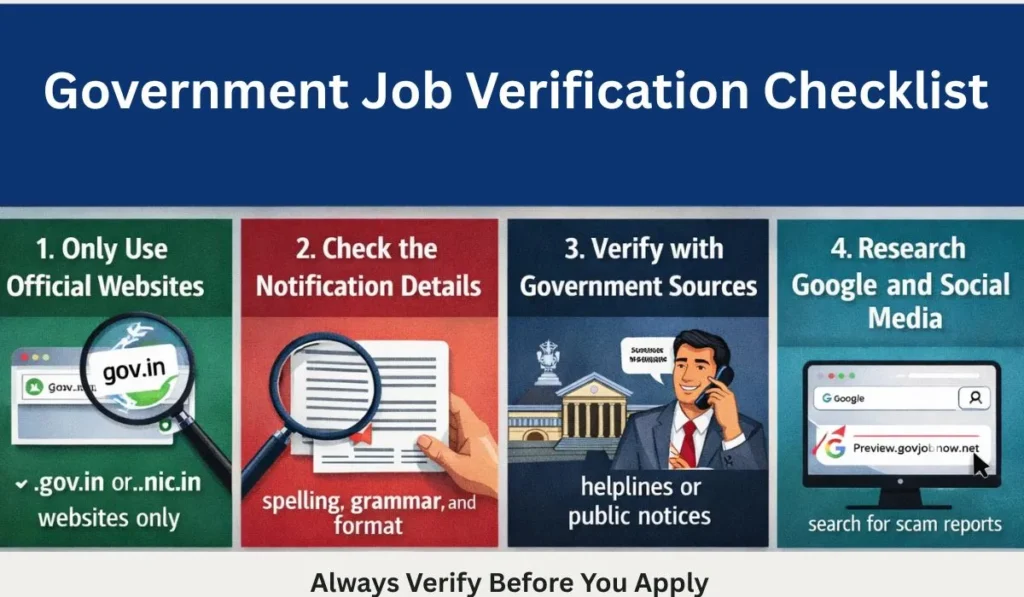
Now for the practical part — exactly how you can confirm whether a notification is genuine before you apply or pay anything.
Step 1: Go Directly to the Official Website
This is non-negotiable. No matter where you first saw the notification — WhatsApp, YouTube, a third-party website — always verify it from the official portal of the recruiting organization.
| Organization | Official Website |
|---|---|
| UPSC | upsc.gov.in |
| SSC | ssc.nic.in |
| IBPS | ibps.in |
| Indian Railways | indianrailways.gov.in |
| Indian Army | joinindianarmy.nic.in |
| Indian Navy | joinindiannavy.gov.in |
And here is an important habit to build: type the URL manually into your browser instead of clicking links. A link can take you to a fake website that looks identical to the real one.
Step 2: Check Employment News
India’s Employment News, published weekly by the Government of India, is one of the most trustworthy places to find verified recruitment notices. If a recruitment is real and significant, it will almost always appear there.
Step 3: Look for Verified Social Media Accounts
Many government organizations now post updates on Twitter/X, Facebook, and Telegram. This can be genuinely helpful — but only if you are following the verified, official account. Look for the verified badge and make sure any links shared take you to a .gov.in or .nic.in domain.
Step 4: Search for News Coverage
If a major government recruitment is announced, it will be reported by established news organizations. Do a quick Google search with the name of the recruitment and the organization. If reputable sources are not covering it, that tells you something important.
Step 5: Read the Official PDF Notification Carefully
A genuine government recruitment notification always contains specific elements. If any of these are missing, be suspicious.
| What to Look For | Why It Matters |
|---|---|
| Official advertisement number | Every genuine notification has a unique reference code |
| Government seal or emblem | Clearly printed and correctly formatted |
| Detailed eligibility criteria | Age limits, educational qualifications, category-wise details |
| Full selection process | Exam pattern, stages, and merit list criteria |
| Application instructions | Clear steps directing you to the official portal |
| Official contact information | A working helpdesk email or phone number |
Protect Your Personal Information
Fake job websites are often built with one specific purpose — to collect your sensitive data and misuse it. Be very deliberate about what you share and where.
Never enter the following on any unverified platform:
- Aadhaar number
- PAN card details
- Bank account or IFSC information
- OTPs of any kind
- Email or portal passwords
Even if a website looks legitimate, take a moment to check the domain before entering anything. A few extra seconds of caution can protect you from months of trouble.
Staying Safe on WhatsApp, Telegram, and YouTube
These platforms are where most recruitment scams travel fastest, because people tend to trust what their own contacts share with them.
On WhatsApp and Telegram: Be skeptical of any group that claims to have exclusive government job information, charges money for “inside updates,” or shares admit cards and answer keys outside of official channels. Many of these groups are run by scammers.
On YouTube: Some channels post sensational government job content purely to drive views. If you see titles like “No exam government job 2025” or “Direct joining confirmed,” treat them as entertainment, not information. Always verify the claim independently.
The rule is the same everywhere: social media is for discovery, official websites are for verification. Never apply or pay based on social media alone.
Basic Online Safety Habits Every Job Seeker Should Build
Beyond spotting scams, there are some simple habits that will protect you more broadly while you are applying for jobs online.
| Habit | Why It Matters |
|---|---|
| Use strong, unique passwords | One compromised password should not unlock everything |
| Avoid applying from cyber cafes or shared computers | Public computers can capture your login and payment details |
| Enable two-factor authentication | Adds a critical extra layer of security to your email and bank apps |
| Always type URLs manually | Prevents you from landing on fake look-alike websites |
| Log out after every session | Especially important on shared or borrowed devices |
These are small habits, but they make a significant difference.
Why Freshers and First-Time Applicants Are Targeted Most
If you are applying for a government job for the first time, you are statistically more likely to be targeted. Scammers know this, and they factor it into their approach.
First-time applicants are often targeted because they:
- Are less familiar with what a real recruitment process looks and feels like
- Are under enormous pressure from family and their own expectations
- May not take the time to verify information before acting on it
- Are emotionally vulnerable and easier to manipulate
Scammers often use language designed to make you feel like you have already won something:
- “Your selection is confirmed, just complete this formality”
- “A government recommendation has been made in your favor”
- “This is a one-time opportunity — do not miss it”
If you ever receive a message like this, the right response is to pause completely and verify through official channels before doing anything else.
What the Real Government Recruitment Process Looks Like
One of the best protections against scams is simply understanding how legitimate government recruitment works. When you know the real process, shortcuts become obvious.
| Stage | What Happens |
|---|---|
| Official Notification | Published on the official website and Employment News |
| Online Application | Submitted through the official portal only |
| Admit Card | Downloaded free of cost from the official portal |
| Written Examination | Held at designated exam centers on the official date |
| Interview or Skill Test | Only for posts where it is specified in the notification |
| Document Verification | Original documents checked at official centers |
| Final Merit List | Published on the official website |
There are no shortcuts in this process. If someone is offering you one, they are lying to you.
What to Do If You Find a Fake Notification
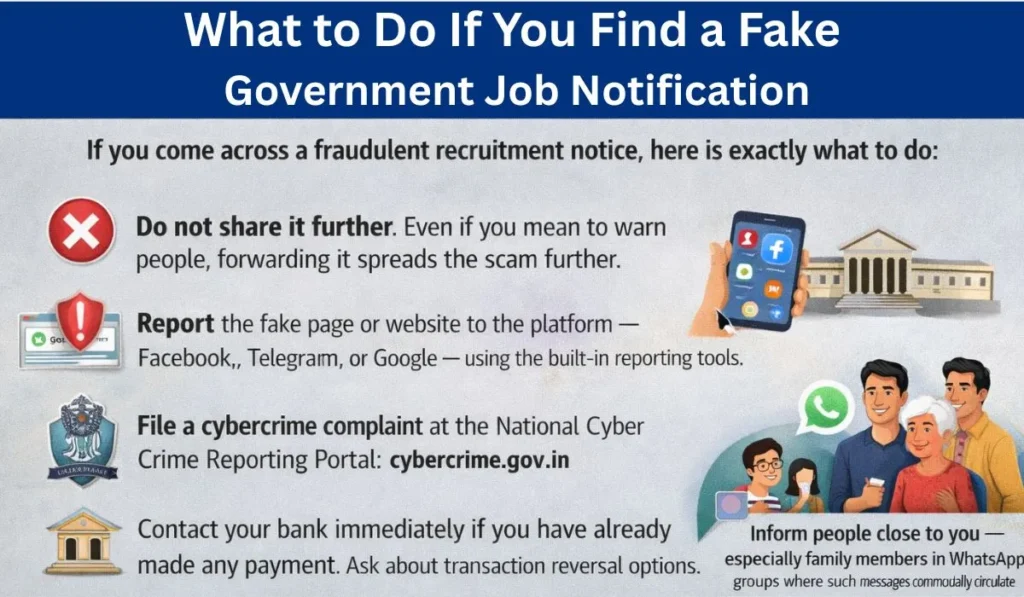
If you come across a fraudulent recruitment notice, here is exactly what to do:
- Do not share it further. Even if you mean to warn people, forwarding it spreads the scam further.
- Report the fake page or website to the platform — Facebook, Telegram, or Google — using the built-in reporting tools.
- File a cybercrime complaint at the National Cyber Crime Reporting Portal: cybercrime.gov.in
- Contact your bank immediately if you have already made any payment. Ask about transaction reversal options.
- Inform people close to you — especially family members in WhatsApp groups where such messages commonly circulate.
A Note for Parents
If you have a child who is preparing for government exams, your role matters more than you might think. Young candidates sometimes panic and make quick payment decisions without telling anyone. Creating an environment where they feel comfortable discussing suspicious offers — without fear of judgment — can prevent a lot of harm.
Encourage them to show you any recruitment notification before applying. Bookmark the official websites together. Make it a habit to verify as a team.
Phrases That Should Immediately Raise a Red Flag
| What You See or Hear | Why It Is a Warning Sign |
|---|---|
| “Direct joining, no exam required” | Every government job involves a competitive selection process |
| “100% selection guaranteed” | Nobody can guarantee a merit-based selection outcome |
| “VIP quota available” | Government recruitment does not work this way |
| “Pay a small fee to confirm your seat” | Legitimate recruitments never charge for confirmation |
| “Urgent — only a few vacancies left” | Pressure tactics designed to stop you from verifying |
| “Government recommendation has been arranged” | Classic impersonation fraud language |
Where to Get Reliable Government Job Updates
| Source | Why You Can Trust It |
|---|---|
| Official government websites (.gov.in / .nic.in) | Primary and most authoritative source |
| Employment News | Official Government of India publication |
| State PSC portals | Direct source for state-level recruitments |
| Established coaching institute websites | Generally vet information before publishing |
| Verified official social media handles | Useful for quick updates when accounts are confirmed |
Avoid any website that relies heavily on clickbait headlines, carries excessive advertisements, or fails to link to official government sources.
The Real Cost of Falling for a Scam
People sometimes think of recruitment fraud as just a financial loss. But the impact goes much deeper than that.
| Impact | What It Actually Feels Like |
|---|---|
| Financial Loss | Losing savings that took months or years to build |
| Identity Theft | Your Aadhaar or PAN being misused in ways you may not discover for months |
| Emotional Stress | The shame, self-doubt, and anxiety that follow |
| Loss of Confidence | Questioning your own judgment at a time when you need it most |
| Wasted Time | Weeks spent chasing a fake opportunity instead of preparing for real ones |
This is why awareness matters so much. It is not just about protecting money. It is about protecting your peace of mind and your preparation.
A Simple Checklist Before You Apply for Any Government Job
Keep this checklist handy and run through it every time you see a new recruitment notice:
- Did I find this notification on the official government website?
- Does the website domain end in .gov.in or .nic.in?
- Does the notification have an official advertisement number and government seal?
- Is the application fee collected through the official portal’s payment gateway?
- Have credible news sources reported this recruitment?
- Is there a clearly defined selection process involving a written exam?
- Am I typing the URL manually rather than clicking a link?
- Have I avoided sharing any personal information on unverified platforms?
If you cannot check every box, verify further before you do anything else.
Conclusion
Preparing for a government job is already one of the hardest things a young person in India can do. You are putting in real effort, real time, and real sacrifice. You deserve to channel all of that into something genuine.
Do not let a scammer take that away from you.
The rule is simple, even if following it requires discipline: genuine government jobs never ask for money in exchange for selection, and they never shortcut the official process. Anything that contradicts that is a red flag, no matter how convincing it looks.
Rely on official websites. Verify before you act. Take your time even when someone is telling you to hurry. And share what you know with the people around you — because awareness is the one thing scammers cannot fake.
Your government job is worth earning the right way.
| Join Yuva Safar WhatsApp Group for Latest Job Updates | Click Here |
| Join Our Telegram Channel for Daily Government & Private Job Alerts | Click Here |
Frequently Asked Questions (FAQs)
1. How do I know if a government job notification is genuine? Always verify the notification directly on the official website of the recruiting organization. Check that the domain ends in .gov.in or .nic.in, confirm the advertisement number, and make sure the application fee is collected through an official payment gateway — not a personal UPI ID or bank transfer.
2. Can I trust government job updates shared on WhatsApp? Treat them as leads, not facts. WhatsApp messages — even from trusted contacts — can carry misinformation. Always verify directly from the official website before taking any action.
3. Do real government jobs ever charge money to guarantee a job? No, never. If anyone is asking for money to secure your selection or get you an interview, it is fraud, regardless of how official they sound or look.
4. What domain extensions do legitimate Indian government websites use? Authentic government websites in India use .gov.in or .nic.in. Any other extension — especially .xyz, .online, .info, or .com — should be treated with caution unless it is a verified official exception.
5. Is applying through third-party job websites safe? It is always safer to apply through the official website of the recruiting body. Third-party platforms may provide information, but for actual applications and payments, use only the official portal.
6. I already paid money to someone claiming to offer a government job. What should I do? Act quickly. File a complaint at cybercrime.gov.in and contact your bank immediately to explore whether the transaction can be reversed. Do not pay anything further.
7. Can fake job websites misuse my personal information? Yes, and this is one of the most serious consequences of falling for a scam. Fake websites are often designed specifically to collect Aadhaar numbers, PAN details, bank account information, and passwords for misuse.
8. Why do scammers focus so heavily on government job seekers? Because the demand is enormous and the emotional stakes are high. Millions of candidates apply for a limited number of seats every year, which creates the desperation that scammers rely on.
9. Are government job Telegram groups trustworthy? Some verified channels run by reputable organizations can be useful for quick updates. But many groups spread fabricated notifications and misinformation. Always verify independently before acting on anything from a Telegram group.
10. What is the safest way to stay updated on government job notifications? Bookmark the official websites of UPSC, SSC, IBPS, Indian Railways, and your state PSC. Visit them regularly and treat them as your primary source. Social media and messaging apps are fine for discovering leads — but official portals are where you confirm them.