If you’ve spent any time job hunting in India over the last few years, you’ve probably gotten at least one message that made you pause. Maybe it was a WhatsApp forward promising a government job with no exam. Maybe it was an email offering ₹60,000 a month for “simple data entry, no experience needed.” Something about it felt off, but you weren’t sure why.
That instinct is worth trusting. Job fraud has become one of the most common forms of online scam in India, and it’s not hard to see why. Lakhs of graduates enter the job market every year, the competition is brutal, and people are understandably anxious to grab anything that looks like an opportunity. Scammers know this, and they’ve gotten good at it.
This guide isn’t about making you paranoid. It’s about giving you a quick, practical way to tell a real opportunity from a trap, so you can apply to jobs with confidence instead of constant second-guessing.
Why This Problem Is So Big in India Specifically
A few things make India a particularly easy target for job scammers, and it helps to understand them before we get into the checklist.
For one, the sheer number of job seekers creates pressure. When there are far more applicants than openings, people are more likely to act fast on something that looks promising, sometimes before they’ve had time to think it through.
There’s also a trust gap when it comes to digital literacy. Most people have smartphones now, but that doesn’t mean everyone knows how to spot a fake email domain or a cloned website. Scammers specifically target users in smaller towns and cities where this gap tends to be wider.
Then there’s the emotional weight of sarkari naukri. Government jobs carry a kind of respect and security in Indian households that private-sector jobs often don’t, and fraudsters exploit that by mimicking official UPSC, SSC, IBPS, or Railway communication almost exactly.
And finally, our habit of forwarding things plays a role too. A fake job post on WhatsApp can reach hundreds of people in an hour, and somewhere in that chain, the question “wait, is this even real?” tends to get lost.
The Warning Signs You Shouldn’t Ignore
Most fake job offers share a handful of common traits. Here’s a quick way to scan for them:
| Red Flag | What It Usually Looks Like |
| Salary that’s too good to be true | ₹50,000+ for an entry-level role with zero experience required |
| Any request for money | Registration fee, training charge, or “security deposit” before joining |
| Email from a personal domain | “hr.tcs.jobs@gmail.com” instead of an official company email |
| Sloppy language | Spelling mistakes or odd phrasing in a supposedly official notice |
| Pressure to act fast | “Only 2 seats left,” “Reply within an hour” |
| Vague job details | No clear role, salary structure, or department mentioned |
| Contact you never initiated | A call or message about a job you never applied for |
A little more on each of these, because the details matter:
If a salary offer sounds unusually high for the role and experience level, it’s worth a quick reality check on Glassdoor, AmbitionBox, or Payscale before getting excited. Real companies pay competitively, not absurdly.
Money requests are probably the clearest giveaway of all. No legitimate employer in India, private or government, will ever ask you to pay to apply, register, or “secure” your seat. The moment someone asks for UPI payment or a bank transfer during hiring, that’s your answer.
Email domains are an easy thing to check and an easy thing scammers get wrong. A genuine recruiter from Infosys will email you from an @infosys.com address, not a Gmail account with the company name stitched into it.
Grammar matters more than people realize. Official communications, especially from government departments, go through review before release. A notice riddled with typos or inconsistent formatting almost never comes from a real source.
Urgency is a tactic, not a coincidence. Real recruiters give you time to think. If someone’s pushing you to decide in the next ten minutes, that pressure is doing the work the job offer should be doing.
Vague descriptions are a quiet red flag people often miss. A real job posting tells you what you’ll actually be doing. If a message could describe literally any job at any company, it’s probably not describing a real one.
And if you’re getting contacted for a job you never applied to, especially if money or personal details come up early in the conversation, slow down. Genuine recruitment usually starts with you applying, not the other way around.
How to Actually Verify a Job Notification
Once something feels suspicious, here’s the process worth following before you do anything else.
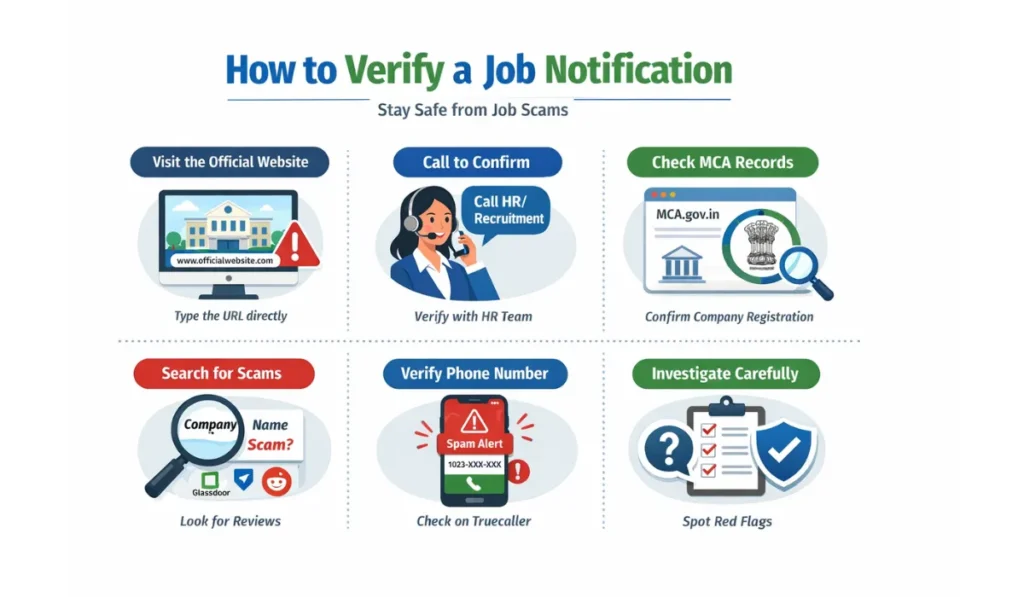
Go to the official website yourself. Don’t click the link in the message. Open a new browser tab and type the company or government body’s web address from memory or a trusted search.
| Organization | Official Website |
| UPSC | upsc.gov.in |
| SSC | ssc.nic.in |
| Indian Railways | indianrailways.gov.in (plus zonal RRB sites) |
| IBPS | ibps.in |
| National Career Service | employment.gov.in |
If the notification isn’t listed there, it’s not real, no matter how official it looked in your inbox.
Call the HR or recruitment number listed on the official site. This takes maybe five minutes and can save you weeks of regret. Most companies are used to this question and will confirm or deny it on the spot.
Check if the company actually exists. Every legitimate private company in India is registered with the Ministry of Corporate Affairs. A quick search on mca.gov.in will tell you whether the name shows up at all. No listing usually means no company.
Search the name with the word “scam” next to it. Sounds blunt, but it works. Glassdoor and AmbitionBox often have employee reviews that call out fraudulent recruiters directly, and Reddit threads (r/india is particularly active here) tend to surface patterns fast.
Run the phone number through Truecaller. If multiple people have already flagged it as spam, that’s not a coincidence. Also notice whether the call came from a personal mobile number when it really should’ve come from a company landline or verified business line.
Look closely at the document itself, especially for government notices. Check for:
- A proper letterhead and advertisement number
- Signatures, seals, and dates that look authentic
- Department names and logos that match what you’ve seen before
- Formal language consistent with how official notices usually read
Check the organization’s verified social media pages. Real announcements from large companies or government bodies usually show up on their official LinkedIn, X, or Facebook accounts. If you only see it shared in a personal WhatsApp group, that’s a gap worth noticing.
Government Job Notifications Need an Extra Layer of Caution
Because sarkari naukri carries so much weight, scammers put extra effort into faking it convincingly. Stick to these sources, no exceptions:
| Category | Official Portal |
| Central Government Jobs | employment.gov.in |
| SSC | ssc.nic.in |
| UPSC | upsc.gov.in |
| IBPS | ibps.in |
| Railways | rrbcdg.gov.in and zonal RRB sites |
| State PSC | State-specific portals (e.g., mpsc.gov.in, tnpsc.gov.in) |
Two things worth remembering here: government jobs never require payment beyond the official application fee, and that fee is always paid through the government’s own payment system, never to someone’s personal UPI ID. Also, genuine vacancies always appear in Employment News or major national newspapers. If a notice is circulating only through WhatsApp or Telegram and nowhere else, treat that absence as a red flag in itself.
If You Think You’ve Spotted a Fake Notification
A few things to do right away:
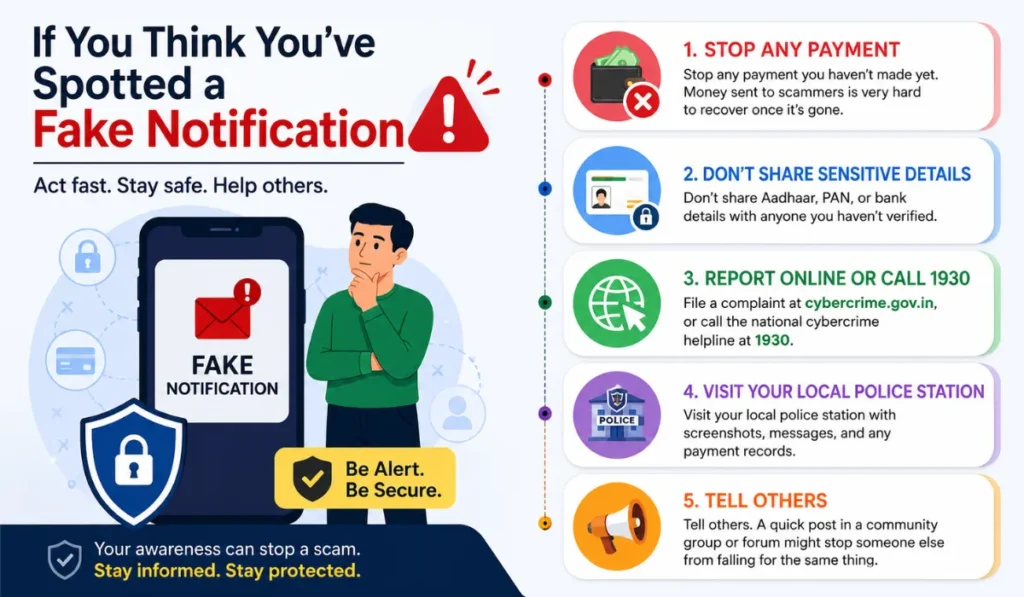
- Stop any payment you haven’t made yet. Money sent to scammers is very hard to recover once it’s gone.
- Don’t share Aadhaar, PAN, or bank details with anyone you haven’t verified.
- File a complaint at cybercrime.gov.in, or call the national cybercrime helpline at 1930.
- Visit your local police station with screenshots, messages, and any payment records.
- Tell others. A quick post in a community group or forum might stop someone else from falling for the same thing.
Where to Actually Look for Real Jobs
Sticking to established platforms reduces your risk significantly, though it doesn’t eliminate the need to verify individual listings.
| Platform | Best Suited For |
| Naukri.com | General job search across industries |
| Verified company pages, professional networking | |
| Indeed India | Global platform with strong India-specific listings |
| Shine.com | Widely used domestic job portal |
| Monster India | Long-established recruitment platform |
| NCS Portal (employment.gov.in) | Government’s own job-matching service |
| iimjobs.com | Mid-to-senior level roles |
| Freshersworld.com | Entry-level positions for new graduates |
Even here, the occasional fake listing slips through. Treat verification as a habit, not a one-time exception.
A Few Habits Worth Building
Staying safe isn’t about one clever check. It’s about a mindset you carry into every job search.
- Be cautious about uploading Aadhaar or PAN documents to portals you haven’t personally verified.
- Treat forwarded WhatsApp job offers with skepticism by default. Real opportunities rarely travel that way.
- Lean on trusted networks: your college placement cell, people you actually know, and official company career pages.
- Stay a little curious about new scam tactics. Following credible cybersecurity accounts or news sources helps you recognize patterns before they catch you off guard.
| Join Yuva Safar WhatsApp Group for Latest Job Updates | Click Here |
| Join Our Telegram Channel for Daily Government & Private Job Alerts | Click Here |
Frequently Asked Questions
Q1. Is it normal for a company to ask for a registration fee before an interview? No. A real employer never charges you to apply. If money comes up before you’ve even started the job, that’s the scam talking.
Q2. I got a job offer over WhatsApp from a well-known company. Is it real? Almost certainly not. Large companies rarely, if ever, recruit through random WhatsApp messages. Check directly on their official site before responding.
Q3. How do I check if a private company is actually registered in India? Search the name on mca.gov.in. If it’s not listed in the registry, it isn’t a recognized company.
Q4. I’ve already paid a recruiter who turned out to be fake. What now? File a complaint immediately at cybercrime.gov.in or call 1930. Visit your local police station too, with screenshots and proof of payment.
Q5. Do real government job notifications ever come through email or SMS? They might send reminders this way, but the original notification always lives on the official website and in Employment News. Never rely on an SMS or email alone.
Q6. What if the email looks really polished and professional? Scammers have gotten better at this. Still check the sender’s domain, visit the official website separately, and call the listed HR number to confirm.
Q7. Can I trust job postings shared on Telegram channels? Not automatically. Plenty of unofficial channels spread fake notices. Always cross-check against the organization’s own website.
Q8. A friend referred me to a recruiter who’s now asking for money. Is that okay? No. Even a trusted referral can unknowingly lead you to a scam. If money is requested, it’s fraud, regardless of who introduced you.
Q9. How do I know if a government notification follows the correct format? Compare it to older notifications from the same department. Look at the advertisement number, the seals, the department name, and whether the tone matches what you’ve seen before.
Q10. Is there an actual helpline for job fraud in India? Yes. Call 1930, the national cybercrime helpline, or report online at cybercrime.gov.in.
Final Thoughts
A job offer that turns out to be fake costs more than just money. It costs time you didn’t have to spare and a bit of hope you were counting on. The good news is that none of the checks in this guide require special skills or hours of effort. A few minutes spent confirming a website, checking an email domain, or making one phone call can save you from a situation that’s much harder to undo.
India’s job market has real opportunities in it, plenty of them. Just make sure the one in front of you is one of them before you act.