Government jobs in India are more than just career choices — they represent stability, respect, and a secure future. Whether you dream of becoming an IAS officer, joining the Indian Army, working in a nationalized bank, or serving in the railways, the path leads through one common gateway: a government competitive exam.
The question most aspirants ask is: Can I really crack a government exam on the first attempt? The honest answer is yes — but only with the right strategy, consistent effort, and the correct mindset. This guide breaks down exactly how to do it.
Understanding Government Exams in India
India conducts hundreds of government recruitment exams across departments and levels every year. Before you begin preparing, it is important to understand the landscape and identify where you fit.
| Exam Category | Popular Exams |
|---|---|
| Civil Services | UPSC IAS, IPS, IFS |
| Staff Selection | SSC CGL, CHSL, MTS, CPO |
| Banking | IBPS PO, Clerk, SO; SBI PO, Clerk |
| Railways | RRB NTPC, Group D, ALP |
| State Public Service | UPPSC, MPPSC, BPSC |
| Defence | NDA, CDS, CAPF |
| Teaching | CTET, DSSSB |
| Medical | NEET, AIIMS |
Each exam has its own syllabus, pattern, and difficulty level. The first step toward success is choosing the right exam and understanding it completely.
Step 1: Choose the Right Exam for Your Profile
One of the most common mistakes aspirants make is preparing for multiple exams simultaneously without focusing on any single one. This scattered approach leads to poor performance across the board.
Before finalizing your target exam, reflect on the following:
- What is your educational qualification and subject background?
- Which age group and category do you belong to?
- What kind of role interests you — administrative, technical, banking, defence, or teaching?
Once you identify your target exam, commit to it fully. A focused preparation strategy dramatically increases your chances of clearing the exam on the first attempt.
Step 2: Understand the Syllabus and Exam Pattern Thoroughly
This is arguably the most critical step — and the most frequently skipped. Many aspirants begin reading books without ever properly studying the official notification and syllabus. That is a costly mistake.
For every exam you target, find clear answers to the following:
- How many stages does the exam have (Prelims, Mains, Interview)?
- What subjects are covered in each stage?
- Is there negative marking? If yes, what is the penalty?
- How much time is given for each paper?
- What is the question format — MCQ, descriptive, or both?
Here is a quick comparison of two popular exams:
| Feature | SSC CGL | UPSC Civil Services |
|---|---|---|
| Number of Stages | 2 (Tier I & Tier II) | 3 (Prelims, Mains, Interview) |
| Key Subjects | Maths, English, GK, Reasoning | History, Geography, Polity, Economy, Science, Optional Subject |
| Negative Marking | Yes | Yes (Prelims only) |
| Descriptive Paper | No | Yes (Mains) |
Understanding the exam structure prevents you from wasting time on irrelevant topics and allows you to build a targeted study plan.
Step 3: Use the Right Study Materials
The market is flooded with books, apps, and coaching materials for government exams. More resources do not mean better preparation. The golden rule is: study fewer books more thoroughly.
Here are the most trusted and widely recommended resources:
| Subject | Recommended Resources |
|---|---|
| General Knowledge | NCERT Books (Class 6–12), Lucent’s General Knowledge |
| Current Affairs | The Hindu / Indian Express (daily), Pratiyogita Darpan, Competition Success Review |
| Quantitative Aptitude | R.S. Aggarwal, Arun Sharma (Banking/CAT level) |
| English Grammar | Wren & Martin, SP Bakshi’s Objective English (Arihant) |
| Reasoning | R.S. Aggarwal – Verbal & Non-Verbal Reasoning |
| Banking-Specific | M. Tyra’s Quicker Maths, Kiran’s IBPS/SSC Books |
Useful online platforms:
- YouTube: Unacademy, Adda247, Testbook, Wifistudy, Drishti IAS, Vision IAS
- Mock Test Portals: Testbook, Gradeup (now Adda247), Oliveboard, BYJU’s Exam Prep
Stick to standard resources, revise them multiple times, and avoid the temptation of collecting new books every week.
Step 4: Build a Realistic and Structured Study Plan
A goal without a plan is just a wish. You need a well-structured timetable that maps your entire syllabus to the available time before your exam.
How to build an effective study plan:
- Check the exam date and count the weeks remaining.
- List all subjects and topics from the official syllabus.
- Allocate more time to your weaker subjects.
- Follow this time-distribution framework:
| Activity | Time Allocation |
|---|---|
| Learning new topics | 60% |
| Revision of covered material | 30% |
| Mock tests and previous year papers | 10% |
- Aim for 6–8 hours of focused study per day.
- Follow the Pomodoro method: study for 45–50 minutes, then take a 10-minute break.
- Quality of study matters more than the number of hours spent at the desk.
Step 5: Make Current Affairs a Daily Habit
Current Affairs is one of the highest-weightage sections in almost every government exam — UPSC, SSC, Banking, Railways — no exam is exempt.
Build a daily current affairs routine:
- Read The Hindu or Indian Express every morning for 30–45 minutes.
- Note important events: government schemes, appointments, awards, sports, economy, and international news.
- Watch daily current affairs videos on YouTube channels like Drishti IAS or Adda247.
- Revise your notes every weekend.
- Download free monthly current affairs PDFs from Testbook, Adda247, or GradeUp.
Consistency here is non-negotiable. Even 30 minutes of daily reading adds up significantly over months of preparation.
Step 6: Solve Previous Year Question Papers
Solving past exam papers is a non-negotiable part of any serious preparation strategy. There is no better way to understand the pattern, difficulty level, and recurring topics of an exam.
Benefits of solving previous year papers:
- Identifies the most frequently tested topics
- Improves speed and accuracy under exam conditions
- Reduces exam-day anxiety by making the format familiar
- Helps you recognize question patterns that repeat year after year
Aim to solve at least the last 5–10 years of papers for your target exam. For UPSC, go even further back.
Step 7: Take Mock Tests Regularly and Analytically
Mock tests are the closest simulation of the real exam experience. Most toppers credit regular mock tests as one of their primary tools for success.
How to use mock tests effectively:
- Begin full-length mock tests at least 2–3 months before the exam.
- Attempt each test in real exam conditions — timed, no distractions, no breaks.
- After every test, spend as much time analyzing your mistakes as you spent taking the test.
- Track your progress over multiple tests and identify weak areas for targeted revision.
Recommended mock test platforms: Testbook, Adda247, Oliveboard, SmartKeeda, BYJU’s Exam Prep.
Step 8: Master Time Management During the Exam
Knowing the answers is only half the battle. Finishing the paper accurately within the allotted time is equally important — and it is a skill that must be practiced.
Time management tips for exam day:
- Attempt easy and familiar questions first to secure quick marks.
- Set a mental time budget for each section before the paper begins.
- Skip difficult questions and return to them only if time permits.
- In exams with negative marking, attempt a question only if you are at least 70% confident of the correct answer.
- Never spend more than 60–90 seconds on a single question in objective papers.
Regular mock test practice is the best way to develop this time discipline naturally.
Step 9: Prioritize Your Health and Mental Well-Being
Government exam preparation is a long journey — sometimes 6 months, sometimes over a year. Many aspirants neglect their physical and mental health during this period, which directly undermines their performance.
Non-negotiable health habits for exam aspirants:
- Sleep at least 7–8 hours every night. Sleep is essential for memory consolidation.
- Exercise for at least 30 minutes daily — even a brisk walk counts.
- Eat balanced, nutritious meals. Minimize junk food and excessive caffeine.
- Practice 10–15 minutes of meditation or breathing exercises to manage stress.
- Limit social media usage — it is one of the biggest productivity killers.
- Stay connected with family and friends to prevent burnout and isolation.
Many top rankers have spoken publicly about how a consistent fitness routine kept them mentally sharp throughout their preparation.
Step 10: Stay Consistent and Avoid Common Mistakes
The single biggest difference between candidates who clear exams on the first attempt and those who do not is consistency. Many aspirants study intensely for a few weeks, lose motivation, and fall into a cycle of stop-start studying.
Common mistakes to avoid:
| Mistake | What to Do Instead |
|---|---|
| No structured study plan | Create a weekly and monthly timetable |
| Ignoring the syllabus | Study only what is in the official syllabus |
| Reading without revision | Revise each topic at least 2–3 times |
| Comparing with others | Focus on your own progress |
| Relying only on coaching | Balance coaching with strong self-study |
| Skipping mock tests | Take full-length tests every week |
| Starting preparation too late | Begin as soon as the notification is released |
Study every single day. On low-motivation days, commit to at least 2–3 hours. Long-term consistency beats short bursts of intense effort every time.
Coaching vs. Self-Study: What Works Better?
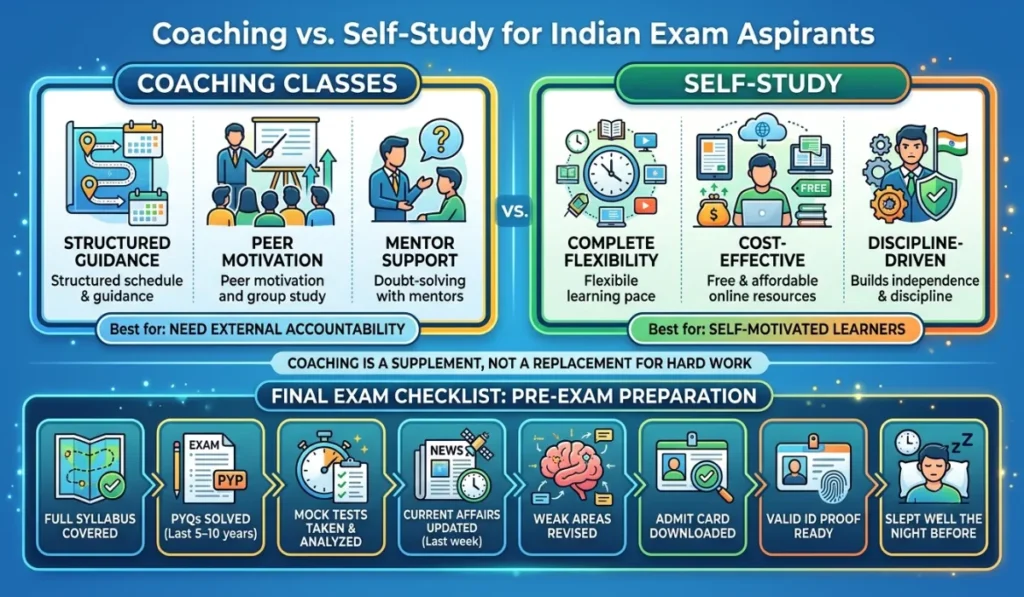
This is one of the most debated questions among Indian exam aspirants. The truth is that coaching is a supplement, not a replacement for hard work.
Many toppers — including UPSC rank-holders — have cleared their exams through self-study alone. Today, free and affordable online resources have made self-study more powerful than ever.
| Coaching Classes | Self-Study |
|---|---|
| Structured schedule and guidance | Complete flexibility in learning pace |
| Peer motivation and group study | Cost-effective with free online resources |
| Doubt-solving with mentors | Discipline-driven, builds independence |
| Suitable if you need external accountability | Ideal for self-motivated learners |
If you cannot afford coaching, do not be discouraged. With the right books, free online resources, and consistent effort, self-study is more than sufficient to crack any government exam in India.
Final Exam Checklist
Before your exam day, ensure you have covered all the bases:
- Full syllabus covered
- Previous year papers solved (last 5–10 years)
- Mock tests taken regularly and analyzed
- Current affairs updated until the last week
- Weak areas identified and revised
- Admit card downloaded and exam centre verified
- Valid ID proof ready
- Slept well the night before the exam
| Join Yuva Safar WhatsApp Group for Latest Job Updates | Click Here |
| Join Our Telegram Channel for Daily Government & Private Job Alerts | Click Here |
Frequently Asked Questions (FAQs)
Q1. Can I crack a government exam in the first attempt without coaching? Yes. Thousands of candidates clear UPSC, SSC, and banking exams every year through disciplined self-study using standard books and free online resources.
Q2. How many hours should I study daily? 6 to 8 hours of focused, distraction-free study is sufficient. Quality always matters more than quantity.
Q3. Which newspaper is best for current affairs? The Hindu and Indian Express are the most recommended newspapers for government exam current affairs preparation.
Q4. How important are NCERT books? Extremely important, especially for UPSC and State PSC exams. NCERTs from Classes 6 to 12 provide a strong conceptual foundation in History, Geography, Science, and Civics.
Q5. What should I do if I fail in the first attempt? Analyze your mistakes honestly, revise your strategy, and try again with greater focus. Many successful officers cleared their exams in the second or third attempt.
Q6. Is there an age limit for government exams? Yes, it varies by exam. UPSC allows attempts between 21–32 years (with relaxation for reserved categories). SSC, banking, and railway exams have their own respective age limits.
Q7. Which is the toughest government exam in India? The UPSC Civil Services Examination is widely considered the toughest due to its vast syllabus, multiple stages, and intense competition.
Q8. Can I prepare for multiple government exams simultaneously? It is possible when exams share similar syllabi (e.g., SSC CGL and IBPS PO), but focusing on one exam at a time yields the best results for a first-attempt clearance.
Conclusion
Cracking a government exam on the first attempt is not about luck or extraordinary intelligence. It is the outcome of smart planning, consistent daily effort, and the right attitude maintained over months of preparation.
Choose your exam. Master the syllabus. Use the right resources. Study every day. Take mock tests. Take care of your health.
Millions of aspirants from small towns and modest backgrounds have transformed their lives by clearing these exams. You have every reason to be next.
Start today. Stay focused. Trust the process.