English remains one of the most decisive sections in competitive exams across India. Whether you are preparing for SSC CGL, UPSC, IBPS Bank PO, Railway RRB, CLAT, or CAT, your score in the English section can make or break your final result.
For millions of students from Hindi-medium backgrounds or regional-language schools, this section feels like the biggest wall to climb. But here is the truth — any student can master English for competitive exams with the right strategy, consistent effort, and the right resources.
This guide covers everything you need: grammar essentials, reading comprehension strategies, smart vocabulary-building methods, and time management tips for exam day. Whether you are starting from zero or trying to push an existing score higher, this guide is written for you.
Why English Matters So Much in Competitive Exams
English carries serious weight in almost every major competitive exam in India. Here is a quick look at how much it counts:
| Competitive Exam | Section Name | Marks / Weightage |
| SSC CGL | English Language | 50 marks (25 questions) |
| IBPS PO | English Language | 30 marks |
| UPSC CSAT | English Comprehension | Separate paper |
| CAT | VARC (Verbal Ability & RC) | One-third of total marks |
| SBI PO | English Language | 30 marks |
| RRB NTPC | General English | 30 marks |
Students from Hindi-speaking states like Bihar, Uttar Pradesh, Madhya Pradesh, and Rajasthan — or from regional-medium schools in Tamil Nadu, West Bengal, Odisha, or Kerala — often struggle here. Not because they are not smart, but simply because of limited exposure and practice.
Here is the good news: competitive exam English is not about speaking fluently or writing literary essays. It is about knowing grammar rules, building vocabulary, and understanding written passages. These are learnable skills — every single one of them.
Step 1: Understand the Exam Pattern and Syllabus First
Before you open a single textbook, know exactly what your target exam tests. Spending weeks on the wrong topics is one of the most common — and costly — mistakes aspirants make.
| Exam Category | Key English Topics Tested |
| SSC (CGL, CHSL, MTS) | Error Detection, Sentence Improvement, Fill in the Blanks, Synonyms & Antonyms, Idioms & Phrases, One Word Substitution, Reading Comprehension, Cloze Test, Para Jumbles |
| Banking (IBPS PO, SBI PO, RBI Grade B) | Reading Comprehension, Cloze Test, Error Detection, Sentence Correction, Word Usage, Para Jumbles |
| CAT / MBA Entrance | Reading Comprehension (high difficulty), Para Summary, Odd One Out, Para Jumbles |
Once you know your exam’s blueprint, you can spend your time where it actually counts.
Step 2: Build a Strong Grammar Foundation
Grammar is the backbone of every English question type. Most questions in SSC, Banking, and Railway exams test grammar — directly or indirectly. You do not need to study it like a literature student. You just need the rules that show up in your exam.
| Grammar Topic | Why It Matters | Where It Is Tested |
| Subject-Verb Agreement | Matches singular/plural subjects with the correct verb | Error Detection |
| Tenses (all 12) | Correct usage of time-based verb forms | Sentence Correction |
| Parts of Speech | Identifies nouns, pronouns, adjectives, adverbs, etc. | Fill in the Blanks |
| Articles (A, An, The) | Definite vs. indefinite article rules | Error Detection |
| Prepositions | Correct linking between phrases | SSC & Banking Exams |
| Active & Passive Voice | Converts sentence structures | SSC Direct Topic |
| Direct & Indirect Speech | Tense shift, pronoun and time expression rules | SSC & State Exams |
| Degrees of Comparison | Comparative and superlative forms | Sentence Improvement |
| Conjunctions & Sentence Structure | Joining clauses correctly | Sentence Improvement |
Recommended grammar books:
- Wren & Martin — High School English Grammar and Composition (the go-to Indian reference)
- SP Bakshi’s Objective General English (built specifically for Indian competitive exams)
- Neetu Singh’s English Grammar (very popular among SSC aspirants)
Spend 30 to 45 minutes daily on grammar. Do not just read the rules — solve 20 to 30 MCQs on each topic the same day you study it. That is what makes the rules actually stick.
Step 3: Build Vocabulary the Smart Way
Vocabulary is what separates average scorers from top performers. Many students make the mistake of trying to memorise hundreds of random words in one go. That approach rarely works. Here is what actually does:
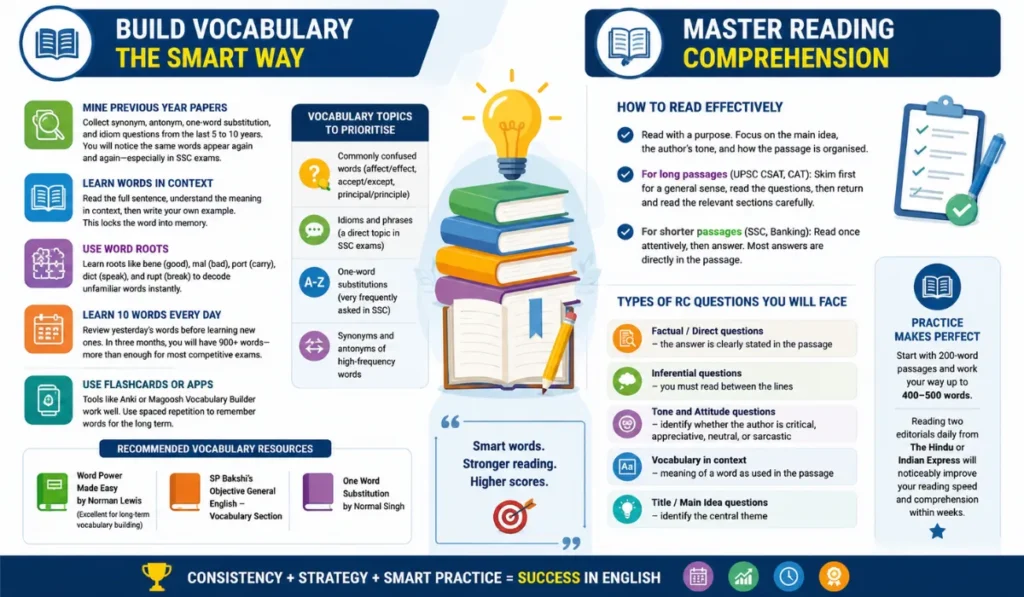
- Mine previous year papers. Collect all synonym, antonym, one-word substitution, and idiom questions from the last 5 to 10 years of your target exam. You will quickly notice the same words appearing again and again — especially in SSC exams.
- Learn words in context. Never study a word in isolation. Read the full sentence it appears in, understand its meaning in context, then write it down with your own example. This locks the word into memory far more effectively.
- Use word roots. Many English words share Latin and Greek roots. Learning roots like bene (good), mal (bad), port (carry), dict (speak), and rupt (break) lets you decode unfamiliar words on the spot. If you know bene means good, you can figure out benevolent, benefactor, and benefit without memorising them one by one.
- Learn 10 words every day. This is a sustainable, manageable target. Review yesterday’s words before learning new ones. In three months, you will have 900+ words — more than enough for most competitive exams.
- Use flashcards or apps. Tools like Anki or Magoosh Vocabulary Builder work well. Write the word, its meaning, and an example sentence. Review using spaced repetition.
Vocabulary topics to prioritise:
- Commonly confused words (affect/effect, accept/except, principal/principle)
- Idioms and phrases (a direct topic in SSC exams)
- One-word substitutions (very frequently asked in SSC)
- Synonyms and antonyms of high-frequency words
Recommended vocabulary resources:
- Word Power Made Easy by Norman Lewis (excellent for long-term vocabulary building)
- SP Bakshi’s Objective General English — Vocabulary Section
- One Word Substitution by Normal Singh
Step 4: Master Reading Comprehension
Reading Comprehension (RC) appears in virtually every competitive exam and carries significant marks. Many students avoid it because it feels time-consuming. That is a costly mistake. When approached correctly, RC can become your most reliable scoring area.
How to read effectively:
- Read with a purpose. Focus on the main idea, the author’s tone, and how the passage is organised. Passive, unfocused reading wastes time and yields nothing.
- For long passages (UPSC CSAT, CAT): Skim first for a general sense, read the questions, then return and read the relevant sections carefully.
- For shorter passages (SSC, Banking): Read once attentively, then answer. Most answers are directly in the passage.
Types of RC questions you will face:
- Factual / Direct questions — the answer is clearly stated in the passage
- Inferential questions — you must read between the lines
- Tone and Attitude questions — identify whether the author is critical, appreciative, neutral, or sarcastic
- Vocabulary in context — meaning of a word as used in the passage
- Title / Main Idea questions — identify the central theme
Start with 200-word passages and work your way up to 400 to 500 words. Reading two editorials daily from The Hindu or Indian Express will noticeably improve both your reading speed and comprehension within weeks.
Step 5: Practise Cloze Tests and Para Jumbles
These two question types appear in almost every banking and SSC exam. With consistent practice, they become some of the easiest marks you can secure.
Cloze Test tips:
- Read the entire passage before filling in any blank. Context is everything.
- Use grammar and logic together — the correct word must fit both the sentence structure and the meaning of the passage.
- Practise at least two cloze tests every day.
Para Jumble tips:
- Find the opening sentence first. It typically introduces the topic without using a pronoun that refers to something not yet mentioned.
- Look for linking words — therefore, however, moreover, consequently — to connect sentences logically.
- Match pronouns to nouns. This tells you which sentence follows which.
- Identify cause-and-effect relationships between sentences.
- Practise at least five para jumbles daily. Patterns become easy to recognise once you have enough practice.
Step 6: Follow a Realistic Daily Study Plan
Consistency beats intensity every time. You do not need four hours a day — you need focused, structured daily practice. Here is a simple plan that takes under two hours:
| Time Slot | Duration | Activity |
| Morning | 30 minutes | Read one editorial from The Hindu or Indian Express. Note 5 new words. Identify the main argument. |
| Afternoon | 30 minutes | Study one grammar topic. Solve 20–30 MCQs from previous year papers on that topic. |
| Evening | 30 minutes | Attempt a full English section mock test. Review every mistake immediately after. |
| Before Sleep | 10 minutes | Revise vocabulary flashcards from the past week. |
That is roughly 100 minutes a day — completely manageable even when juggling multiple subjects.
Step 7: Use Previous Year Papers and Mock Tests
No preparation is complete without regular mock testing. Previous year papers are your most valuable study tools because they:
- Show you the actual difficulty level of the exam
- Reveal which topics appear most frequently
- Train your mind to perform under time pressure
- Help you identify and fix your weak areas
Where to find free resources:
- Testbook, Adda247, Gradeup (now Exam Cognition) — free and paid mock tests for all major Indian exams
- SSC official website — past papers available for download
- IBPS official website — sample papers and practice sets
Attempt at least one full English section mock test every week. After each test, spend double that time reviewing your mistakes. Understanding why you got something wrong is more valuable than getting it right in the first place.
Step 8: Avoid These Common Mistakes
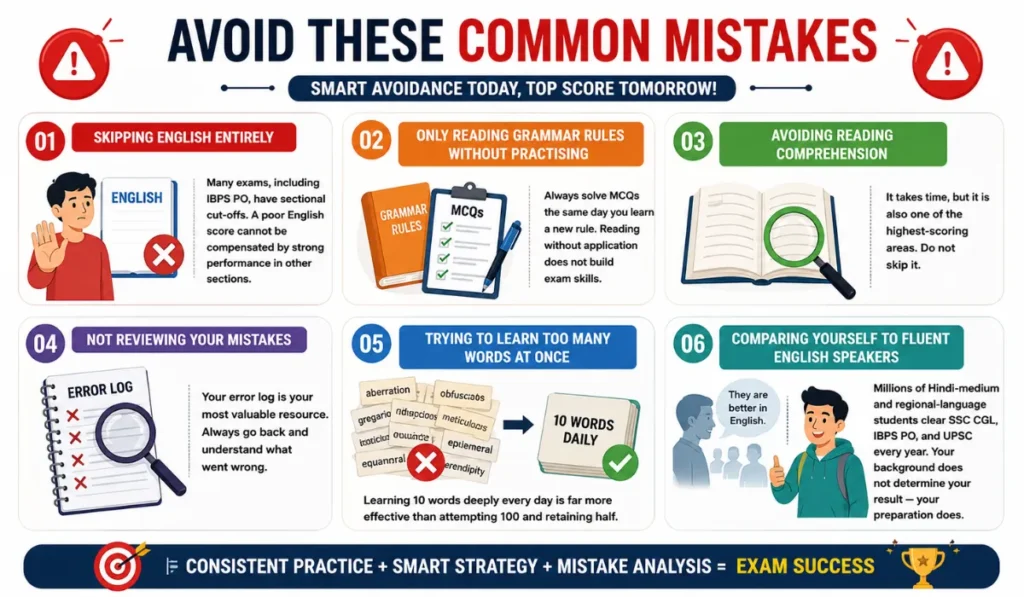
- Skipping English entirely. Many exams, including IBPS PO, have sectional cut-offs. A poor English score cannot be compensated by strong performance in other sections.
- Only reading grammar rules without practising. Always solve MCQs the same day you learn a new rule. Reading without application does not build exam skills.
- Avoiding Reading Comprehension. It takes time, but it is also one of the highest-scoring areas. Do not skip it.
- Not reviewing your mistakes. Your error log is your most valuable resource. Always go back and understand what went wrong.
- Trying to learn too many words at once. Learning 10 words deeply every day is far more effective than attempting 100 and retaining half.
- Comparing yourself to fluent English speakers. Millions of Hindi-medium and regional-language students clear SSC CGL, IBPS PO, and UPSC every year. Your background does not determine your result — your preparation does.
Recommended Books at a Glance
| Book Title | Author | Best For |
| Objective General English | SP Bakshi | SSC, Banking, Railway (all-in-one) |
| High School English Grammar and Composition | Wren & Martin | Grammar fundamentals |
| Word Power Made Easy | Norman Lewis | Long-term vocabulary building |
| Plinth to Paramount (English) | Neetu Singh | SSC grammar & error detection |
| English Language and Comprehension | Kiran Publication | SSC practice papers |
| How to Prepare for Verbal Ability and RC | Arun Sharma | CAT / MBA entrance exams |
| Join Yuva Safar WhatsApp Group for Latest Job Updates | Click Here |
| Join Our Telegram Channel for Daily Government & Private Job Alerts | Click Here |
Conclusion
Improving your English for competitive exams is not about becoming a literature expert or sounding like a native speaker. It is about mastering a specific, learnable set of skills — grammar rules, vocabulary patterns, reading strategies, and question-solving techniques.
The formula is simple:
- Read one newspaper editorial every day
- Practise 30 to 50 English MCQs daily
- Review every mistake thoroughly
- Learn 10 new vocabulary words each day
- Take at least one full mock test every week
Stick to this routine for three to four months and you will see a real, measurable difference in your scores. Thousands of students who once found English overwhelming have gone on to clear SSC CGL, IBPS PO, UPSC, and CAT. You can too. Start today.
Frequently Asked Questions (FAQ)
Q1. Which book is best for English in SSC exams? SP Bakshi’s Objective General English is the most recommended book for SSC and banking exam preparation in India.
Q2. How many words should I learn daily? Aim for 10 new words per day. This pace is sustainable and builds a 900+ word vocabulary in just three months.
Q3. Is The Hindu newspaper helpful for exam prep? Absolutely. The Hindu’s editorials are excellent for sharpening reading comprehension and expanding academic vocabulary.
Q4. How long does it take to see improvement? With one hour of focused daily practice, most students notice a clear improvement within two to three months.
Q5. Can a Hindi-medium student clear the English section? Yes — without any doubt. Thousands of Hindi-medium students clear SSC CGL, IBPS PO, and UPSC every year with smart, structured preparation.
Q6. Should I prioritise grammar or vocabulary? Start with grammar. It forms the base for nearly all question types. Build vocabulary on top once your grammar foundation is solid.
Q7. Are previous year papers necessary? They are essential. Past papers show you the actual exam pattern, reveal repeating topics, and train you to work under real exam conditions.
Q8. What grammar topics are most important for SSC? Focus on Error Detection, Sentence Improvement, Active-Passive Voice, Direct-Indirect Speech, and Tenses.
Q9. How do I improve in Reading Comprehension? Read one editorial daily and practise RC passages regularly. Always focus on the main idea and the author’s tone, not just isolated facts.
Q10. Are online mock tests useful? Yes. Platforms like Testbook, Adda247, and Gradeup offer free and paid mock tests that closely mirror real exam patterns.