Lakhs of students dream of a government job every year. But not everyone can afford expensive coaching institutes in Delhi, Patna, or Kota. The good news? You don’t need one. With the right strategy, self-discipline, and free resources, you can crack any government exam sitting at home in your own town.
This guide breaks down exactly how to do that, step by step.
Why Self-Study Works Just as Well as Coaching
Coaching centers sell structure, not magic. They give you a syllabus, study material, and a fixed schedule. You can build all three yourself, for free, using the internet.
Thousands of toppers across SSC, Banking, Railway, and state PSC exams have cleared without joining any institute. Many of them studied from their village or small town, far from any coaching hub. What they had in common was consistency, not coaching. Self-study also gives you the freedom to learn at your own pace, repeat weak topics as many times as needed, and avoid wasting hours and money commuting to a coaching class in the city.
Step 1: Understand the Exam Pattern Thoroughly
Before opening a single book, study the exam itself. Every government exam, whether it’s SSC, UPSC, Railway, or a state PSC, has a fixed pattern, and knowing it saves months of wasted effort.
Visit the official website of the exam body. Download the latest notification PDF. Read every section carefully, including the syllabus, marking scheme, and eligibility criteria.
| Element to Check | Why It Matters |
| Exam stages | Tells you how many rounds you need to clear |
| Syllabus | Defines exactly what to study and what to skip |
| Marking scheme | Helps you decide which sections to prioritize |
| Negative marking | Changes your guessing strategy during the exam |
| Previous cutoffs | Gives a realistic target score |
Once you know the pattern, you stop studying randomly and start studying with purpose.
Step 2: Collect the Right Study Material
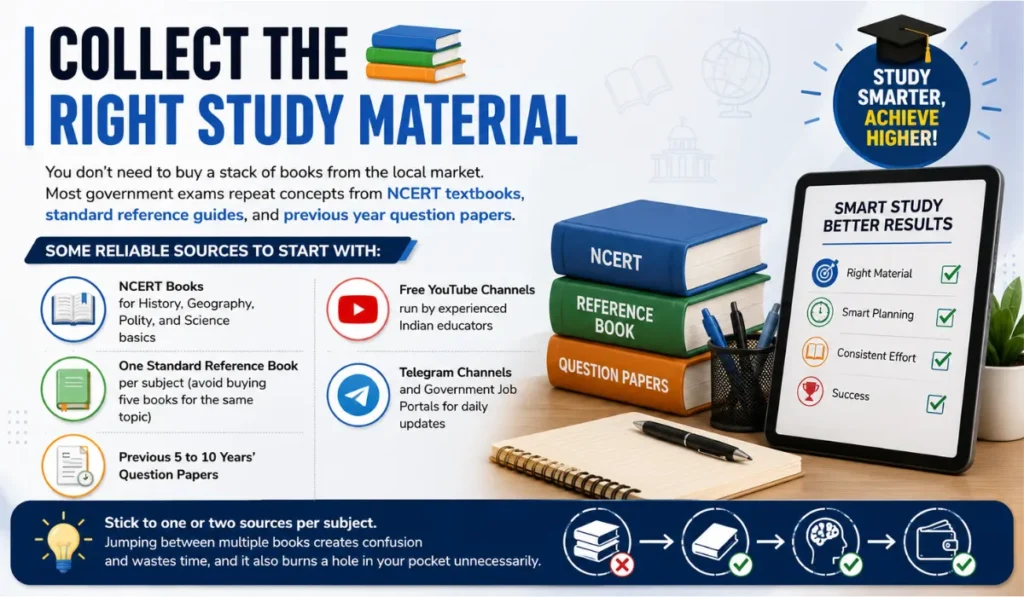
You don’t need to buy a stack of books from the local market. Most government exams repeat concepts from NCERT textbooks, standard reference guides, and previous year question papers.
Some reliable sources to start with:
- NCERT books for History, Geography, Polity, and Science basics
- One standard reference book per subject (avoid buying five books for the same topic)
- Previous 5 to 10 years’ question papers
- Free YouTube channels run by experienced Indian educators
- Telegram channels and government job portals for daily updates
Stick to one or two sources per subject. Jumping between multiple books creates confusion and wastes time, and it also burns a hole in your pocket unnecessarily.
Step 3: Build a Realistic Study Timetable
A timetable only works if you can actually follow it. Don’t copy a topper’s 12-hour schedule from a YouTube video if you can only manage 5 hours a day. Many aspirants in India are also working part-time, helping with family responsibilities, or studying alongside college. Build something that fits your actual life.
| Time Block | Suggested Activity |
| Morning | Tackle the toughest subject when your mind is fresh |
| Afternoon | Revise previous day’s topics |
| Evening | Practice mock tests or solve previous papers |
| Night | Quick revision of formulas, dates, or static GK |
Keep one day each week lighter, for revision or rest. Burnout kills consistency faster than laziness does.
Step 4: Focus on NCERT and Basics First
Many aspirants jump straight into advanced books and skip the basics. This is a mistake. Government exams test fundamental understanding, not complex theories.
Start with NCERT books from Class 6 to 12 for subjects like History, Geography, Economics, and Polity. They’re available cheaply, even in Hindi medium, and explain concepts in simple language. Once basics are clear, move to advanced reference books or static GK compilations.
Step 5: Practice Previous Year Question Papers
This single habit can make or break your preparation. Previous year papers reveal:
- Which topics appear repeatedly
- The difficulty level of questions
- How questions are framed
- Time management patterns
Solve at least the last 8 to 10 years of papers for your target exam. Time yourself while solving them. This builds speed and reduces exam-day anxiety, which matters a lot given how competitive Indian government exams have become.
Step 6: Take Regular Mock Tests
Mock tests simulate real exam conditions. They show you where you stand and which areas need more work.
Many Indian websites and apps offer free or affordable mock tests for SSC, Banking, Railway, and state-level exams. Take one full-length mock every week, then increase frequency as your exam date approaches.
After every mock test, do this:
- Check your accuracy, not just your score
- Identify which topics caused the most mistakes
- Note down silly errors separately
- Revise those weak areas before the next mock
This cycle of test, analyze, and improve is more valuable than reading ten new chapters.
Step 7: Strengthen Current Affairs Daily
Static GK can be memorized once. Current affairs need daily attention. Spend 20 to 30 minutes every day reading a newspaper like The Hindu or a reliable current affairs app.
Make monthly compilations in your own words. Writing things down, even briefly, helps retention far more than just reading.
Step 8: Use Mobile Apps and YouTube Wisely
A smartphone with a decent internet connection is often enough today. Used correctly, it’s a powerful study tool. Used carelessly, it becomes the biggest distraction.
Follow two or three trusted YouTube channels for your exam. Avoid switching channels constantly, since each educator follows a different teaching style, and switching disrupts your rhythm. Turn off social media notifications during study hours. Apps like quiz platforms and PDF readers can replace expensive printed material entirely, saving you both money and shelf space.
Step 9: Join Online Peer Groups, Not Coaching Groups
You don’t need a coaching institute, but you do need a support system. Join Telegram or WhatsApp groups made up of fellow aspirants preparing for the same exam.
These groups help in several ways:
- Share free PDFs and notes
- Discuss doubts instantly
- Stay updated on exam notifications
- Keep you motivated during low phases
Choose groups that are disciplined and exam-focused, not ones filled with irrelevant chatter or rumors about exam dates.
Step 10: Revise Smartly, Not Repeatedly
Revision isn’t about reading the same chapter five times. It’s about active recall. Close the book and try to write down what you remember. Then check what you missed.
Use short notes, flashcards, or mind maps for static subjects like history dates or polity articles. Revise weak topics more frequently than strong ones. This method takes less time and retains more information.
Common Mistakes Self-Study Aspirants Make
| Mistake | Better Approach |
| Buying too many books | Stick to one or two trusted sources |
| Ignoring previous papers | Solve them from day one of preparation |
| Studying without a timetable | Build a flexible but consistent schedule |
| Skipping mock tests | Take at least one mock test weekly |
| Comparing progress with others | Track only your own improvement |
| Studying for hours without breaks | Use short breaks every 45 to 60 minutes |
How Long Should You Prepare Without Coaching?
There’s no fixed answer, since it depends on the exam level and your current knowledge base. As a rough guide:
| Exam Type | Suggested Preparation Time |
| SSC CHSL / Railway Group D | 4 to 6 months |
| SSC CGL / Bank PO | 6 to 9 months |
| UPSC Civil Services | 12 to 18 months |
| State PSC exams | 8 to 12 months |
These are estimates, not rules. Some aspirants need less time, others need more. Focus on quality of preparation rather than rushing toward a deadline.
Staying Motivated During Self-Study
Self-study can feel lonely at times, especially when relatives keep asking when you’ll get a job. There’s no instructor checking your attendance or pushing you forward. You have to build that discipline yourself.
A few things help:
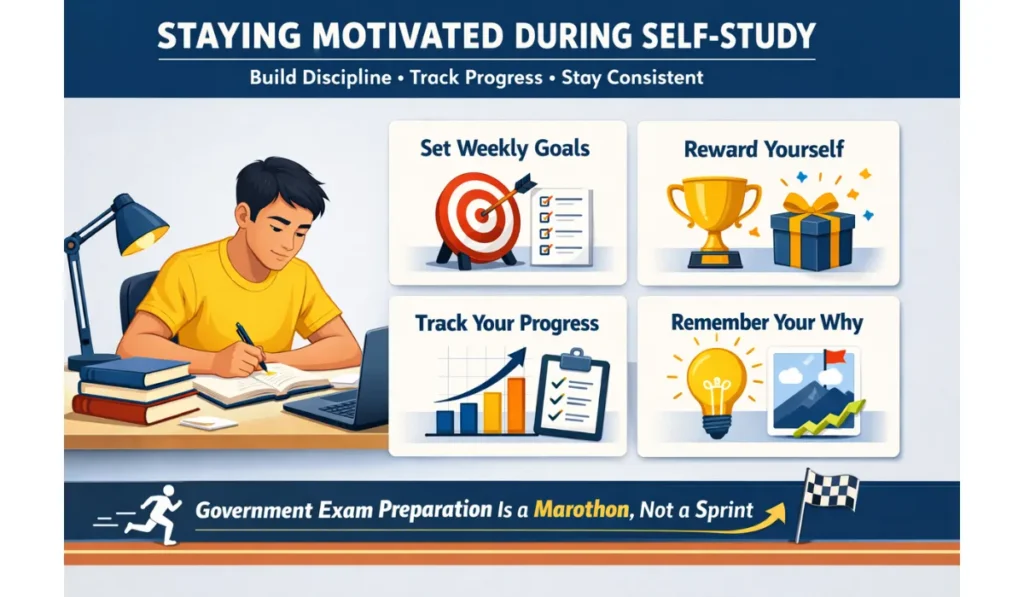
- Set small weekly goals instead of vague long-term ones
- Reward yourself after completing tough topics
- Track progress in a simple notebook or spreadsheet
- Remind yourself why you started, especially on low-motivation days
Government job preparation in India is a marathon, not a sprint. Pace yourself accordingly.
| Join Yuva Safar WhatsApp Group for Latest Job Updates | Click Here |
| Join Our Telegram Channel for Daily Government & Private Job Alerts | Click Here |
Frequently Asked Questions
Is it really possible to clear a government exam without coaching? Yes. Many successful candidates across SSC, Banking, Railway, and state-level exams in India have cleared without joining any coaching institute. Self-discipline and the right strategy matter more than expensive classes in Delhi or Kota.
How many hours should I study daily without coaching? There’s no fixed number. Quality matters more than quantity. Most successful aspirants study 5 to 7 focused hours daily, depending on their job, college, or family commitments.
Which books are best for self-study government exam preparation? NCERT books for basics, along with one standard reference book per subject, work well for most exams. Avoid collecting too many books for the same topic, since it adds unnecessary cost.
How important are mock tests in self-preparation? Extremely important. Mock tests reveal your actual exam-day performance, help with time management, and highlight weak areas that need more attention.
Can YouTube replace coaching classes completely? For most subjects, yes. Many experienced Indian educators offer detailed, free lectures on YouTube in Hindi, English, and regional languages. Stick to two or three trusted channels for consistency.
How do I stay motivated without classmates or a coaching environment? Join online peer groups of fellow aspirants, set small weekly goals, and track your progress regularly. A support system helps even without a physical classroom or coaching batch.
Is current affairs preparation different from static GK? Yes. Static GK can be memorized once and revised occasionally. Current affairs need daily attention since new events, government schemes, and appointments keep adding to the syllabus.
What is the biggest mistake self-study aspirants make? Skipping previous year question papers and mock tests. Many students focus only on reading material and ignore practice, which hurts their speed and accuracy on exam day.
Final Thoughts
Coaching institutes don’t guarantee success, and their absence doesn’t guarantee failure either. What matters is a clear strategy, the right study material, consistent practice, and honest self-evaluation.
Thousands of government job aspirants across India, from small towns to big cities, have proven that self-study works. With discipline and the steps outlined above, you can join that list too.