
Government Job Documents Checklist for Freshers 2026: Complete Guide for First-Time Applicants
If you’re a fresher gearing up to apply for a government job in India in 2026, there’s one step that gets overlooked far more often than it should: getting your documents in order. Every year, thousands of genuinely qualified candidates lose their shot at a government job — not because they failed the exam, but because they showed up to document verification with the wrong certificate, an expired one, or none at all.
This guide covers everything you need, organized by category, so you can start collecting and arranging your paperwork well before you actually need it. Bookmark it. Future-you will be grateful.
Why Document Verification Deserves as Much Attention as the Exam Itself
Clearing the written exam or interview is only half the journey. Document verification (DV) is where many strong candidates unexpectedly stumble. These rounds tend to be strict, fast-paced, and unforgiving of last-minute scrambling — a single missing, outdated, or incorrectly formatted document can cost you a seat you’ve spent months, sometimes years, working toward.
The smartest approach is to start preparing your documents before you even sit for the exam. Below is a category-wise breakdown of everything you’ll typically need.
Category 1: Identity Proof Documents
These establish who you are, and most recruitment boards ask for at least two or three of them.
| Document | Why It Matters | What to Check |
| Aadhaar Card | The default identity document for nearly all government job applications | Mobile number linked for OTP, address updated, name matches your Class 10 certificate exactly |
| PAN Card | Mandatory for central government roles, banking jobs, and any post involving financial handling | Apply via the Income Tax Department portal or NSDL if you don’t have one (typically takes 15–20 working days) |
| Voter ID (EPIC) | Doubles as both identity and address proof | Make sure you’re registered on the electoral roll if you’ve recently turned 18 |
| Passport | One of the strongest identity proofs; often requested in UPSC and central government DV rounds | Also works as age proof — worth applying for even if not immediately required |
| Driving License | Valid for both identity and address verification | Keep a self-attested copy on hand |
Keep your originals safe, along with several self-attested photocopies of each, and download a backup e-Aadhaar from uidai.gov.in in case the physical card is misplaced.
Category 2: Age Proof Documents
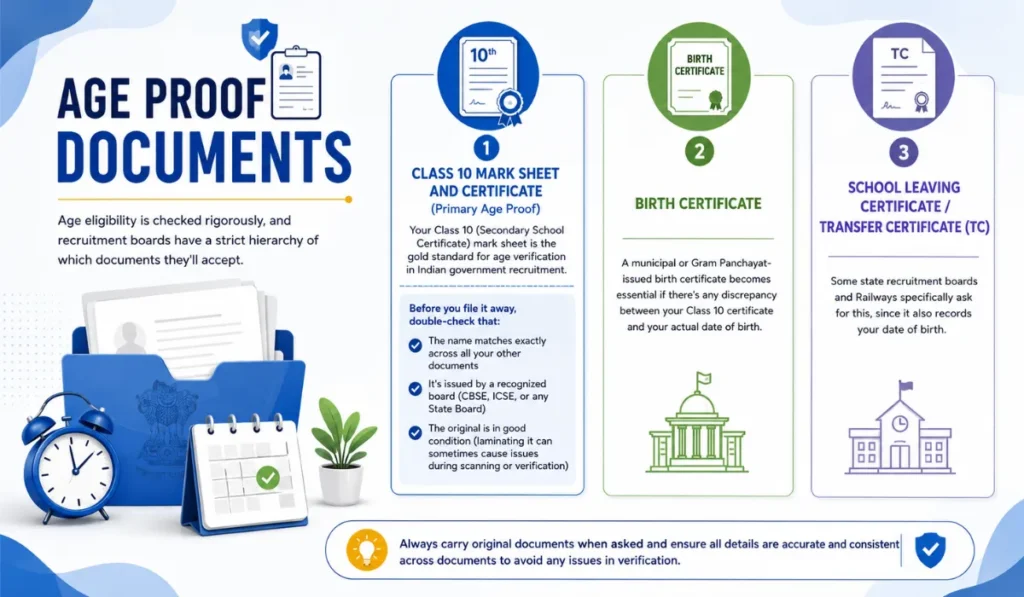
Age eligibility is checked rigorously, and recruitment boards have a strict hierarchy of which documents they’ll accept.
1. Class 10 Mark Sheet and Certificate (Primary Age Proof)
Your Class 10 (Secondary School Certificate) mark sheet is the gold standard for age verification in Indian government recruitment. The date of birth recorded here is treated as your official date of birth, full stop — don’t submit any other document as primary proof unless the notification specifically asks for it.
Before you file it away, double-check that:
- The name matches exactly across all your other documents
- It’s issued by a recognized board (CBSE, ICSE, or any State Board)
- The original is in good condition (laminating it can sometimes cause issues during scanning or verification)
2. Birth Certificate
A municipal or Gram Panchayat-issued birth certificate becomes essential if there’s any discrepancy between your Class 10 certificate and your actual date of birth.
3. School Leaving Certificate / Transfer Certificate (TC)
Some state recruitment boards and Railways specifically ask for this, since it also records your date of birth.
Category 3: Educational Qualification Documents
Your eligibility for a specific post depends heavily on these. Here’s what to keep ready, organized by qualification level:
| Qualification Level | Documents Needed | Typically Required For |
| Class 10 | Mark sheet and certificate | Matriculation-level posts (also doubles as age proof) |
| Class 12 | Mark sheet and certificate | SSC CHSL, banking clerical roles, Railway Group C/D, LDC posts |
| Graduation | Degree certificate or provisional certificate, plus all semester/year mark sheets | SSC CGL, UPSC, Bank PO, IBPS, State Civil Services |
| Post-Graduation | PG degree and mark sheets | IFS, IES, and select specialized state posts |
| Diploma / ITI | Certificate plus semester or yearly mark sheets | Railways, Defence, PSUs, state industrial departments |
| Professional Degree (MBBS, LLB, B.Tech, etc.) | Degree certificate | Specialist posts like doctors, engineers, legal officers |
A quick but important note: most recruitment notifications allow final-year students to apply using a provisional certificate, but you’ll need to produce the actual degree before or at the time of joining.
Category 4: Caste and Category Certificates
If you’re applying under SC, ST, OBC, or EWS reservation, these certificates need particular attention because the rules around format and validity differ by category.
| Certificate | Issuing Authority | Key Validity Rule |
| SC / ST Certificate | Tehsildar, SDM, or District Magistrate (from your home state) | Generally valid for life, though a few states require periodic renewal; must follow the central government format mentioned in the notification |
| OBC (Non-Creamy Layer) | Tehsildar or SDM | Must explicitly state “Non-Creamy Layer” status; for central government jobs, it must be issued within one year of your application or the cutoff date — always check the notification for the exact window |
| EWS Certificate | Tehsildar, SDM, or District Collector’s office | Family income must be below ₹8 lakh per year, with specified limits on land/property holdings; valid only for the financial year it’s issued in, so it needs to be renewed annually |
| PH / Disability Certificate | Government medical board or authorized medical authority | Must clearly state the type and percentage of disability; check whether the post specifies a minimum disability percentage |
Central and State OBC certificates are not interchangeable — for SSC, UPSC, or Railway exams, you need the Central OBC format specifically. You can verify formats at ncbc.nic.in.
Category 5: Address Proof Documents
You’ll generally need at least two different address proofs, since some boards ask to see more than one during verification. Commonly accepted documents include:
- Aadhaar Card (most widely accepted)
- Voter ID Card
- Passport
- Utility bills (electricity, water, or gas) — must be from the last three months
- Bank passbook with photograph (accepted by some departments)
- Ration card (accepted for many state government roles)
Category 6: Photographs and Signatures
It’s easy to underestimate, but photo and signature mismatches are among the most common reasons applications get rejected.
Photograph guidelines:
- Keep 20–25 passport-size photographs ready
- Photos should be no older than 3–6 months
- Use a white or light-colored background
- Avoid casual or sleeveless clothing — check the specific notification for any dress guidelines
- Keep both matte and glossy prints, along with scanned digital copies
- Digital copies should be in JPG format, usually between 20–50 KB for online applications (confirm exact specs in the notification)
Signature guidelines:
- Practice and finalize one consistent signature style across all documents and applications
- Keep a scanned copy ready in the size and format required for online forms
- Many departments cross-check your application signature against your documents during verification, so consistency matters — a mismatch can raise unnecessary red flags
Category 7: Domicile / Residence Certificate
If you’re applying for state-specific government jobs, you’ll likely need to prove long-term residency in that state. This applies particularly to:
- State PSC exams
- State Police recruitment
- Revenue Department and Panchayati Raj posts
- State Teaching Recruitment Boards
Domicile certificates are issued by the Tehsildar or SDM, and the required residency period (often 5–15 years) varies by state, so check your specific state’s rules in advance.
Category 8: No Objection Certificate (NOC)
If you’re currently employed — whether in a government or private organization — and applying for another government post, you may need an NOC from your current employer. Always check the notification carefully to see if this applies to you.
Category 9: Experience Certificates (If Required)
For posts that require prior work experience, keep the following ready:
- Experience certificates on official company letterhead
- Appointment and relieving letters
- Payslips, in case additional proof of your role is requested
Most entry-level government posts don’t require work experience, but it’s worth double-checking the eligibility criteria for the specific post you’re targeting.
Category 10: Other Documents to Keep Handy
Depending on the post and the category you’re applying under, you may also need:
- Ex-Servicemen Certificate — for candidates who have served in the armed forces
- Sports Certificate — issued by a recognized sports body, for sports quota applicants
- Widow / Divorced Woman Certificate — required for certain state quota reservations
- Freedom Fighter Dependent Certificate — for applicable state quotas
- Character Certificate — issued by a Gazetted Officer or Class I government officer
- Medical Fitness Certificate — commonly required either before joining or during verification
How to Organize Your Documents the Smart Way
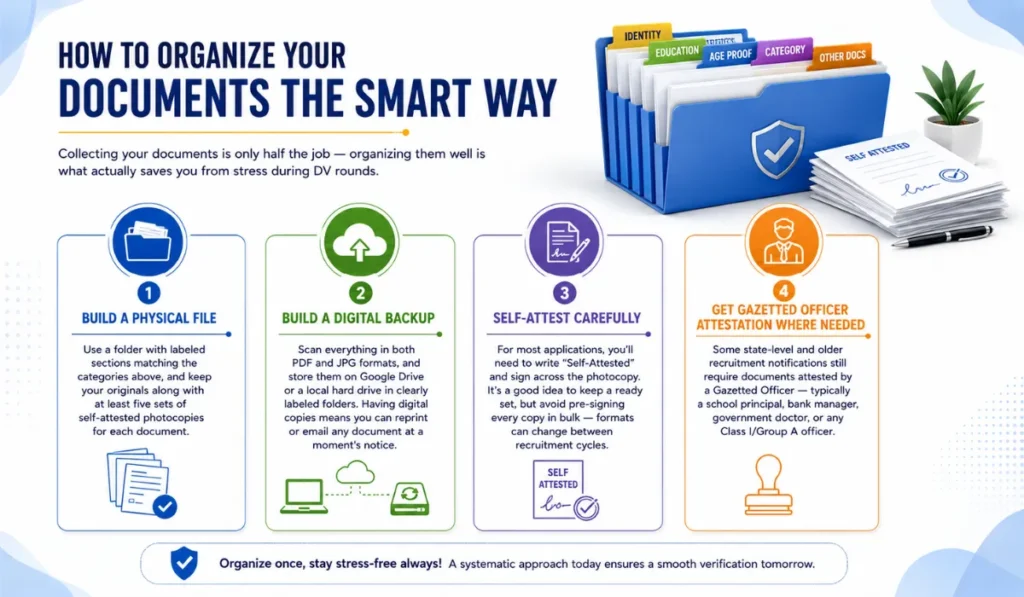
Collecting your documents is only half the job — organizing them well is what actually saves you from stress during DV rounds.
Build a physical file. Use a folder with labeled sections matching the categories above, and keep your originals along with at least five sets of self-attested photocopies for each document.
Build a digital backup. Scan everything in both PDF and JPG formats, and store them on Google Drive or a local hard drive in clearly labeled folders. Having digital copies means you can reprint or email any document at a moment’s notice.
Self-attest carefully. For most applications, you’ll need to write “Self-Attested” and sign across the photocopy. It’s a good idea to keep a ready set, but avoid pre-signing every copy in bulk — formats can change between recruitment cycles.
Get Gazetted Officer attestation where needed. Some state-level and older recruitment notifications still require documents attested by a Gazetted Officer — typically a school principal, bank manager, government doctor, or any Class I/Group A officer.
Common Mistakes Freshers Make (and How to Dodge Them)
| Mistake | The Fix |
| Name spelling differs across documents (e.g., Aadhaar vs. degree certificate) | Get it corrected well in advance — don’t wait until DV day |
| Assuming an old OBC/EWS certificate is still valid | These need annual renewal — check the issue date before submitting |
| Submitting the wrong caste certificate format | Central and state formats differ; match it to what the specific notification asks for |
| Blurry or poor-quality photocopies | Always photocopy on clean white A4 paper |
| Starting document collection too late | Tehsildar and SDM offices can be slow — start at least 2–3 months before your expected DV round |
Final Checklist Summary
| Category | Documents |
| Identity Proof | Aadhaar, PAN Card, Voter ID, Passport, Driving License |
| Age Proof | Class 10 Certificate & Mark Sheet, Birth Certificate, School Leaving Certificate |
| Educational Qualifications | Class 10, Class 12, Graduation Degree/Provisional, All Semester Mark Sheets, PG Degree (if applicable), Diploma/ITI (if applicable) |
| Category Certificates | SC/ST, OBC-NCL, EWS, Disability Certificate (as applicable) |
| Address Proof | Aadhaar/Voter ID/Utility Bill (minimum two) |
| Photo & Signature | 20+ passport-size photos, scanned digital photo and signature |
| Other | Domicile Certificate, NOC (if employed), Character Certificate, Experience Certificate (if required), Medical Fitness Certificate |
| Join Yuva Safar WhatsApp Group for Latest Job Updates | Click Here |
| Join Our Telegram Channel for Daily Government & Private Job Alerts | Click Here |
Frequently Asked Questions
Q1. Which is the single most important document for government job applications? Your Class 10 mark sheet or certificate — it serves as proof of both age and educational qualification.
Q2. Is Aadhaar mandatory for government jobs? Yes, Aadhaar is required for virtually all government job applications, and it should be linked to your active mobile number.
Q3. How long is an OBC-NCL certificate valid? For central government jobs, it’s valid for one year. If yours is older than six months, it’s safer to apply for a fresh one before submitting your application.
Q4. What’s the difference between State OBC and Central OBC certificates? Central government recruitment (SSC, UPSC, Railways) requires a Central OBC certificate specifically — a State OBC certificate won’t be accepted. You can check the format at ncbc.nic.in.
Q5. Can I apply for a government job before my degree is finalized? Yes, most notifications allow you to apply with a provisional certificate, but you’ll need to submit the original degree at the time of document verification or joining.
Q6. What should I do if there’s a name mismatch across my documents? Update your Aadhaar through the UIDAI portal, apply for a correction with your university for educational documents, or get a notarized affidavit if correction isn’t possible.
Q7. Is a birth certificate mandatory for SSC, UPSC, or Railway exams? No, your Class 10 certificate is generally sufficient. That said, it’s worth keeping your birth certificate handy just in case it’s requested.
Q8. How many photocopy sets should I carry for document verification? At least five sets of self-attested photocopies of each document.
Q9. Who qualifies as a “Gazetted Officer”? A Gazetted Officer is someone in a high-ranking government position — a school or college principal, government bank manager, government doctor, Tehsildar, Police Inspector, or above, including IAS, IPS, and IFS officers.
Q10. Is a Domicile Certificate required for SSC, UPSC, or Railway jobs? No, but it’s typically required for state government job applications.
Q11. What exactly is a Character Certificate, and when is it needed? It’s a document certifying that you have no criminal record, usually required during document verification or joining — and almost always for police and defence recruitment.
Q12. What happens if I forget a document on the day of verification? You risk disqualification. Prepare your full document folder at least a week in advance and recheck it the night before your DV round.
Q13. Can I carry a photocopy of Aadhaar instead of the original? A self-attested photocopy or downloaded e-Aadhaar from uidai.gov.in is usually accepted, but it’s wise to carry the original as a backup.
Q14. Is there an age limit for obtaining an OBC or EWS certificate? No age limit applies — eligibility depends on your family’s income and property criteria, not your age.
Q15. Where can I find the exact document list for a specific government job? Always refer to the official notification PDF on the recruiting body’s website — for example, ssc.nic.in for SSC, upsc.gov.in for UPSC, rrbcdg.gov.in for Railways, or ibps.in for IBPS.
Final Word
Landing a government job in India in 2026 takes more than just clearing the written exam. There’s a second, quieter test running alongside it — making sure your paperwork is complete, correctly formatted, and ready to go the moment it’s asked for.
Start early, stay organized by category, and keep both physical and digital backups of everything. Do that, and document verification stops being a source of last-minute panic — it becomes just another box you’ve already ticked on your way to your government job.

